
Built to provide research that’s more actionable and strategically valuable, The Business Research Company’s 2026 market reports include market attractiveness analysis, total addressable market sizing, company benchmarking matrices, interactive Excel dashboards, broader supply chain intelligence, emerging startup tracking, and in-depth product insights.
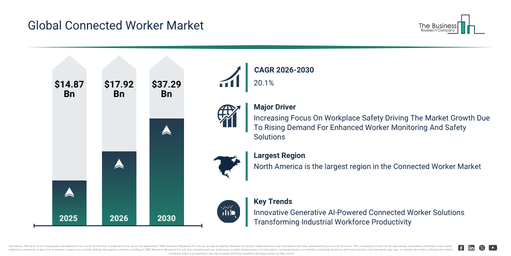
Connected Worker Market Forecast: Value Set To Climb From $17.92 Billion To $37.29 Billion
The connected worker market has experienced substantial growth in recent years. Its expansion is anticipated to be from $14.87 billion in 2025 to $17.92 billion in 2026, achieving a compound annual growth rate (CAGR) of 20.5%. This historical rise can be attributed to several factors including an increased necessity for better workplace safety, a heightened demand for improved workforce productivity, the growing intricacy of industrial operations, the escalating requirement for real-time operational data, and the broadening acceptance of digital workplace solutions.
The connected worker market size is projected to undergo significant growth in the coming years. It is expected to reach $37.29 billion in 2030, showing a compound annual growth rate (CAGR) of 20.1%. This expansion during the forecast period can be attributed to factors such as an increasing demand for connected workforce management, a growing need for faster workplace decision-making, a rising demand for remote assistance capabilities, an expanding requirement for workforce visibility and coordination, and an increasing demand for digital task execution support. Key trends for the forecast period include a heightened demand for real-time worker connectivity, the rising adoption of digital workforce platforms, a growing utilization of remote worker assistance solutions, an increasing demand for connected workforce safety tools, and an expanding use of digital collaboration systems.
Get A Free Sample Report With In-Depth Market Insights:
Connected Worker Market Growth Drivers: What’s Behind The Acceleration?
A heightened emphasis on workplace safety is anticipated to propel the expansion of the connected worker market in the future. Workplace safety refers to the collection of practices, technologies, and measures implemented by organizations to shield employees from occupational hazards, accidents, and health risks, while simultaneously boosting operational efficiency. The increasing attention on workplace safety is driven by stricter workplace regulations, which compel organizations to adopt more rigorous safety standards, implement preventive strategies, and ensure improved protection for employees against occupational dangers and incidents. This growing focus on workplace safety is accelerating the adoption of connected worker solutions through mechanisms like real-time communication, remote monitoring, the integration of wearable technology, and access to crucial safety information, thereby assisting organizations in bolstering worker protection and reducing operational risks. For instance, according to the Dräger Safety and Health at Work Report 2024 by Dräger Safety UK, a UK-based medical technology company, a survey of 750 employees and 250 managers from organizations with over 50 staff revealed that 94% supported updating the Health and Safety at Work Act 1974, 82% advocated for more focus on mental health, 75% stressed ESG issues, and 52% reported feeling safer at work compared to two years ago, largely due to enhanced safety training (56%). Consequently, the escalating focus on workplace safety is a key driver for the growth of the connected worker market.
Connected Worker Market Segment Trends And Revenue Contributors
The connected worker market covered in this report is segmented –
1) By Component: Hardware, Software, Services
2) By Connected Worker Solution: Smart Glasses, Head-Mounted Displays, Body-Worn Cameras, Wearable Sensors, Collaboration Software, Asset Tracking Systems
3) By Deployment Model: On-Premise, Cloud-Based, Hybrid
4) By Application: Remote Monitoring, Hands-Free Collaboration, Safety And Compliance, Data Analytics And Visualization, Predictive Maintenance
5) By End User: Banking Financial Services And Insurance, Healthcare, Retail, Manufacturing, Oil And Gas, Construction, Other End Users
Subsegments:
1) By Hardware: Wearable Devices, Mobile Devices, Industrial Devices, Smart Sensors, Edge Computing Devices
2) By Software: Workforce Management Software, Collaboration Software, Knowledge Management Software, Augmented Reality Software, Data Analytics Software
3) By Services: Consulting Services, Implementation Services, Training Services, Support And Maintenance Services, Managed Services
Connected Worker Market Trends: What’s Defining The Industry’s Next Phase?
Major companies operating in the connected worker market are focusing on developing innovative solutions, such as generative AI-enabled operational technology (OT) platforms, to significantly enhance workforce productivity, facilitate real-time decision-making, boost operational efficiency, and improve worker safety. These generative AI-enabled OT platforms represent advanced digital solutions that integrate large language models (LLMs), edge computing, and industrial data systems, enabling workers to interact with intricate machinery and operational systems using natural language. They provide real-time insights and recommendations while ensuring security, reliability, and data sovereignty, distinguishing them from traditional industrial interfaces. As an illustration, in February 2024, Nokia Corporation, a telecommunications and technology firm from Finland, launched MX Workmate, an OT-compliant Generative AI solution tailored for connected workers in industrial environments. This solution utilizes Generative AI and LLM technologies to generate contextual information from real-time OT data, thereby allowing workers to understand machine conditions, access operational insights, and communicate with industrial systems through natural language. MX Workmate operates on Nokia’s on-premise edge computing platform, delivering secure and reliable AI capabilities while minimizing knowledge barriers between workers and machines. The solution also supports predictive maintenance, automated knowledge retrieval, workflow optimization, and safety improvements by offering early warnings, production status updates, and real-time recommendations to industrial workers.
Connected Worker Market Competitive Landscape: Who Leads The Industry?
Major companies operating in the connected worker market are Microsoft Corporation, Oracle Corporation, Siemens AG, International Business Machines Corporation, SAP SE, Honeywell International Inc, Schneider Electric SE, Tata Consultancy Services Limited, Wipro Limited, Fujitsu Limited, Rockwell Automation Inc, Zebra Technologies Corporation, Hexagon AB, PTC Inc, GE Vernova Inc, Panasonic Connect Co Ltd, TeamViewer SE, RealWear Inc, Vuzix Corporation, SafetyCulture Pty Ltd, MaintainX Inc, Tulip Interfaces Inc, Innovapptive Inc, Dozuki Inc, Augmentir Inc
View The Full Connected Worker Market Report:
Connected Worker Market Geographic Landscape: Which Region Leads Industry Growth?
North America was the largest region in the connected worker market in 2025. Asia-Pacific is expected to be the fastest-growing region in the forecast period. The regions covered in the connected worker market report are Asia-Pacific, South East Asia, Western Europe, Eastern Europe, North America, South America, Middle East, Africa.
Reach Out To Our Team:
The Business Research Company: https://www.thebusinessresearchcompany.com/
Americas: +1 310-496-7795
Asia: +44 7882 955267 & +91 8897263534
Europe: +44 7882 955267
Email us at: marketing@tbrc.info
Follow us on:
LinkedIn: https://in.linkedin.com/company/the-business-research-company
YouTube: https://www.youtube.com/channel/UC24_fI0rV8cR5DxlCpgmyFQ
Global Market Model: https://www.thebusinessresearchcompany.com/global-market-model

Wasay has over a decade of experience in market research, data modelling, and analytics, with prior experience at GlobalData and Decision Tree Consulting Services. At The Business Research Company , he leads research operations across syndicated studies, customized consulting engagements, and the Global Market Model platform. His professional experience includes supporting organizations such as Boston Consulting Group, KPMG, and Ernst & Young. Wasay holds a degree in Electronics and Communications Engineering, postgraduate management qualifications from International Management Institute Belgium and Indian School of Business and Entrepreneurship, and completed the Integrated Program in Business Analytics from Indian Institute of Management Indore.