
Delivering more actionable and strategically valuable research, The Business Research Company’s 2026 market reports feature market attractiveness analysis, total addressable market evaluation, company benchmarking matrices, interactive Excel dashboards, expanded supply chain intelligence, emerging startup coverage, and detailed product insights.
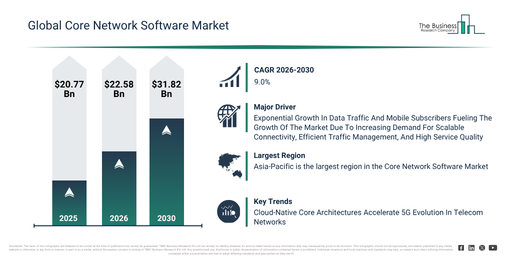
Core Network Software Market Growth From $22.58 Billion In 2026 To $31.82 Billion By 2030 At A CAGR Of 9%
The core network software market size has seen strong growth in recent years. It is forecast to expand from $20.77 billion in 2025 to $22.58 billion in 2026, achieving a compound annual growth rate (CAGR) of 8.7%. The historical growth of this market can be linked to the dominance of legacy circuit-switched infrastructure, manual network provisioning alongside siloed operations, limited virtualization adoption, monolithic telecom core architectures, and fundamental rule-based routing and policy systems.
The core network software market size is anticipated to experience robust expansion over the coming years, with projections indicating it will attain a valuation of $31.82 billion by 2030, demonstrating a compound annual growth rate (CAGR) of 9.0%. This projected growth can be ascribed to factors such as increased adoption of network function virtualization, the rising demand for 5G and beyond scalability, the expansion of autonomous network orchestration, the proliferation of edge distributed architectures, and the integration of zero trust security frameworks within telecom core networks. Significant trends during this forecast period include the widespread embrace of network function virtualization and software defined core technologies, the modernization of legacy core networks alongside IP transition, the standardization of telecom APIs to foster open network interoperability, advanced real time traffic engineering and quality of service optimization, and enhanced systems for subscriber identity and fraud prevention.
Download A Free Sample Report For Comprehensive Market Insights:
https://www.thebusinessresearchcompany.com/sample_request?id=13146513&type=smp
Core Network Software Market Development Factors: Which Trends Are Supporting Demand?
The core network software market is anticipated to expand due to the exponential increase in data traffic and the number of mobile subscribers. This refers to the growing volume of data utilized across mobile networks and the escalating count of active mobile users connecting to these networks over time. The primary catalyst for this rapid growth in data traffic and subscriber numbers is the swift expansion of high-speed mobile broadband networks, facilitating the widespread use of data-heavy applications like video streaming, cloud computing, and real-time digital platforms. Core network software plays a crucial role by efficiently routing data traffic for uninterrupted performance, and by authenticating and managing mobile subscribers to ensure secure access, accurate billing, and continuous communication services. As an illustration, in January 2024, data from the Office of Communications, a UK communications regulator, showed that average monthly mobile data usage per user hit 9.6 GB in Q2 2023, marking a 19% increase year-on-year. Concurrently, total mobile data traffic saw an even higher growth of 27% during the identical period, largely due to an increase in the total number of mobile data users. Consequently, the exponential rise in data traffic and mobile subscribers is a significant driver for the expansion of the core network software market.
Core Network Software Market Segment Analysis Highlighting Growth Areas
The core network software market covered in this report is segmented –
1) By Component: Software, Services
2) By Deployment Mode: On-Premises, Cloud-Based
3) By Network Type: Mobile Core Networks, Fixed Core Networks
4) By Application: Voice Over Internet Protocol Services, Data Communication Services, Video And Multimedia Services, Internet Of Things Connectivity, Mission Critical Communications
5) By End User: Telecom Operators, Internet Service Providers, Enterprises
Subsegments:
1) By Software: Network Function Virtualization Software, Policy And Charging Rules Function Software, Subscriber Data Management Software, Network Orchestration Software, Network Management Software, Routing And Switching Software
2) By Services: Professional Services, Managed Services, Integration Services, Consulting Services, Support And Maintenance Services
Core Network Software Market Transformation Trends: Which Innovations Are Driving Change?
Major companies in the core network software market are concentrating on creating technological advancements in cloud-native core architectures, including cloud-native packet core modernization platforms, to improve network scalability, accelerate service deployment, lessen operational complexity, and support evolving 5G and future connectivity needs. The advancement of cloud-native core architecture signifies a shift from conventional hardware-based telecom core systems to software-defined, containerized, and cloud-optimized network functions, which enable automated deployment, elastic scaling, continuous upgrades, and efficient management of 4G and 5G core networks. For example, in December 2024, Ericsson, a Sweden-based telecommunications infrastructure firm, launched the Ericsson Compact Packet Core. This introduced solution facilitates the streamlined modernization of legacy packet core networks into a cloud-native 4G/5G core architecture utilizing pre-integrated configurations and automation-driven deployment. It achieves notable operational efficiency by reducing configuration complexity by up to 80% and allows for automated lifecycle management with seamless software upgrades, providing a future-ready, scalable, and energy-efficient core network platform that supports 5G standalone, non-standalone, and 4G evolution with optimized performance and a reduced infrastructure footprint.
Core Network Software Market Leading Companies: Who Holds Significant Market Presence?
Major companies operating in the core network software market are Samsung Electronics Co. Ltd., Huawei Technologies Co. Ltd., Cisco Systems Incorporated, Oracle Corporation, Hewlett Packard Enterprise Company, Telefonaktiebolaget LM Ericsson, Nokia Corporation, ZTE Corporation, Amdocs Limited, Ciena Corporation, NEC Corporation, Parallel Wireless Inc., Alianza Inc., Celona Inc., Druid Software Limited, IPLOOK Technologies Co. Ltd., Lemko Corporation, BroadForward B.V., Cumucore Oy, Monogoto Ltd.
Access The Complete Core Network Software Market Report:
https://www.thebusinessresearchcompany.com/report/core-network-software-market-report
Core Network Software Market Geographic Distribution And Regional Opportunities
Asia-Pacific was the largest region in the core network software market in 2025. Asia-Pacific is expected to be the fastest-growing region in the forecast period. The regions covered in the core network software market report are Asia-Pacific, South East Asia, Western Europe, Eastern Europe, North America, South America, Middle East, Africa.
Get in touch with us:
The Business Research Company: https://www.thebusinessresearchcompany.com/
Americas: +1 310-496-7795
Asia: +44 7882 955267 & +91 8897263534
Europe: +44 7882 955267
Email us at: marketing@tbrc.info
Follow us on:
LinkedIn: https://in.linkedin.com/company/the-business-research-company
YouTube: https://www.youtube.com/channel/UC24_fI0rV8cR5DxlCpgmyFQ
Global Market Model: https://www.thebusinessresearchcompany.com/global-market-model

Wasay has over a decade of experience in market research, data modelling, and analytics, with prior experience at GlobalData and Decision Tree Consulting Services. At The Business Research Company , he leads research operations across syndicated studies, customized consulting engagements, and the Global Market Model platform. His professional experience includes supporting organizations such as Boston Consulting Group, KPMG, and Ernst & Young. Wasay holds a degree in Electronics and Communications Engineering, postgraduate management qualifications from International Management Institute Belgium and Indian School of Business and Entrepreneurship, and completed the Integrated Program in Business Analytics from Indian Institute of Management Indore.