
Backed by market attractiveness analysis, total addressable market sizing, company benchmarking matrices, interactive Excel dashboards, wider supply chain intelligence, emerging startup coverage, and detailed product-level insights, The Business Research Company’s 2026 market reports are designed to offer research that is more actionable and strategically valuable than ever.
Cyber-Physical Threat Simulation Market Growth Analysis: How Will Revenue Trend Over The Forecast Period?
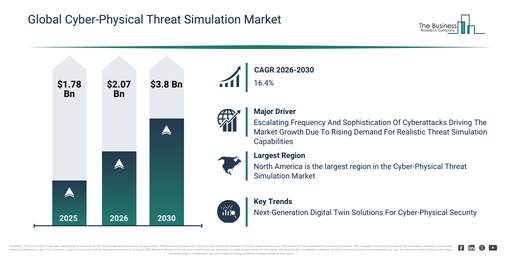
The cyber-physical threat simulation market has observed rapid expansion in recent years. Its value is anticipated to rise from $1.78 billion in 2025 to $2.07 billion in 2026, demonstrating a compound annual growth rate (CAGR) of 16.2%. The historical growth of this market can be linked to factors such as an increase in cyber-physical attacks on critical infrastructure, stricter regulatory compliance demands, the wider adoption of cyber range environments, the proliferation of networked industrial systems, and the greater utilization of simulation for incident response.
The cyber-physical threat simulation market is expected to show significant growth in the coming years, with its size projected to reach $3.8 billion in 2030 at a compound annual growth rate (CAGR) of 16.4%. This anticipated growth is attributed to the increasing adoption of AI-driven threat modeling, the expanded use of digital twins for cyber-physical systems, the broadening of cloud-based simulation services, rising integration with predictive analytics and risk intelligence, and a growing demand for immersive AR/XR training environments. Key trends for the forecast period include the increasing uptake of threat simulation platforms for critical infrastructure, a surging demand for cloud-based cyber-physical simulation services, the integration of real-time attack simulation with incident response workflows, the expansion of managed security and continuous validation services, and a heightened focus on training and awareness programs utilizing immersive simulations.
Get A Free Sample Report With In-Depth Market Insights:
Cyber-Physical Threat Simulation Market Growth Factors: What’s Supporting Expansion?
The growing occurrence and complexity of cyberattacks are projected to spur the expansion of the cyber-physical threat simulation market moving forward. Cyberattacks represent malicious endeavors by hackers to penetrate computer systems, networks, or devices with the intent to steal, modify, or destroy data. The surge in both the frequency and sophistication of these cyberattacks stems from an increased reliance on digital systems, thereby offering more avenues for attackers to exploit vulnerabilities across networks, software, and devices. Cyber-physical threat simulation strengthens cybersecurity resilience by proactively simulating and evaluating the interactions between digital systems and physical processes. This capability empowers organizations to pinpoint vulnerabilities, predict potential attack vectors, and implement targeted defenses before real-world cyberattacks can be leveraged. Illustratively, in April 2025, the Federal Bureau of Investigation (FBI), a US-based government agency, reported that in 2024, the volume of cybercrime complaints reached 859,532, with associated losses surpassing $16.6 billion, marking a 33% increase in losses compared to 2023. Thus, the escalating frequency and sophistication of cyberattacks are driving the growth of the cyber-physical threat simulation market.
Cyber-Physical Threat Simulation Market Segment Trends And Revenue Contributors
The cyber-physical threat simulation market covered in this report is segmented –
1) By Component: Software, Hardware, Services
2) By Simulation Type: Network Simulation, Device Simulation, Attack Simulation, Scenario Simulation, Other Simulations
3) By Deployment Mode: On-Premises, Cloud
4) By Organization Size: Large Enterprises, Small And Medium-Sized Enterprises (SMEs)
5) By End-User: Government And Defense, Bank Financial Service Insurance, Manufacturing, Healthcare, Energy And Utilities, Transportation, Other End-Users
Subsegments:
1) By Software: Simulation Platforms, Threat Modeling Tools, Risk Analytics Solutions, Scenario Management Systems, Visualization And Reporting Tools
2) By Hardware: Industrial Sensors, Control Systems, Network Communication Devices, High Performance Computing Systems, Hardware Emulation Devices
3) By Services: Consulting Services, System Integration Services, Training And Education Services, Maintenance And Support Services, Managed Security Services
Cyber-Physical Threat Simulation Market Industry Trends: What’s Reshaping Demand?
Leading companies within the cyber-physical threat simulation market are concentrating on employing cutting-edge technologies, including artificial intelligence (AI)-powered digital twin simulations, to anticipate and avert cyber-physical threats. These artificial intelligence (AI)-powered digital twin simulations represent virtual reproductions of physical systems, augmented with AI algorithms, enabling them to foresee, examine, and lessen potential cyber-physical threats instantly, thereby assisting organizations in proactively detecting weaknesses and enhancing system durability. As an illustration, in August 2025, Trend Micro, a Japan-based cybersecurity firm, introduced its Digital Twin Security Model, a pioneering technology specifically engineered to simulate cyber-physical threats utilizing artificial intelligence. This particular solution integrates real-time information from operational technology with AI-driven threat modeling, aiming to pinpoint vulnerabilities and evaluate system resilience prior to any attacks. It allows users to execute various attack scenarios, observe the potential effects on interconnected systems, and effectively deploy preventative actions. The distinct blending of digital twin technology with AI analytics sets this offering apart from conventional simulation methods, providing a dynamic, automated, and scalable evaluation of threats for vital infrastructure.
Cyber-Physical Threat Simulation Market Competitive Overview And Top Companies
Major companies operating in the cyber-physical threat simulation market are Microsoft Corporation, Lockheed Martin Corporation, International Business Machines Corporation, Honeywell International Inc., BAE Systems plc, Dassault Systèmes SE, Fortinet Inc., Hexagon AB, Keysight Technologies Inc., Ansys Inc., Palantir Technologies Inc., Tenable Inc., Darktrace Holdings Ltd., Kaspersky Lab AO, Claroty Ltd., Immersive Labs Ltd., Dragos Inc., Cyberbit Ltd., Radiflow Ltd., and Rhebo GmbH.
View The Full Cyber-Physical Threat Simulation Market Report:
Cyber-Physical Threat Simulation Market Leading Geography: Which Region Contributes The Most Revenue?
North America was the largest region in the cyber-physical threat simulation market in 2025. Asia-Pacific is expected to be the fastest-growing region in the forecast period. The regions covered in the cyber-physical threat simulation market report are Asia-Pacific, South East Asia, Western Europe, Eastern Europe, North America, South America, Middle East, Africa.
Reach Out To Our Team:
The Business Research Company: https://www.thebusinessresearchcompany.com/
Americas: +1 310-496-7795
Asia: +44 7882 955267 & +91 8897263534
Europe: +44 7882 955267
Email us at: marketing@tbrc.info
Follow us on:
LinkedIn: https://in.linkedin.com/company/the-business-research-company
YouTube: https://www.youtube.com/channel/UC24_fI0rV8cR5DxlCpgmyFQ
Global Market Model: https://www.thebusinessresearchcompany.com/global-market-model

Wasay has over a decade of experience in market research, data modelling, and analytics, with prior experience at GlobalData and Decision Tree Consulting Services. At The Business Research Company , he leads research operations across syndicated studies, customized consulting engagements, and the Global Market Model platform. His professional experience includes supporting organizations such as Boston Consulting Group, KPMG, and Ernst & Young. Wasay holds a degree in Electronics and Communications Engineering, postgraduate management qualifications from International Management Institute Belgium and Indian School of Business and Entrepreneurship, and completed the Integrated Program in Business Analytics from Indian Institute of Management Indore.