Backed by market attractiveness analysis, total addressable market sizing, company benchmarking matrices, interactive Excel dashboards, wider supply chain intelligence, emerging startup coverage, and detailed product-level insights, The Business Research Company’s 2026 market reports are designed to offer research that is more actionable and strategically valuable than ever.
Data Acquisition (DAQ) System Market Poised To Hit $2.45 Billion By 2030 With A 4.3% CAGR
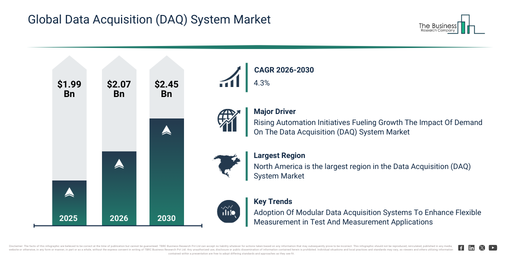
The data acquisition (DAQ) system market size has shown steady expansion in recent years. It is projected to increase from $1.99 billion in 2025 to $2.07 billion in 2026, exhibiting a compound annual growth rate (CAGR) of 4.1%. This growth witnessed during the historic period stems from factors such as the expansion of industrial automation, an increase in electronic testing applications, the adoption of digital measurement systems, a rising demand for precision instrumentation, and advancements in manufacturing quality control.
The data acquisition (daq) system market is projected to experience consistent expansion over the upcoming years. Its valuation is anticipated to reach $2.45 billion by 2030, exhibiting a compound annual growth rate (CAGR) of 4.3%. This anticipated growth during the projection period stems from factors such as enhanced implementation in smart factories, a surge in demand for real-time data analysis, the broadening of electric vehicle testing uses, increasing application in predictive maintenance, and greater integration with cloud-hosted analysis solutions. Key developments expected within this timeframe involve the wider acceptance of modular daq systems, a heightened need for rapid data acquisition, deeper integration with IoT and edge computing technologies, the proliferation of portable and wireless daq instruments, and a stronger emphasis on continuous real-time oversight.
Get A Free Sample Report With In-Depth Market Insights:
Data Acquisition (DAQ) System Market Industry Drivers: What’s Behind The Revenue Growth?
The increasing demand for automation stands as a significant driver for the data acquisition (DAQ) system market’s expansion. Automation is defined as the application of technologies that enable the production and delivery of goods and services with minimal human intervention. Many industrial sectors are embracing automated technologies to diminish errors, lessen repetitive tasks, and reduce processing costs. This growing demand for automation within industries directly promotes the wider adoption of data acquisition (DAQ) systems. For instance, in October 2023, a report from Cavintek Inc., a US-based firm specializing in workflow automation and productivity applications, indicated that over 80% of business leaders stated they were accelerating productivity automation and broadening the use of remote labor. Furthermore, 43% of firms are planning to reduce their workforce through the implementation of automation technologies. Therefore, the heightened demand for automation is propelling the data acquisition (DAQ) system market growth.
Data Acquisition (DAQ) System Market Segments: Where Is Growth Concentrated?
The data acquisition (daq) system market covered in this report is segmented –
1) By Type: Peripheral Component Interconnect (PCI), LAN Extensions For Instrumentation (LXI) Or Ethernet, VME Extensions For Instrumentation (VXI), PCI Extensions For Instrumentation (PXI), Universal Serial Bus (USB), Standalone
2) By Component: Hardware, Software
3) By Speed: High-speed (>100 KS/S), Low-speed (<100 KS/S)
4) By Application: Research And Analysis, Manufacturing And Quality, Asset Condition Monitoring, Design Validation And Repair
5) By End User: Aerospace And Defense, Energy And Power, Automotive And Transportation, Wireless Communication And Infrastructure, Water And Wastewater Treatment, Healthcare, Food And Beverages
Subsegments:
1) By Peripheral Component Interconnect (PCI): PCI DAQ Cards, PCI Express DAQ Cards
2) By LAN Extensions For Instrumentation (LXI) Or Ethernet: LXI-Compliant DAQ Devices, Ethernet-Based DAQ Systems
3) By VME Extensions For Instrumentation (VXI): VXI Modules, VXI Systems
4) By PCI Extensions For Instrumentation (PXI): PXI Modules, PXI Chassis
5) By Universal Serial Bus (USB): USB DAQ Devices, USB Data Loggers
6) By Standalone: Portable DAQ Systems, Integrated DAQ Devices
#Data Acquisition (DAQ) System Market Growth Trends: What’s Shaping The Future Outlook?
Leading firms in the data acquisition (DAQ) system market are concentrating on creating breakthroughs like modular, click-together platforms, which enable flexible, high-channel measurement and real-time data logging. This type of modular DAQ platform incorporates a base unit alongside interchangeable amplifier or sensor-interface modules. This design lets users combine various inputs, including voltage, current, temperature, strain, or vibration sensors, within a single system, and facilitates synchronized, high-speed data capture across multiple dispersed locations. Such systems provide enhanced flexibility and scalability when contrasted with conventional fixed-channel or monolithic DAQ systems. As an illustration, in June 2023, imc Test & Measurement GmbH, a German company specializing in test and measurement solutions, introduced the imc ARGUSfit. This modular DAQ system is specifically engineered for applications in automotive, aerospace, and industrial testing. Key features of the system include click-together modules, support for up to 1000 channels, sampling rates reaching 500 kS/s per channel, a fiber-optic connection for distributed modules, and integrated real-time processing for independent data logging. These capabilities allow for sensor-close positioning, minimized cabling requirements, and adaptable deployment within intricate testing scenarios.
Data Acquisition (DAQ) System Market Key Participants And Competitive Landscape
Major companies operating in the data acquisition (daq) system market are Siemens AG; National Instruments Corporation; Keysight Technologies; ABB Group; Fortive Corporation; Emerson Electric Company; Rockwell Automation Inc.; General Electric Company; Schneider Electric; Honeywell International Inc.; Agilent Technologies Inc.; Advantech Co. Ltd.; Yokogawa Electric Corporation; ADwin by Jäger Computergesteuerte Messtechnik GmbH; Data Translation Inc.; Campbell Scientific Inc.; Teledyne Technologies Incorporated; Tektronix Inc.; Texas Instruments; Thermo Fisher Scientific Inc.; Vishay Precision Group; DGH Corporation; Diversified Technical Systems Inc.; ESI Group; Fluke Calibration; HBM Test and Measurement; HIOKI E. E. CORPORATION; IMC Test & Measurement GmbH
View The Full Data Acquisition (DAQ) System Market Report:
Data Acquisition (DAQ) System Market Regional Analysis And Top Geography
North America was the largest region in the data acquisition (DAQ) system market in 2025. Asia-Pacific is expected to be the fastest-growing region in the forecast period. The regions covered in the data acquisition (daq) system market report are Asia-Pacific, South East Asia, Western Europe, Eastern Europe, North America, South America, Middle East, Africa.
Reach Out To Our Team:
The Business Research Company: https://www.thebusinessresearchcompany.com/
Americas: +1 310-496-7795
Asia: +44 7882 955267 & +91 8897263534
Europe: +44 7882 955267
Email us at: marketing@tbrc.info
Follow us on:
LinkedIn: https://in.linkedin.com/company/the-business-research-company
YouTube: https://www.youtube.com/channel/UC24_fI0rV8cR5DxlCpgmyFQ
Global Market Model: https://www.thebusinessresearchcompany.com/global-market-model

Wasay has over a decade of experience in market research, data modelling, and analytics, with prior experience at GlobalData and Decision Tree Consulting Services. At The Business Research Company , he leads research operations across syndicated studies, customized consulting engagements, and the Global Market Model platform. His professional experience includes supporting organizations such as Boston Consulting Group, KPMG, and Ernst & Young. Wasay holds a degree in Electronics and Communications Engineering, postgraduate management qualifications from International Management Institute Belgium and Indian School of Business and Entrepreneurship, and completed the Integrated Program in Business Analytics from Indian Institute of Management Indore.