Enhanced with market attractiveness analysis, total addressable market evaluation, company benchmarking matrices, interactive Excel dashboards, expanded supply chain intelligence, emerging startup coverage, and detailed product insights, The Business Research Company’s 2026 market reports deliver more actionable and strategically valuable research.
Data Center Blade Server Market Value Analysis: What Growth Is Expected Over The Forecast Period?
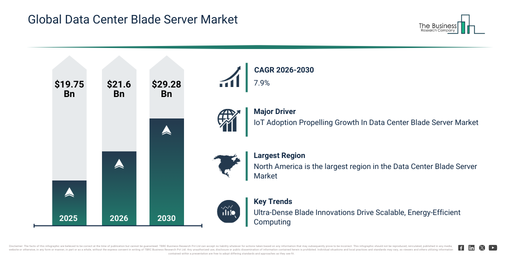
The data center blade server market has experienced significant growth in recent years. It is projected to expand from $19.75 billion in 2025 to $21.6 billion in 2026, achieving a compound annual growth rate (CAGR) of 9.4%. This historical growth can be attributed to the expansion of centralized data centers, the increasing need for server consolidation, the early adoption of virtualization, the demand for space-efficient hardware, and a rise in enterprise IT workloads.
The data center blade server market size is anticipated to experience robust expansion over the next few years. It is projected to climb to $29.28 billion by 2030, achieving a compound annual growth rate (CAGR) of 7.9%. The growth anticipated during this forecast period can be attributed to factors such as the expansion of hyperscale data centers, the increasing demand for high-performance computing, a greater focus on energy-efficient infrastructure, the rising deployment of cloud services, and the necessity for scalable enterprise-grade servers. Prominent trends observed during this period will include the adoption of high-density computing, the development of modular and scalable server architectures, blade deployments optimized for virtualization, enhanced shared resource optimization within chassis, and advancements in cooling and power efficiency designs.
Download A Free Sample Report For Comprehensive Market Insights:
Data Center Blade Server Market Industry Drivers: What Is Driving Revenue Growth?
Growing data traffic is anticipated to propel the expansion of the Data Center Blade Server Market in the future. This refers to the flow of digital data packets across computer networks or the internet. Data center blade servers are essential for handling the rising demand from data traffic, offering an infrastructure that is efficient, scalable, and highly integrated for computing. Their design features, including high density, modular scalability, and integrated networking and management, allow blade servers to optimize computing power within data center racks. As an example, Ericsson Group, a telecommunications firm based in Sweden, reported in 2023 that 5G subscriptions are projected to hit 5.6 billion by late 2029, while data traffic for smartphone users in Southeast Asia is predicted to increase to 42 GB/month by 2029, up from 17 GB/month in 2023. Consequently, the surge in data traffic is a key factor driving the expansion of the Data Center Blade Server Market.
Data Center Blade Server Market Segments: Where Are The Largest Growth Opportunities?
The data center blade server market covered in this report is segmented –
1) By Type: Tier 1, Tier 2, Tier 3, Tier 4
2) By Enterprise Size: Large Enterprises, Smal And Medium Enterprises
3) By End User: Banking, Financial Services And Insurance (BFSI), IT and Telecom, Manufacturing, Healthcare, Energy and Utility, Other End Users
Subsegments:
1) By Tier 1: Entry-Level Blade Servers, Basic Configuration Blade Servers, Small to Medium Business (Smb) Blade Servers, Low-Cost Blade Servers, Single Processor Blade Servers
2) By Tier 2: Mid-Level Blade Servers, Balanced Performance Blade Servers, Dual Processor Blade Servers, Blade Servers for Business Applications, Mid-Range Storage and Processing Blade Servers
3) By Tier 3: High-Performance Blade Servers, Advanced Configuration Blade Servers, Blade Servers for Virtualization and Cloud Computing, High-Capacity Memory Blade Servers, Blade Servers with Enhanced Security Features
4) By Tier 4: Enterprise-Class Blade Servers, Ultra-High-Performance Blade Servers, Mission-Critical Blade Servers, High Availability and Redundancy Blade Servers, Blade Servers for Data Centers with Demanding Applications, Top-Tier Blade Servers with Advanced Cooling and Power Management
Data Center Blade Server Market Innovation Trends: Which Developments Are Transforming The Industry?
Major companies within the data-center blade server market are concentrating on developing advanced solutions, such as ultra-dense, high-performance blade servers, to address the growing demand for scalable and energy-efficient computing. These ultra-dense, high-performance blade servers are compact units specifically designed to maximize computing power and storage capacity within a minimal physical footprint, allowing data centers to manage more workloads efficiently while reducing energy consumption compared to traditional rack servers. For instance, in August 2025, Giga Computing Technology Co., Ltd., a Taiwan-based data-center hardware company, unveiled its initial 3U 10-node blade servers, available as GIGABYTE B-series models B343-C40 (which supports AMD EPYC 4005 or Ryzen 9000 processors) and B343-X40 (which supports Intel Xeon 6300-series processors). These blade servers are built with a compact shared chassis housing ten independent server nodes, each equipped with high-speed PCIe Gen5 lanes, dual LAN ports for redundancy, and support for DDR5 memory (in the Intel variant), alongside a chassis-level backplane and shared power supplies to maximize energy efficiency and simplify management. A unique feature is their incorporation of post-consumer recycled (PCR) low-carbon materials in essential structural components like air ducts, heat sinks, and the chassis, thereby aligning performance needs with sustainability and assisting enterprises in meeting tightening carbon-regulation and ESG reporting requirements.
Data Center Blade Server Market Major Participants And Competitive Dynamics
Major companies operating in the data center blade server market are Dell Inc; Huawei Technologies Co. Ltd; Lenovo; Intel Corporation; Cisco Systems Inc; Oracle Corporation; Quanta Computer; Fujitsu Limited; Hewlett Packard Enterprise Development LP; NVIDIA Corporation; NEC Corporation; AMD (Advanced Micro Devices); Inventec Corporation; ASUS; Bull Atos Technologies; Atos SE; Wiwynn Corporation; Super Micro Computer, Inc; Arm Ltd; Hitachi Vantara Corporation; Inspur Software Co. Ltd; Sugon; MSI (Micro-Star International); TYAN Computer Corporation; ASRock Rack; ZT Systems
Access The Complete Data Center Blade Server Market Report:
Data Center Blade Server Market Regional Outlook: Where Are The Largest Opportunities Located?
North America was the largest region in the data center blade server market in 2025. Asia-Pacific is expected to be the fastest-growing region in the forecast period. The regions covered in the data center blade server market report are Asia-Pacific, South East Asia, Western Europe, Eastern Europe, North America, South America, Middle East, Africa.
Get in touch with us:
The Business Research Company: https://www.thebusinessresearchcompany.com/
Americas: +1 310-496-7795
Asia: +44 7882 955267 & +91 8897263534
Europe: +44 7882 955267
Email us at: marketing@tbrc.info
Follow us on:
LinkedIn: https://in.linkedin.com/company/the-business-research-company
YouTube: https://www.youtube.com/channel/UC24_fI0rV8cR5DxlCpgmyFQ
Global Market Model: https://www.thebusinessresearchcompany.com/global-market-model

Wasay has over a decade of experience in market research, data modelling, and analytics, with prior experience at GlobalData and Decision Tree Consulting Services. At The Business Research Company , he leads research operations across syndicated studies, customized consulting engagements, and the Global Market Model platform. His professional experience includes supporting organizations such as Boston Consulting Group, KPMG, and Ernst & Young. Wasay holds a degree in Electronics and Communications Engineering, postgraduate management qualifications from International Management Institute Belgium and Indian School of Business and Entrepreneurship, and completed the Integrated Program in Business Analytics from Indian Institute of Management Indore.