
Featuring market attractiveness scoring, total addressable market sizing, company benchmarking matrices, interactive Excel dashboards, deeper supply chain intelligence, emerging startup tracking, and granular product-level insights, The Business Research Company’s 2026 market reports are built to deliver research that is both more actionable and more strategically valuable.
Data Infrastructure Monitoring Market Size Forecast: How Big Could The Market Get By 2030?
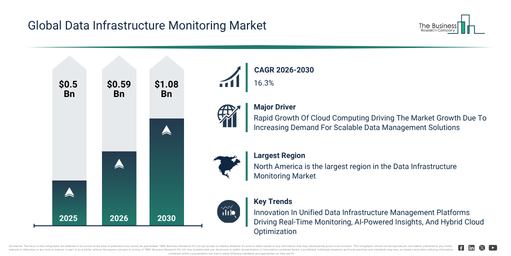
The data infrastructure monitoring market size has experienced rapid growth in recent years. It is anticipated to expand from $0.5 billion in 2025 to $0.59 billion in 2026, exhibiting a compound annual growth rate (CAGR) of 16.7%. Historically, this market expansion can be ascribed to elements such as the increasing complexity of IT infrastructure, the rising adoption of cloud environments, the growing volume of infrastructure data, a greater need to reduce system downtime, and the expanding deployment of distributed data environments.
The data infrastructure monitoring market size is anticipated to experience substantial growth over the next few years. It is forecast to expand to $1.08 billion by 2030, showing a compound annual growth rate (CAGR) of 16.3%. This projected growth is primarily due to the increasing demand for proactive infrastructure performance management, a rising necessity for continuous infrastructure availability, the growing adoption of hybrid infrastructure environments, an escalating requirement for automated resource optimization, and an expanding need for infrastructure security monitoring. Significant trends expected during this forecast period include a heightened demand for real-time infrastructure visibility, a growing embrace of automated performance alerts, an increasing need for proactive anomaly detection, a greater focus on centralized infrastructure observability, and the expanding application of predictive infrastructure monitoring.
Get A Free Sample Report With In-Depth Market Insights:
Data Infrastructure Monitoring Market Demand Drivers: What’s Powering Industry Growth?
The accelerating expansion of cloud computing is projected to fuel the growth of the data infrastructure monitoring market moving forward. Cloud computing involves the on-demand provision of computing services, including storage, processing, and networking, accessible over the internet, allowing organizations to leverage scalable and flexible IT resources without the burden of maintaining physical infrastructure. The increase in cloud computing adoption is attributed to the rising implementation of digital transformation initiatives, as businesses increasingly migrate their applications, data, and operational processes to cloud-based platforms to enhance scalability, improve operational efficiency, and achieve greater cost-effectiveness. Data infrastructure monitoring offers continuous visibility across data systems, servers, networks, and cloud environments, thereby enabling proactive issue identification, optimizing infrastructure performance, boosting reliability, and supporting efficient management within hybrid and multi-cloud settings. For instance, as reported in June 2026 by Eurostat, the Luxembourg-based official statistical office of the European Union, the percentage of enterprises using paid cloud computing services in the European Union (EU) saw an increase of 7.42 percentage points in 2025 compared to 2023. Therefore, the swift growth of cloud computing is driving the expansion of the data infrastructure monitoring market.
Data Infrastructure Monitoring Market Segment Analysis Spotlighting Growth Areas
The data infrastructure monitoring market covered in this report is segmented –
1) By Component: Hardware, Software, Services
2) By Infrastructure Type: Physical Infrastructure, Virtual Infrastructure, Cloud Environments, Data Pipelines
3) By Deployment Mode: On-Premises, Cloud, Hybrid Cloud
4) By Organization Size: Small And Medium Enterprises, Large Enterprises
5) By End-User Industry: Information Technology (IT) And Technology, Banking Financial Services And Insurance, E-commerce And Retail, Telecommunications, Other End-User Industries
Subsegments:
1) By Hardware: Servers, Storage Devices, Network Devices, Monitoring Appliances, Edge Devices
2) By Software: Infrastructure Monitoring Software, Cloud Monitoring Software, Network Monitoring Software, Performance Monitoring Software, Analytics Software
3) By Services: Consulting Services, Integration Services, Managed Services, Support And Maintenance Services, Training Services
Data Infrastructure Monitoring Market Innovation Trends: What Developments Are Reshaping The Industry?
Leading companies operating in the data infrastructure monitoring market are concentrating on developing innovative solutions, such as unified data infrastructure management platforms, to enhance real-time monitoring, operational efficiency, predictive analytics, and hybrid cloud data management. Unified data infrastructure management platforms represent software solutions that integrate monitoring, orchestration, and governance functionalities across various storage environments, including block, file, object, and software-defined storage, thereby enabling organizations to achieve centralized visibility, optimize resource utilization, and manage complex data environments more effectively than traditional, fragmented monitoring tools. For example, in May 2025, Hitachi Vantara LLC, a US-based data infrastructure and hybrid cloud management company, launched Virtual Storage Platform 360 (VSP 360), a unified data management software solution crafted to simplify data infrastructure monitoring and operations. This platform consolidates multiple storage management tools into a single interface, delivering end-to-end visibility across hybrid cloud environments and supporting block, file, object, and software-defined storage systems. VSP 360 integrates AIOps-powered observability capabilities to provide predictive insights into system performance, storage capacity utilization, security, and overall infrastructure health. The solution also facilitates automated data governance, compliance management, and lifecycle optimization, assisting organizations in improving decision-making, reducing operational complexity, and preparing their data environments for AI-driven workloads.
Data Infrastructure Monitoring Market Leading Players And Competitive Positioning
Major companies operating in the data infrastructure monitoring market are Amazon Web Services Inc, Google LLC, Microsoft Corporation, International Business Machines Corporation, Cisco Systems Inc, Oracle Corporation, Broadcom Inc, Datadog Inc, Elastic NV, Zoho Corporation Private Limited, SolarWinds Worldwide LLC, Nutanix Inc, Grafana Labs Inc, LogicMonitor Inc, ScienceLogic Inc, PagerDuty Inc, Centreon SAS, Nagios Enterprises LLC
View The Full Data Infrastructure Monitoring Market Report:
Data Infrastructure Monitoring Market Regional Distribution: Which Areas Power Market Growth?
North America was the largest region in the data infrastructure monitoring market in 2025. Asia-Pacific is expected to be the fastest-growing region in the forecast period. The regions covered in the data infrastructure monitoring market report are Asia-Pacific, South East Asia, Western Europe, Eastern Europe, North America, South America, Middle East, Africa.
Reach Out To Our Team:
The Business Research Company: https://www.thebusinessresearchcompany.com/
Americas: +1 310-496-7795
Asia: +44 7882 955267 & +91 8897263534
Europe: +44 7882 955267
Email us at: marketing@tbrc.info
Follow us on:
LinkedIn: https://in.linkedin.com/company/the-business-research-company
YouTube: https://www.youtube.com/channel/UC24_fI0rV8cR5DxlCpgmyFQ
Global Market Model: https://www.thebusinessresearchcompany.com/global-market-model

Wasay has over a decade of experience in market research, data modelling, and analytics, with prior experience at GlobalData and Decision Tree Consulting Services. At The Business Research Company , he leads research operations across syndicated studies, customized consulting engagements, and the Global Market Model platform. His professional experience includes supporting organizations such as Boston Consulting Group, KPMG, and Ernst & Young. Wasay holds a degree in Electronics and Communications Engineering, postgraduate management qualifications from International Management Institute Belgium and Indian School of Business and Entrepreneurship, and completed the Integrated Program in Business Analytics from Indian Institute of Management Indore.