
Featuring market attractiveness scoring, total addressable market sizing, company benchmarking matrices, interactive Excel dashboards, deeper supply chain intelligence, emerging startup tracking, and granular product-level insights, The Business Research Company’s 2026 market reports are built to deliver research that is both more actionable and more strategically valuable.
Database Management System Market Forecast: Value Set To Climb From $101.98 Billion To $155.27 Billion
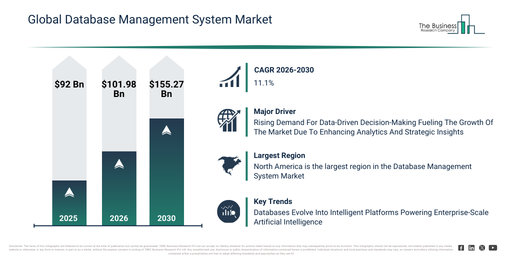
The database management system market has witnessed rapid expansion in recent years. It is forecast to grow from $92 billion in 2025 to $101.98 billion in 2026, achieving a compound annual growth rate (CAGR) of 10.8%. This historical growth can be attributed to several factors, including the increasing volume of enterprise data, the rising adoption of relational database systems, the growing demand for multi-user data access, the expansion of IT infrastructure, and the increasing need for data backup and recovery solutions.
The database management system market is projected to experience swift expansion over the coming years. Its valuation is set to reach $155.27 billion by 2030, exhibiting a compound annual growth rate (CAGR) of 11.1%. This anticipated growth during the forecast period stems from factors such as the rising implementation of cloud and hybrid database solutions, the escalating need for AI-driven database management, the expanding deployment of distributed and in-memory databases, the proliferation of database monitoring and optimization utilities, and a heightened emphasis on data security and regulatory adherence. Key trends anticipated during this period encompass a surge in the embrace of cloud-centric database platforms, an uptick in the requirement for database performance enhancement services, an intensified concentration on database security and compliance governance, the broadening of database monitoring and upkeep provisions, and an increased convergence of in-memory and distributed database systems.
Get A Free Sample Report With In-Depth Market Insights:
Database Management System Market Demand Drivers: What’s Powering Industry Growth?
The increasing requirement for data-driven decision-making is anticipated to stimulate the growth of the database management system market moving forward. This type of decision-making involves making business or operational choices based on the analysis and interpretation of relevant data, rather than on intuition or personal experience. The surge in demand for data-driven decision-making is mainly propelled by the expanding volumes of data, as organizations produce and collect extensive information that can be analyzed to refine strategies, boost efficiency, and acquire competitive insights. Database management systems enhance data-driven decision-making by effectively storing, organizing, and retrieving large quantities of information, making them perfect for businesses and organizations seeking actionable insights. They decrease data retrieval time and errors while improving data consistency and accessibility, thereby elevating overall strategic planning and operational effectiveness. For example, in January 2025, according to Kanerika Software Pvt. Ltd., an India-based software company, 95% of organizations intend to reinforce their data-driven decision-making, underscoring the vital role of analytics in forming strategic plans. Therefore, the escalating demand for data-driven decision-making is a primary factor driving the expansion of the database management system market.
Database Management System Market Segment Performance And Emerging Opportunities
The database management system market covered in this report is segmented –
1) By Component: Software, Hardware, Services
2) By Database Type: Relational, Non Relational, In Memory, Other Database Types
3) By Deployment Mode: On-Premises, Cloud
4) By Organization Size: Small And Medium Enterprises, Large Enterprises
5) By Industry Vertical: Banking, Financial Services And Insurance, Healthcare, Retail, Information Technology And Telecommunications, Government, Manufacturing, Other Industry Verticals
Subsegments:
1) By Software: Database Management Software, Relational Database Management Software, Non Relational Database Management Software, In Memory Database Software, Distributed Database Management Software, Cloud Based Database Management Software, Data Warehousing Software, Database Monitoring And Optimization Software
2) By Hardware: Database Servers, Storage Systems, High Performance Computing Systems, Network Infrastructure Equipment, Backup And Recovery Hardware, Data Center Storage Devices, On-Premises Database Appliances
3) By Services: Database Installation And Configuration Services, Database Migration Services, Database Monitoring And Maintenance Services, Database Performance Optimization Services, Database Security And Compliance Services, Database Consulting Services, Managed Database Services
Database Management System Market Innovation Trends: What Developments Are Reshaping The Industry?
Leading companies in the database management system market are prioritizing the creation of advanced innovations like AI-native databases, intended to support artificial intelligence workloads, consolidated data management, and extensive analytics. An AI-native database refers to a database management system that integrates artificial intelligence features to handle, protect, and analyze various data types within a unified platform. For instance, in October 2025, Oracle Corporation, a US-based enterprise software company, introduced Oracle AI Database 26ai. This database provides capabilities such as unified hybrid vector search, embedded artificial intelligence agents, multimodal data compatibility, and sophisticated privacy and governance measures, all without necessitating application recertification. Its capacity to function effortlessly across cloud, multicloud, and on-premises infrastructures positions it as a scalable, production-ready system for enterprise operations driven by artificial intelligence.
Database Management System Market Competitive Overview And Top Companies
Major companies operating in the database management system market are , Amazon Web Services Inc., Google LLC, Microsoft Corporation, IBM Corporation, Oracle Corporation, SAP SE, Hewlett Packard Enterprise (HPE), Snowflake Inc., Databricks Inc., Teradata Corporation, MongoDB Inc., InterSystems Corporation, Alibaba Cloud, Redis Labs Inc., Cockroach Labs, Yugabyte Inc., Neo4j Inc., Percona LLC, ScyllaDB Inc., Aerospike Inc., InfluxData Inc., Timescale Inc., Hazelcast Inc., VoltDB Inc., and PostgreSQL Global Development Group.
View The Full Database Management System Market Report:
Database Management System Market Top Region: Where Does Most Revenue Come From?
North America was the largest region in the database management system market in 2025. Asia-Pacific is expected to be the fastest-growing region in the forecast period. The regions covered in the database management system market report are Asia-Pacific, South East Asia, Western Europe, Eastern Europe, North America, South America, Middle East, Africa.
Reach Out To Our Team:
The Business Research Company: https://www.thebusinessresearchcompany.com/
Americas: +1 310-496-7795
Asia: +44 7882 955267 & +91 8897263534
Europe: +44 7882 955267
Email us at: marketing@tbrc.info
Follow us on:
LinkedIn: https://in.linkedin.com/company/the-business-research-company
YouTube: https://www.youtube.com/channel/UC24_fI0rV8cR5DxlCpgmyFQ
Global Market Model: https://www.thebusinessresearchcompany.com/global-market-model

Wasay has over a decade of experience in market research, data modelling, and analytics, with prior experience at GlobalData and Decision Tree Consulting Services. At The Business Research Company , he leads research operations across syndicated studies, customized consulting engagements, and the Global Market Model platform. His professional experience includes supporting organizations such as Boston Consulting Group, KPMG, and Ernst & Young. Wasay holds a degree in Electronics and Communications Engineering, postgraduate management qualifications from International Management Institute Belgium and Indian School of Business and Entrepreneurship, and completed the Integrated Program in Business Analytics from Indian Institute of Management Indore.