Backed by market attractiveness analysis, total addressable market sizing, company benchmarking matrices, interactive Excel dashboards, wider supply chain intelligence, emerging startup coverage, and detailed product-level insights, The Business Research Company’s 2026 market reports are designed to offer research that is more actionable and strategically valuable than ever.
Digital Identity Verification Market Size, Value And Growth Trajectory Through 2030
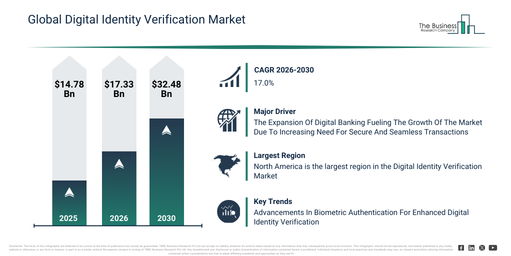
The digital identity verification market has experienced considerable growth in recent years. This market is anticipated to expand from $14.78 billion in 2025 to $17.33 billion in 2026, achieving a compound annual growth rate (CAGR) of 17.2%. Historically, its growth has been propelled by factors such as an escalation in online fraud incidents, the early adoption of digital banking, compliance with regulatory KYC requirements, the proliferation of online services, and a persistent demand for secure authentication.
The digital identity verification market is anticipated to experience substantial expansion in the coming years, with projections indicating it will reach $32.48 billion in 2030, exhibiting a compound annual growth rate (CAGR) of 17.0%. This growth during the forecast period is primarily attributed to the expansion of digital financial services, the implementation of stricter compliance regulations, the increasing adoption of biometric technologies, the rise of remote onboarding practices, and the integration of AI verification tools. Key trends expected within this period include biometric-based identity verification, the evolution of remote digital KYC processes, AI-driven fraud detection, comprehensive document and liveness verification, and the development of seamless user authentication systems.
Get A Free Sample Report With In-Depth Market Insights:
Digital Identity Verification Market Growth Momentum: What Factors Are Shaping Demand?
The increasing adoption of digital banking is anticipated to fuel the expansion of the digital identity verification market moving ahead. Digital banking offers financial services via online platforms, enabling users to manage their banking requirements conveniently, regardless of time or place. The rise of digital banking is driven by a growing need for ease, allowing customers to oversee their accounts, execute transactions, and access services anytime, anywhere, thus enhancing accessibility and user experience. Digital identity verification bolsters security in digital banking by employing biometrics, passwords, or authentication apps to confirm a user’s identity. This helps deter fraud, ensures compliance, and facilitates secure, seamless transactions, thereby fostering customer trust. For instance, in January 2024, according to the European Central Bank, a Germany-based central bank of the European Union countries, the number of contactless card payments in the first half of 2023 rose by 24.3% from 20.9 billion in the first half of 2022, with the corresponding total value increasing by 25.9% to €0.5 trillion ($545.27 billion). Consequently, the expansion of digital banking is driving the growth of the digital identity verification market.
Digital Identity Verification Market Segment Breakdown: Which Categories Lead On Revenue?
The digital identity verification market covered in this report is segmented –
1) By Component: Solutions, Services
2) By Technology: Biometric Verification, Biometric Authentication, Document Verification, Video Verification, Artificial Intelligence (AI) And Machine Learning (ML) Integration, Other Technologies
3) By Deployment Mode: Cloud-Based, On-Premises
4) By Application: Identity Management, Access Control, Fraud Prevention, Customer Onboarding, Compliance And Regulatory Requirements, Remote User Verification
5) By End-User: Banking, Financial Services, And Insurance (BFSI), Government And Defense, Healthcare, Retail And E-commerce, Information Technology And Telecommunications, Other End-Users
Subsegments:
1) By Solutions: Identity Authentication, Identity Verification, Identity Document Verification, Biometrics, Liveness Detection, Risk And Compliance Solutions, Identity Proofing, Fraud Detection And Prevention
2) By Services: Consulting, Integration And Implementation, Training And Education, Identity Monitoring, Technical Support, Outsourced Verification Services
Digital Identity Verification Market Trends Redefining Industry Growth
Leading companies operating in the digital identity verification market are prioritizing the development of advanced technologies, such as biometric authentication, to bolster security and streamline the processes for verifying users. Biometric authentication functions as a security measure that validates an individual’s identity using unique biological characteristics, including fingerprints, facial recognition, or iris scans. This method offers a highly secure and efficient means to confirm identity, ensuring that access to specific systems or services is exclusively granted to authorized individuals. For instance, in October 2024, Jumio, a US-based identity verification company, launched Jumio Liveness, a next-generation liveness detection technology. This solution is engineered to counteract sophisticated fraud tactics like deepfakes and injection attacks, all while preserving a seamless user experience. The AI-driven technology employs cutting-edge biometric and anti-spoofing methodologies, encompassing real-time behavior analysis and ISO 30107-3 compliance, to verify that users are physically present and genuine during identity verification. This innovation enhances fraud prevention without increasing complexity, making it ideal for industries that necessitate rigorous security standards.
Digital Identity Verification Market Leading Players And Competitive Positioning
Major companies operating in the digital identity verification market are Oracle Corporation, SAP SE, Mastercard Inc., Thales Group S.A., LexisNexis Risk Solutions Group, Experian PLC, Equifax Inc., IDEMIA LLC, Ping Identity Corporation, Jumio Inc., OneSpan Inc., Mitek Systems Inc., Trulioo, Verrif, Shufti Pro, Socure, Sumsub, AU10TIX, Aware Inc., Idology Inc.
View The Full Digital Identity Verification Market Report:
Digital Identity Verification Market Largest Region: Which Geography Holds The Biggest Share?
North America was the largest region in the digital identity verification market in 2025. Asia-Pacific is expected to be the fastest-growing region in the forecast period. The regions covered in the digital identity verification market report are Asia-Pacific, South East Asia, Western Europe, Eastern Europe, North America, South America, Middle East, Africa.
Reach Out To Our Team:
The Business Research Company: https://www.thebusinessresearchcompany.com/
Americas: +1 310-496-7795
Asia: +44 7882 955267 & +91 8897263534
Europe: +44 7882 955267
Email us at: marketing@tbrc.info
Follow us on:
LinkedIn: https://in.linkedin.com/company/the-business-research-company
YouTube: https://www.youtube.com/channel/UC24_fI0rV8cR5DxlCpgmyFQ
Global Market Model: https://www.thebusinessresearchcompany.com/global-market-model

Wasay has over a decade of experience in market research, data modelling, and analytics, with prior experience at GlobalData and Decision Tree Consulting Services. At The Business Research Company , he leads research operations across syndicated studies, customized consulting engagements, and the Global Market Model platform. His professional experience includes supporting organizations such as Boston Consulting Group, KPMG, and Ernst & Young. Wasay holds a degree in Electronics and Communications Engineering, postgraduate management qualifications from International Management Institute Belgium and Indian School of Business and Entrepreneurship, and completed the Integrated Program in Business Analytics from Indian Institute of Management Indore.