Backed by market attractiveness analysis, total addressable market sizing, company benchmarking matrices, interactive Excel dashboards, wider supply chain intelligence, emerging startup coverage, and detailed product-level insights, The Business Research Company’s 2026 market reports are designed to offer research that is more actionable and strategically valuable than ever.
Digital Twin For Buildings Market Value Growth And Long-Term Outlook
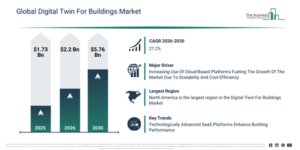
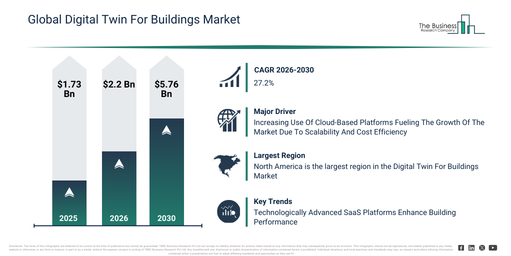
The digital twin for buildings market size has experienced significant expansion in recent years. It will grow from $1.73 billion in 2025 to $2.2 billion in 2026 at a compound annual growth rate (CAGR) of 27.5%. This historical growth is largely due to factors such as the increasing embrace of smart buildings, enhanced implementation of Building Information Modeling (BIM), a greater need for energy-efficient infrastructure, the wider rollout of IoT sensor technology, and the expanding adoption of cloud computing.
The digital twin for buildings market is expected to experience substantial growth in the coming years, with its size projected to reach $5.76 billion in 2030 at a compound annual growth rate (CAGR) of 27.2%. This expansion during the forecast period is primarily driven by factors such as the integration of AI-based building analytics, an increase in investment for green building projects, the spread of smart city initiatives, a rising need for automated facility management, and the adoption of real-time digital monitoring platforms. Key trends anticipated during this period include continuous building performance monitoring, predictive maintenance and asset optimization, enhancing energy efficiency and reducing carbon footprint, the implementation of remote facility management, and analytics focused on space utilization and occupancy.
Get A Free Sample Report With In-Depth Market Insights:
Digital Twin For Buildings Market Growth Momentum: What Factors Are Shaping Demand?
The growing adoption of cloud-based platforms is anticipated to accelerate the expansion of the digital twin for the buildings market in the future. Cloud computing platforms are online services that deliver on-demand access to a wide array of computing resources, such as storage, servers, and software, over the internet, thereby enabling scalability, flexibility, and cost efficiency. The demand for cloud computing platforms is escalating due to their scalability and cost efficiency, as they facilitate flexible resource allocation and diminish the necessity for expensive on-premises infrastructure. Digital twins for buildings enhance cloud-based platforms by offering real-time data integration and simulation, making them perfectly suited for optimizing building performance and operations. They improve decision-making by providing actionable insights for maintenance, energy efficiency, and space utilization. For instance, in December 2023, Eurostat, the Luxembourg-based government agency, reported that, in 2023, 45.2% of EU enterprises purchased cloud computing services. Furthermore, the majority of these purchased services were e-mail services (82.7%), followed by storage services for files (68.0%) and office software (66.3%). Security software applications (61.0%), finance or accounting software applications (51.6%), and hosting for the enterprise’s database (43.0%) were also widely adopted. Therefore, the increasing utilization of cloud-based platforms is a significant driver for the growth of the digital twin for the buildings market.
Digital Twin For Buildings Market Segmentation: How Does The Market Break Down By Category?
The digital twin for buildings market covered in this report is segmented –
1) By Component: Software, Service
2) By Type: Descriptive Twin, Informative Twin, Predictive Twin, Comprehensive Twin, Autonomous Twin
3) By Application: Automated Progress Monitoring, As-executed Vs. As-Planned Models, Resource Management And Logistics, Safety Monitoring, Quality Assessment, Optimization Of Equipment Usage, Monitoring And Tracking Of Workers
4) By Industry: Manufacturing, Aerospace And Defense, Oil And Gas, Utilities, Healthcare And Life Sciences, Automotive, Construction, Information Technology And Telecommunications, Retail, Other Industries
Subsegments:
1) By Software: Three-Dimensional (3D) Modeling Software, Simulation Software, Data Analytics Software, Cloud-Based Software, Asset Management Software, Building Information Modeling Software
2) By Service: Consulting Services, Integration Services, Support And Maintenance Services, Managed Services
Digital Twin For Buildings Market Trends Redefining Industry Growth
Leading companies active in the digital twin for buildings market are concentrating on developing advanced technological solutions, such as software as a service (SaaS) digital twin platforms, with the goal of enhancing building performance, improving energy efficiency, and streamlining maintenance procedures. A software as a service (SaaS) digital twin platform is characterized as a cloud-based software solution that creates a virtual representation of physical buildings or assets, enabling continuous monitoring, analysis, and optimization of both performance and operations. For example, in October 2023, Nemetschek Group, a German software company, launched dTwin, a SaaS digital twin platform designed to offer data-driven insights for more effective facility management throughout the building’s lifecycle, from initial design to ongoing operations. By integrating various sources of building data, including real-time information from internet of things (IoT) sensors and other formats, dTwin provides actionable insights through customizable dashboards and reports. Its open application programming interface (API) architecture ensures effortless connectivity across different systems, thereby boosting visibility and efficiency and facilitating data-informed decision-making at every phase of a building’s lifecycle.
Digital Twin For Buildings Market Competitive Overview And Top Companies
Major companies operating in the digital twin for buildings market are Amazon Web Services Inc., Robert Bosch GmbH, Hitachi Ltd., Siemens AG, Microsoft Azure, General Electric Company, Accenture plc, International Business Machines Corporation, Oracle Corporation, Cisco Systems Inc., Honeywell International Inc., SAP SE, Fujitsu Limited, DXC Technology Company, Wipro Limited, Synopsys Inc., Dassault Systemes SE, Autodesk Inc., PTC Inc., Bentley Systems Incorporated
View The Full Digital Twin For Buildings Market Report:
Digital Twin For Buildings Market Geographic Landscape: Which Region Leads Industry Growth?
North America was the largest region in the digital twin for buildings market in 2025. The regions covered in the digital twin for buildings market report are Asia-Pacific, South East Asia, Western Europe, Eastern Europe, North America, South America, Middle East, Africa.
Reach Out To Our Team:
The Business Research Company: https://www.thebusinessresearchcompany.com/
Americas: +1 310-496-7795
Asia: +44 7882 955267 & +91 8897263534
Europe: +44 7882 955267
Email us at: marketing@tbrc.info
Follow us on:
LinkedIn: https://in.linkedin.com/company/the-business-research-company
YouTube: https://www.youtube.com/channel/UC24_fI0rV8cR5DxlCpgmyFQ
Global Market Model: https://www.thebusinessresearchcompany.com/global-market-model

Wasay has over a decade of experience in market research, data modelling, and analytics, with prior experience at GlobalData and Decision Tree Consulting Services. At The Business Research Company , he leads research operations across syndicated studies, customized consulting engagements, and the Global Market Model platform. His professional experience includes supporting organizations such as Boston Consulting Group, KPMG, and Ernst & Young. Wasay holds a degree in Electronics and Communications Engineering, postgraduate management qualifications from International Management Institute Belgium and Indian School of Business and Entrepreneurship, and completed the Integrated Program in Business Analytics from Indian Institute of Management Indore.