Delivering more actionable and strategically valuable research, The Business Research Company’s 2026 market reports feature market attractiveness analysis, total addressable market evaluation, company benchmarking matrices, interactive Excel dashboards, expanded supply chain intelligence, emerging startup coverage, and detailed product insights.
Digital Twin Market Value Analysis: What Growth Is Expected Over The Forecast Period?
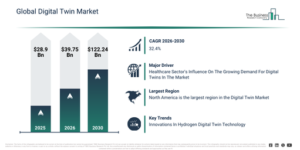
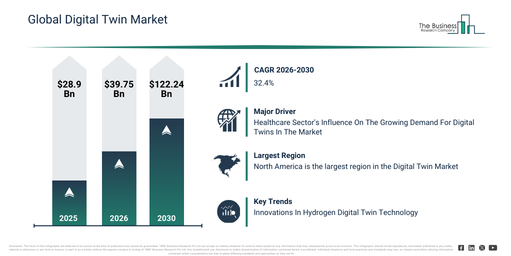
The digital twin market has witnessed significant expansion over recent years. It is forecast to increase from $28.9 billion in 2025 to $39.75 billion in 2026, achieving a compound annual growth rate (CAGR) of 37.6%. This historical development can be ascribed to several factors, including the uptake of industrial IoT, the imperative for asset performance optimization, the advancement of simulation software, the proliferation of connected sensors, and the escalating intricacy of systems.
The digital twin market is projected to experience substantial expansion in the coming years. By 2030, its value is anticipated to reach $122.24 billion, demonstrating a compound annual growth rate (CAGR) of 32.4%. This expansion during the projection period stems from factors such as the incorporation of AI driven simulations, the increasing scope of smart manufacturing, the advancement of infrastructure digitalization, the widespread adoption of 5G connectivity, and a growing need for real time decision support. Key developments expected within this timeframe involve real time asset simulation, predictive maintenance modeling, optimization of lifecycle performance, integrated physical digital systems, and virtual prototyping and testing.
Download A Free Sample Report For Comprehensive Market Insights:
Digital Twin Market Demand Drivers: What Is Fueling Industry Growth?
The growing need for digital twins within the healthcare sector is anticipated to boost the digital twin market throughout the forecast period. In healthcare systems, digital twins serve to construct virtual models of various health-related data, such as hospital environments, laboratory results, and human physiological aspects, among others. By developing a virtual replica of healthcare facilities, this technology facilitates the analysis of operational strategies, resource distribution, personnel management, and care delivery approaches, thereby enabling the identification of issues, foresight into future challenges, and refinement of organizational methods. Leading healthcare organizations are integrating digital twins to achieve greater operational effectiveness. For example, data from January 2025 by Deloitte Touche Tohmatsu Limited, a UK-based software company, indicates that approximately 70% of those surveyed consider investments in digital tools and platforms crucial, 60% focus on essential technologies such as EMRs and ERP, and close to 90% of C-suite leaders foresee an accelerated adoption of digital technology in 2025. Consequently, the escalating demand for digital twins in healthcare is set to propel the expansion of the digital twin market throughout the forecast period.
Digital Twin Market Segment Analysis Highlighting Growth Areas
The digital twin market covered in this report is segmented –
1) By Type: Product Digital Twin, Process Digital Twin, System Digital Twin
2) By Technology: IoT, Blockchain, Artificial Intelligence and Machine Learning, Extended Reality and Other Technology, Big Data Analytics
3) By Application: Manufacturing, Energy and Power, Aerospace, Automotive, Transportation, Other Applications
Subsegments:
1) By Product Digital Twin: Virtual Prototyping, Performance Monitoring, Lifecycle Management
2) By Process Digital Twin: Workflow Simulation, Process Optimization, Predictive Maintenance
3) By System Digital Twin: Infrastructure Modeling, Network Performance Analysis, Integrated System Simulation
Digital Twin Market Strategic Trends: What Is Defining The Next Phase Of Growth?
Leading companies active in the digital twin market are concentrating on creating innovative technologies, including holistic simulation, to bolster operational efficiency, improve system performance, and provide more accurate predictive insights throughout intricate processes. Holistic simulation refers to a unified simulation method that models a complete system to deliver a true-to-life understanding of performance and to support precise outcome forecasting and enhanced decision-making. For example, in February 2025, Peaxy, Inc., a US-based software firm, launched what it identified as the industry’s first Hydrogen Digital Twin, which took over seven years to develop and is now operational for a major Fortune 200 client. This comprehensive solution models the entire hydrogen value chain, spanning from renewable power input to electrolyzers, compression, and storage, with the goal of optimizing plant design, simulating operations, and producing key metrics like the levelized cost of hydrogen. It provides users with an interactive 3D visualization of plant layouts, allows for scenario analysis to fine-tune equipment sizing and spatial configurations, and speeds up engineering and commissioning phases via physics-based simulation. By integrating system integration, cost modeling, and operational forecasting, the platform positions Peaxy prominently among digital tool providers for hydrogen project implementation.
Digital Twin Market Leading Companies: Who Holds Significant Market Presence?
Major companies operating in the digital twin market are SAP SE; IBM Corporation; ANSYS Inc; Microsoft Corporation; General Electric; Siemens AG; Bentley Systems; Dassault Systèmes; ABB Ltd.; Oracle Corporation; PTC; TIBCO Software Inc; SAS Institute Inc; Bosch; Aveva Group; Amazon Web Services; FARO; Hexagon AB; Rockwell Automation; Schneider Electric; Altair Engineering; Cisco Systems
Access The Complete Digital Twin Market Report:
Digital Twin Market Leading Geography: Which Region Generates The Most Revenue?
North America was the largest region in the digital twin market in 2025. Asia-Pacific is expected to be the fastest-growing region in the forecast period. The regions covered in the digital twin market report are Asia-Pacific, South East Asia, Western Europe, Eastern Europe, North America, South America, Middle East, Africa.
Get in touch with us:
The Business Research Company: https://www.thebusinessresearchcompany.com/
Americas: +1 310-496-7795
Asia: +44 7882 955267 & +91 8897263534
Europe: +44 7882 955267
Email us at: marketing@tbrc.info
Follow us on:
LinkedIn: https://in.linkedin.com/company/the-business-research-company
YouTube: https://www.youtube.com/channel/UC24_fI0rV8cR5DxlCpgmyFQ
Global Market Model: https://www.thebusinessresearchcompany.com/global-market-model

Wasay has over a decade of experience in market research, data modelling, and analytics, with prior experience at GlobalData and Decision Tree Consulting Services. At The Business Research Company , he leads research operations across syndicated studies, customized consulting engagements, and the Global Market Model platform. His professional experience includes supporting organizations such as Boston Consulting Group, KPMG, and Ernst & Young. Wasay holds a degree in Electronics and Communications Engineering, postgraduate management qualifications from International Management Institute Belgium and Indian School of Business and Entrepreneurship, and completed the Integrated Program in Business Analytics from Indian Institute of Management Indore.