Market attractiveness scoring, total addressable market sizing, company benchmarking matrices, interactive Excel dashboards, deeper supply chain intelligence, emerging startup tracking, and granular product-level insights are among the key offerings featured in The Business Research Company’s 2026 market reports, designed to deliver more actionable and strategically valuable research.
Digital Twin Technology Market Valued At $30.85 Billion In 2026, Projected To Reach $94.27 Billion By 2030
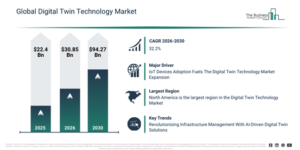
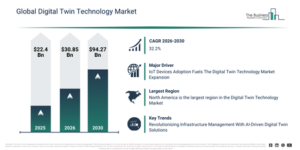
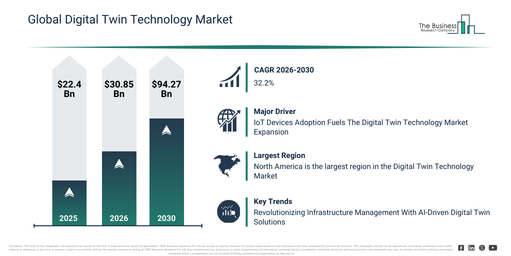
The market for digital twin technology has expanded significantly in size over recent years. It will grow from $22.4 billion in 2025 to $30.85 billion in 2026 at a compound annual growth rate (CAGR) of 37.7%. Historically, this growth has been driven by factors including the increasing uptake of industrial automation systems, the expansion of sensor and IoT deployments, a heightened demand for asset lifecycle visibility, the proliferation of advanced manufacturing processes, and the availability of high-performance computing platforms.
The digital twin technology market is projected to experience substantial growth in the upcoming years, with its size expected to reach $94.27 billion by 2030, exhibiting a compound annual growth rate (CAGR) of 32.2%. This anticipated expansion during the forecast period is attributed to several factors, such as heightened investments in smart manufacturing, the increasing adoption of AI-enabled digital twins, the proliferation of smart infrastructure projects, a surging demand for remote monitoring and optimization solutions, and the enhanced integration of digital twins with enterprise systems. Key trends anticipated over the forecast horizon include the expanded deployment of real-time asset digital twins, a rise in the adoption of predictive maintenance applications, wider utilization of simulation-based design tools, the broadening of system-level digital twin models, and a sharpened focus on optimizing operational performance.
Request A Complimentary Digital Twin Technology Market Research Sample:
Key Factor Propelling The Digital Twin Technology Market Forward
The expanding uptake of IoT devices is anticipated to fuel the progression of the digital twin technology market. IoT (Internet of Things) devices encompass specialized hardware such as sensors, actuators, and appliances, designed to communicate wirelessly with a network to gather, exchange, and process data. The demand for these IoT (Internet of Things) devices is increasing owing to enhanced connectivity, ongoing digital transformation, greater convenience and efficiency, and improved safety and security. IoT devices collect real-time data on various characteristics, including temperature, pressure, and usage patterns, which digital twins then utilize to generate virtual models. With continuous data streaming, digital twins facilitate real-time monitoring, enabling businesses to optimize operations and identify challenges proactively. For instance, in April 2025, according to Ericsson, a Sweden-based telecommunications company, global IoT connections reached 18.8 billion connections in 2024 and are expected to increase to 43.0 billion connections by 2030. Therefore, the growing adoption of IoT devices is a significant driver for the growth of the digital twin technology market.
Digital Twin Technology Market Segments And Subsegments Explained
The digital twin technology market covered in this report is segmented –
1) By Type: Product Digital Twins, Process Digital Twins, System Digital Twins, Asset Performance Digital Twins
2) By Application: Predictive Maintenance, Product Design And Development, Supply Chain Optimization, Remote Monitoring And Control, Performance Optimization
3) By End-User Industry: Manufacturing, Energy And Utilities, Transportation And Logistics, Other End Users
Subsegments:
1) By Product Digital Twins: Consumer Products, Industrial Products, Automotive Products, Aerospace Products, Electronics And High-Tech Products
2) By Process Digital Twins: Manufacturing Processes, Supply Chain Processes, Energy Management Processes, Chemical Processes, Industrial Automation Processes
3) By System Digital Twins: Operational Systems, Smart Cities, Buildings And Infrastructure Systems, Transportation Systems, Utilities And Grid Systems
4) By Asset Performance Digital Twins: Predictive Maintenance, Performance Monitoring, Lifecycle Management, Condition Monitoring
Emerging Trends Transforming The Digital Twin Technology Market
Leading firms in the digital twin technology market are concentrating on advancing technological solutions, particularly AI-enabled digital twin platforms, for the digitization and analysis of essential infrastructure assets. An AI-enabled digital twin platform is defined as an advanced software system incorporating artificial intelligence (AI) functionalities for the development and oversight of digital twins. For example, in March 2024, Looq AI, a software company based in the US, introduced its AI-enabled digital twin technology, known as the Looq platform. This platform serves as a comprehensive tool enabling surveyors, engineers, contractors, and asset owners to digitally map physical infrastructure with survey-grade precision in minutes, thereby facilitating the creation and maintenance of a safer, more sustainable, and electrified future. The Looq platform operates utilizing a handheld ‘Q’ camera, which integrates four high-resolution cameras, survey-grade GPS, and an AI processor. This setup provides nearly 360-degree coverage, enabling rapid data collection. Furthermore, the Looq platform delivers a full end-to-end workflow, empowering project teams to interact with the generated digital twins and AI-derived data for executing engineering, surveying, analysis, and coordination tasks.
Digital Twin Technology Market Key Players: Major Companies In The 2026 Report
Major companies operating in the digital twin technology market are Microsoft Corporation, Siemens AG, General Electric Company, Amazon Web Services Inc., International Business Machines Corporation, Oracle Corporation, Schneider Electric SE, Honeywell International Inc., SAP SE, ABB Limited, NTT DATA Corporation, Infosys Limited, Emerson Electric Co., Dassault Systèmes, Hexagon AB, Autodesk Inc., ANSYS Inc., PTC Inc., Bosch Global Software Technologies Private Limited, AVEVA Group Limited, Bentley Systems Incorporated, TIBCO Software Inc., L&T Technology Services Limited, Altair Engineering Inc., Digital Twin Consortium
Explore The Full Digital Twin Technology Market Report With Forecasts To 2030:
Digital Twin Technology Market By Region: Where Is Demand Strongest?
North America was the largest region in the digital twin technology market in 2025. The regions covered in the digital twin technology market report are Asia-Pacific, South East Asia, Western Europe, Eastern Europe, North America, South America, Middle East, Africa.
Reach Out To Our Team:
The Business Research Company: https://www.thebusinessresearchcompany.com/
Americas: +1 310-496-7795
Asia: +44 7882 955267 & +91 8897263534
Europe: +44 7882 955267
Email us at: marketing@tbrc.info
Follow us on:
LinkedIn: https://in.linkedin.com/company/the-business-research-company
YouTube: https://www.youtube.com/channel/UC24_fI0rV8cR5DxlCpgmyFQ
Global Market Model: https://www.thebusinessresearchcompany.com/global-market-model

Wasay has over a decade of experience in market research, data modelling, and analytics, with prior experience at GlobalData and Decision Tree Consulting Services. At The Business Research Company , he leads research operations across syndicated studies, customized consulting engagements, and the Global Market Model platform. His professional experience includes supporting organizations such as Boston Consulting Group, KPMG, and Ernst & Young. Wasay holds a degree in Electronics and Communications Engineering, postgraduate management qualifications from International Management Institute Belgium and Indian School of Business and Entrepreneurship, and completed the Integrated Program in Business Analytics from Indian Institute of Management Indore.