
Delivering more actionable and strategically valuable research, The Business Research Company’s 2026 market reports feature market attractiveness analysis, total addressable market evaluation, company benchmarking matrices, interactive Excel dashboards, expanded supply chain intelligence, emerging startup coverage, and detailed product insights.
Digital Twins Market Revenue Outlook: What CAGR Is Expected Through 2030?
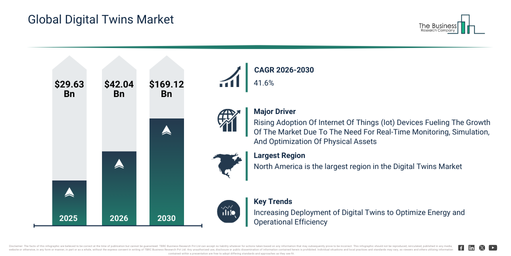
The digital twins market has experienced substantial growth in recent years. It is anticipated to expand from $29.63 billion in 2025 to $42.04 billion by 2026, registering a compound annual growth rate (CAGR) of 41.9%. The market’s growth in the past can be attributed to the increasing adoption of simulation and modeling technologies, a rising demand for predictive maintenance solutions, greater utilization in industrial automation and smart manufacturing, the widening of Internet of Things (IOT) enabled infrastructure, and a sustained focus on enhancing operational efficiency.
The digital twins market is anticipated to experience substantial expansion over the coming years, with its valuation projected to reach $169.12 billion by 2030, exhibiting a compound annual growth rate (CAGR) of 41.6%. This growth in the forecast period is primarily driven by the increasing integration of digital twins (DT) with artificial intelligence (AI) and machine learning (ML) solutions, alongside their growing adoption in smart city and industrial applications. Further contributing factors include rising investments in virtual prototyping and testing, the expansion of connected and data-driven ecosystems, and an increased demand for real-time monitoring and optimization. Key trends during this period involve technology-driven innovations in simulation and visualization platforms, advancements in artificial intelligence (AI)-enabled predictive analytics, the evolution of cloud and edge-based digital twin systems, intensifying research and development in Internet of Things (IoT) integration, and novel approaches to immersive and interactive twin representations.
Download A Free Sample Report For Comprehensive Market Insights:
Digital Twins Market Development Factors: Which Trends Are Supporting Demand?
The increasing integration of Internet of Things (IoT) devices is projected to fuel the expansion of the digital twins market. IoT devices constitute a network of linked physical objects, including smartphones, sensors, wearables, smart home gadgets, and security cameras, which facilitate data exchange and communication online autonomously. The demand for these interconnected IoT devices is growing because they provide real-time data, thereby boosting efficiency, enabling remote oversight, and facilitating more informed decisions across various sectors. Digital twins further bolster IoT device uptake by generating virtual models of physical assets, allowing for real-time monitoring, simulation, and optimization of their performance. This leads to better operational efficiency and improved decision-making, prompting broader adoption of IoT devices throughout industries. For example, data from IoT Analytics, a German research firm specializing in IoT market insights, indicated that by 2023, the count of connected IoT devices had climbed to 16.6 billion, marking a 15% rise from 14.4 billion in 2022. Consequently, the increasing prevalence of IoT device adoption is a key factor propelling the expansion of the digital twins market.
Digital Twins Market Segment Performance And Strategic Opportunities
The digital twins market covered in this report is segmented –
1) By Offering: Software, Services, Hardware
2) By Deployment: Cloud, On Premises
3) By Technology Type: Internet Of Things Enabled Digital Twins, Artificial Intelligence Driven Digital Twins, Augmented Reality And Virtual Reality Digital Twins, Blockchain Enabled Digital Twins, Mixed Reality Digital Twins, Cloud Based Digital Twins, Edge Computing Based Digital Twins, Hybrid Digital Twins, Other Technology Types
4) By Application: Predictive Maintenance, Product Design And Development, Business Optimization, Other Applications
5) By Industry Vertical: Manufacturing, Healthcare, Automotive, Aerospace And Defense, Energy And Utilities, Retail, Transportation And Logistics, Construction And Building Management, Agriculture, Other Industry Verticals
Subsegments:
1) By Software: Simulation And Modeling Software, Analytics And Visualization Software, Integration And Collaboration Software
2) By Services: Implementation And Deployment Services, Maintenance And Support Services, Consulting And Training Services
3) By Hardware: Sensor And IoT Devices, Edge Computing Hardware, Data Acquisition And Storage Hardware
Digital Twins Market Transformation Trends: Which Innovations Are Driving Change?
Major companies operating in the digital twins market are concentrating on developing sophisticated solutions, including integrated load profile simulation and asset dimensioning, to enhance efficiency, optimize resource use, and support predictive maintenance. Integrated load profile simulation and asset dimensioning delineate the tools and processes utilized in digital twin systems to model energy or resource consumption patterns (load profiles) and ascertain the optimal size, capacity, or configuration of assets. For instance, in April 2024, Siemens Aktiengesellschaft, a Germany-based industrial technology company, collaborated with Mercedes-Benz, a Germany-based luxury automotive manufacturer, to unveil the Digital Energy Twin. This co-created software solution features a behavioral model of factory energy systems designed to prevent inefficient planning, substantially reducing the risk of costly design errors. It incorporates integrated load profile simulation and asset dimensioning, enabling seamless optimization of energy use for both new and existing factories without the need for extensive manual calculation. The solution also includes scenario analysis and automated recommendations, thereby extending the tool’s applicability and contributing to lower operational costs and a reduced carbon footprint for industrial operators.
Digital Twins Market Key Players: Which Companies Shape Industry Competition?
Major companies operating in the digital twins market are Amazon Web Services Inc., Robert Bosch GmbH, Siemens AG, Hitachi Ltd., International Business Machines Corporation, Cisco Systems Inc., Oracle Corporation, General Electric Company, Schneider Electric SE, Honeywell International Inc., ABB Ltd., SAP SE, Emerson Electric Co., Rockwell Automation Inc., Dassault Systèmes SE, Hexagon AB, Ansys Inc., PTC Inc., AVEVA Group plc, Bentley Systems Incorporated, Aspen Technology Inc., Altair Engineering Inc., Azure LLC, AnyLogic Company
Access The Complete Digital Twins Market Report:
Digital Twins Market Regional Analysis: Which Region Leads By Revenue?
North America was the largest region in the digital twins market in 2025. Asia-Pacific is expected to be the fastest-growing region in the forecast period. The regions covered in the digital twins market report are Asia-Pacific, South East Asia, Western Europe, Eastern Europe, North America, South America, Middle East, Africa.
Get in touch with us:
The Business Research Company: https://www.thebusinessresearchcompany.com/
Americas: +1 310-496-7795
Asia: +44 7882 955267 & +91 8897263534
Europe: +44 7882 955267
Email us at: marketing@tbrc.info
Follow us on:
LinkedIn: https://in.linkedin.com/company/the-business-research-company
YouTube: https://www.youtube.com/channel/UC24_fI0rV8cR5DxlCpgmyFQ
Global Market Model: https://www.thebusinessresearchcompany.com/global-market-model

Wasay has over a decade of experience in market research, data modelling, and analytics, with prior experience at GlobalData and Decision Tree Consulting Services. At The Business Research Company , he leads research operations across syndicated studies, customized consulting engagements, and the Global Market Model platform. His professional experience includes supporting organizations such as Boston Consulting Group, KPMG, and Ernst & Young. Wasay holds a degree in Electronics and Communications Engineering, postgraduate management qualifications from International Management Institute Belgium and Indian School of Business and Entrepreneurship, and completed the Integrated Program in Business Analytics from Indian Institute of Management Indore.