Designed to make market research more actionable and strategically valuable, The Business Research Company’s 2026 market reports feature market attractiveness scoring, total addressable market sizing, company benchmarking matrices, interactive Excel dashboards, deeper supply chain intelligence, emerging startup tracking, and granular product-level insights.
Disaggregated Optical System Market To Expand At A 16.1% CAGR: Size And Growth Projections Through 2030
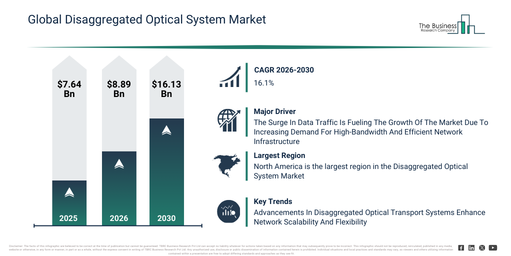
The size of the disaggregated optical system market has experienced swift expansion in recent years. It is anticipated to grow from $7.64 billion in 2025 to $8.89 billion in 2026, at a compound annual growth rate (CAGR) of 16.4%. The historical rise can be attributed to factors such as increasing data traffic and network demand, the growing adoption of optical networking, multi-vendor optical deployment strategies, the requirement for cost-efficient network upgrades, and the expanding use of coherent transponders.
The disaggregated optical system market is anticipated to experience significant expansion over the coming years. This market is projected to reach $16.13 billion by 2030, demonstrating a compound annual growth rate (CAGR) of 16.1%. This projected growth is driven by factors such as the broadening of 400G and 800G networks, the uptake of SDN and network management software, increased deployment in data centers and by cloud providers, the escalating need for high-capacity telecommunication infrastructure, and the incorporation of analytics and monitoring solutions. Key trends anticipated during this period encompass the implementation of modular optical hardware, vendor-agnostic interoperability, the development of scalable network architectures, optimization for high-capacity data transmission, and the management of software-defined optical networks.
Get Your Free Disaggregated Optical System Market Report Sample Today:
Which Factor Is Expected To Drive The Disaggregated Optical System Market Over The Forecast Period?
The increasing volume of data traffic is anticipated to propel the expansion of the disaggregated optical system market moving forward. Data traffic signifies the flow of digital information transmitted across communication networks during a specific timeframe. This surge in data traffic is primarily due to the exponential growth of video streaming, given that high-definition and on-demand content consumes significantly more bandwidth and drives intensive network utilization. A disaggregated optical system enhances data traffic capacity by enabling operators to independently scale, upgrade, and manage optical components, consequently improving bandwidth efficiency, reducing network congestion, and accommodating escalating data demands. For example, in June 2025, Ericsson, a Sweden-based telecommunications company, reported that by the end of 2024, 5G accounted for 35% of mobile data traffic, a rise from 26% in 2023, and is forecast to climb to 80% by 2030. Consequently, the escalating data traffic is a key driver for the growth of the disaggregated optical-system market.
Disaggregated Optical System Market Segmentation Insights: How Is The Industry Categorized?
The disaggregated optical system market covered in this report is segmented –
1) By Component: Optical Transponders, Optical Line Systems, Optical Switches, Software, Other Components
2) By Data Rate: 100 Gigabits Per Second (100G) And Below, 200 Gigabits Per Second (200G), 400 Gigabits Per Second (400G), 800 Gigabits Per Second (800G) And Above
3) By Application: Data Centers, Telecommunication, Enterprises, Cloud Providers, Other Applications
Subsegments:
1) By Optical Transponders: Coherent Transponders, Non-coherent Transponders, Pluggable Transponders, Embedded Transponders
2) By Optical Line Systems: Optical Amplifiers, Reconfigurable Optical Add-Drop Multiplexers (ROADM), Multiplexers (MUX), Demultiplexers (DEMUX), Optical Supervisory Channel (OSC) Equipment
3) By Optical Switches: Wavelength Selective Switches (WSS), Optical Cross-Connects (OXC), Packet Optical Switches
4) By Software: Network Management Software (NMS), Software-Defined Networking (SDN) Controllers, Analytics And Monitoring Software
5) By Other Components: Optical Receivers, Optical Couplers And Splitters, Dispersion Compensation Modules (DCM), Fiber Bragg Gratings
Disaggregated Optical System Market Trends Explained: What Is Changing And Why It Matters
Leading companies in the disaggregated optical systems market are prioritizing the development of advanced products, such as disaggregated optical transponders, to improve scalability, flexibility, and cost-effectiveness. Disaggregated optical transponders are modular devices engineered to convert, transmit, and receive optical signals over fiber networks, enabling independent scaling and vendor interoperability for adaptable and efficient optical communication. For example, in January 2025, Edgecore Networks, a Taiwan-based provider of open infrastructure solutions, unveiled the Phoenix AMX3200. This high-capacity C-band optical transponder and muxponder is characterized by its disaggregated design and support for open operating environments. The AMX3200 is capable of switching a total of 3.2 Tbps and supports links up to 400G, making it an excellent choice for connecting data centers and addressing the backhaul requirements of service providers. It features a modular 1RU chassis with SLED-based line modules, redundant power and cooling systems, and PTP time synchronization functionality. The AMX3200 is built to offer operators flexibility and scalability to satisfy the increasing demands of modern optical transport networks.
Disaggregated Optical System Market Competitor Landscape: Who Are The Major Companies?
Major companies operating in the disaggregated optical system market are Huawei Technologies Co. Ltd., International Business Machines Corporation, Cisco Systems Inc., Jabil Inc., Sumitomo Electric Industries Ltd., Fujitsu Limited, NEC Corporation, Nokia Corporation, Marvell Technology Inc., Coherent Corp., Ciena Corporation, Accton Technology Corporation, ADTRAN Holdings Inc., Alpha Networks Inc., Sterlite Technologies Limited, IP Infusion Inc., DriveNets Inc., Smartoptics AS, UfiSpace Inc., PacketLight Networks Ltd.
See The Full Disaggregated Optical System Market Report For Complete Market Sizing And Trends:
Disaggregated Optical System Market Regional Demand Analysis And Leading Geography
North America was the largest region in the disaggregated optical system market in 2025. Asia-Pacific is expected to be the fastest-growing region in the forecast period. The regions covered in the disaggregated optical system market report are Asia-Pacific, South East Asia, Western Europe, Eastern Europe, North America, South America, Middle East, Africa.
Reach Out To Our Team:
The Business Research Company: https://www.thebusinessresearchcompany.com/
Americas: +1 310-496-7795
Asia: +44 7882 955267 & +91 8897263534
Europe: +44 7882 955267
Email us at: marketing@tbrc.info
Follow us on:
LinkedIn: https://in.linkedin.com/company/the-business-research-company
YouTube: https://www.youtube.com/channel/UC24_fI0rV8cR5DxlCpgmyFQ
Global Market Model: https://www.thebusinessresearchcompany.com/global-market-model

Wasay has over a decade of experience in market research, data modelling, and analytics, with prior experience at GlobalData and Decision Tree Consulting Services. At The Business Research Company , he leads research operations across syndicated studies, customized consulting engagements, and the Global Market Model platform. His professional experience includes supporting organizations such as Boston Consulting Group, KPMG, and Ernst & Young. Wasay holds a degree in Electronics and Communications Engineering, postgraduate management qualifications from International Management Institute Belgium and Indian School of Business and Entrepreneurship, and completed the Integrated Program in Business Analytics from Indian Institute of Management Indore.