
Featuring market attractiveness scoring, total addressable market sizing, company benchmarking matrices, interactive Excel dashboards, deeper supply chain intelligence, emerging startup tracking, and granular product-level insights, The Business Research Company’s 2026 market reports are built to deliver research that is both more actionable and more strategically valuable.
Disaster Recovery Systems Market Poised To Hit $40.27 Billion By 2030 With A 17.4% CAGR
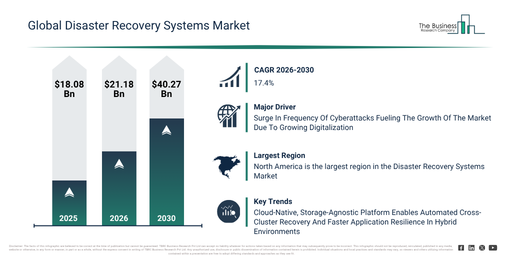
The disaster recovery systems market size has experienced rapid expansion in recent years. This market is projected to expand from $18.08 billion in 2025 to $21.18 billion in 2026, demonstrating a compound annual growth rate (CAGR) of 17.1%. Historically, this growth can be ascribed to several factors, including a rise in cyberattack occurrences, wider adoption of enterprise IT infrastructure, increased need for business continuity planning, greater reliance on digital business operations, and heightened awareness regarding data loss prevention.
The disaster recovery systems market is projected to experience significant expansion in the coming years, reaching $40.27 billion in 2030 at a compound annual growth rate (CAGR) of 17.4%. This anticipated growth during the forecast period is driven by factors such as the wider uptake of cloud disaster recovery solutions, an escalating need for automated recovery procedures, the rising imperative for robust cyber resilience strategies, a heightened emphasis on minimizing recovery time objectives, and the increasing demand for scalable disaster recovery infrastructure. Key trends identified for this period encompass the increased deployment of automated disaster recovery solutions, a growing appetite for cloud-based disaster recovery platforms, an intensified focus on swift system recovery functionalities, a rising inclination towards disaster recovery orchestration solutions, and a burgeoning demand for resilient IT infrastructure management.
Get A Free Sample Report With In-Depth Market Insights:
Disaster Recovery Systems Market Growth Factors: What’s Supporting Expansion?
The escalating incidence of cyberattacks is anticipated to stimulate the expansion of the disaster recovery systems market in the future. Cyberattacks represent intentional efforts by malicious parties to steal data, hijack user accounts, or misdirect funds through unauthorized digital access. The rise in cyberattack frequency is attributed to increasing digitalization, which broadens the attack surface and provides more avenues for hackers to exploit vulnerable systems. Disaster recovery systems empower organizations to address cyberattacks by quickly restoring essential data, applications, and infrastructure, thereby minimizing downtime, reducing data loss, and ensuring operational continuity. For example, in November 2023, the Australian Signals Directorate, an Australian government body, disclosed that Australia encountered a considerable rise in cyber threats during 2022–23, with close to 94,000 cybercrime reports submitted, indicating a 23% increase from the year before, while the financial toll of cybercrime on businesses climbed by 14% compared to the previous financial year. Therefore, the growing occurrence of cyberattacks is a key driver for the disaster recovery systems market’s growth.
Disaster Recovery Systems Market Segment Landscape: Which Areas Lead Development?
The disaster recovery systems market covered in this report is segmented –
1) By Type: Backup And Restore, Real Time Replication, Data Protection, Hosting Services, Other Types
2) By Service Type: Consulting, Managed Services, Training And Support
3) By Deployment Type: On-Premises, Cloud Based, Hybrid
4) By Organization Size: Small Enterprises, Midsize Enterprises, Large Enterprises
5) By Application: Banking, Financial Services, And Insurance, Information Technology, Government, Healthcare, Industrial And Manufacturing, Other Applications
Subsegments:
1) By Backup And Restore: Full Backup, Incremental Backup, Differential Backup, Bare Metal Recovery, Snapshot Recovery
2) By Real Time Replication: Synchronous Replication, Asynchronous Replication, Continuous Data Replication, Block Level Replication, File Level Replication
3) By Data Protection: Data Encryption, Immutable Storage, Data Archiving, Data Deduplication, Data Integrity Monitoring
4) By Hosting Services: Colocation Hosting, Managed Hosting, Virtual Private Hosting, Dedicated Server Hosting, Recovery Site Hosting
5) By Other Types: Recovery Orchestration, Failover Management, Workload Mobility, Disaster Recovery Testing, Recovery Automation Solutions
Disaster Recovery Systems Market Industry Trends: What’s Reshaping Demand?
Leading companies in the disaster recovery systems market are concentrating on developing innovative platforms, such as storage-agnostic, cloud-native disaster recovery platforms, to enhance data resilience, reduce downtime, and strengthen cyber-resilient infrastructure across hybrid and multi-cloud environments. A storage-agnostic disaster recovery platform is engineered to decouple disaster recovery processes from the underlying storage infrastructure, allowing organizations to execute backups, replication, and recovery workflows across heterogeneous storage systems without vendor lock-in, unlike traditional disaster recovery methods that are closely tied to specific hardware or proprietary storage ecosystems. For instance, in May 2026, Trilio Data Inc., a US-based cloud data protection and disaster recovery software provider, launched Trilio Site Recovery, an advanced disaster recovery solution for Red Hat OpenShift Virtualization. The platform incorporates a Kubernetes-native architecture that integrates directly with OpenShift environments, enabling application-consistent backups and automated failover across clusters. It supports policy-driven orchestration, allowing enterprises to define recovery objectives such as RPO and RTO with precise control over workloads. The solution also provides storage-agnostic operations, meaning it can execute backup and recovery workflows across various storage backends without requiring infrastructure changes. Key benefits include faster workload recovery, simplified disaster recovery management in cloud-native environments, and improved operational continuity for virtualized applications.
Disaster Recovery Systems Market Competitive Analysis Of Leading Industry Participants
Major companies operating in the disaster recovery systems market are Amazon Web Services Inc., Microsoft Corporation, Alphabet Inc., Dell Technologies Inc., Oracle Corporation, Hewlett Packard Enterprise Company, NetApp Inc., Commvault Systems Inc., Nutanix Inc., Veeam Software Corporation, Rubrik Inc., Druva Inc., Wasabi Technologies LLC, HYCU Inc., 11:11 Systems Inc., Asigra Inc., Infrascale Inc., Keepit A/S, NAKIVO Inc., FalconStor Software Inc., Acronis International GmbH, Cohesity Inc., Kaseya Limited, OpenText Corporation, Arcserve LLC
View The Full Disaster Recovery Systems Market Report:
Disaster Recovery Systems Market Geographic Distribution And Regional Opportunities
North America was the largest region in the disaster recovery systems market in 2025. Asia-Pacific is expected to be the fastest-growing region in the forecast period. The regions covered in the disaster recovery systems market report are Asia-Pacific, South East Asia, Western Europe, Eastern Europe, North America, South America, Middle East, Africa.
Reach Out To Our Team:
The Business Research Company: https://www.thebusinessresearchcompany.com/
Americas: +1 310-496-7795
Asia: +44 7882 955267 & +91 8897263534
Europe: +44 7882 955267
Email us at: marketing@tbrc.info
Follow us on:
LinkedIn: https://in.linkedin.com/company/the-business-research-company
YouTube: https://www.youtube.com/channel/UC24_fI0rV8cR5DxlCpgmyFQ
Global Market Model: https://www.thebusinessresearchcompany.com/global-market-model

Wasay has over a decade of experience in market research, data modelling, and analytics, with prior experience at GlobalData and Decision Tree Consulting Services. At The Business Research Company , he leads research operations across syndicated studies, customized consulting engagements, and the Global Market Model platform. His professional experience includes supporting organizations such as Boston Consulting Group, KPMG, and Ernst & Young. Wasay holds a degree in Electronics and Communications Engineering, postgraduate management qualifications from International Management Institute Belgium and Indian School of Business and Entrepreneurship, and completed the Integrated Program in Business Analytics from Indian Institute of Management Indore.