
Enhanced with market attractiveness analysis, total addressable market evaluation, company benchmarking matrices, interactive Excel dashboards, expanded supply chain intelligence, emerging startup coverage, and detailed product insights, The Business Research Company’s 2026 market reports deliver more actionable and strategically valuable research.
Distributed Data Grid Software Market Growth Analysis: How Will Revenue Expand During The Forecast Period?
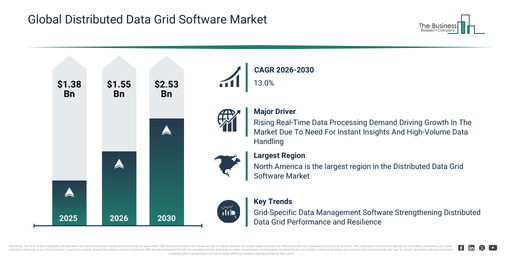
The distributed data grid software market has experienced rapid expansion in recent years. Projections indicate it will expand from $1.38 billion in 2025 to $1.55 billion in 2026, demonstrating a compound annual growth rate (CAGR) of 12.7%. Historically, this growth has been driven by several factors, including an escalating demand for real-time data processing, the widespread adoption of cloud-based applications, the expansion of IT infrastructure, rising data volumes within enterprises, and the imperative for low-latency distributed systems.
The distributed data grid software market is projected to experience substantial expansion over the upcoming years. By 2030, its value is anticipated to reach $2.53 billion, demonstrating a compound annual growth rate (CAGR) of 13.0%. Factors contributing to this growth during the forecast period include the integration with ai and ml applications, an increase in hybrid and multi-cloud deployments, a heightened emphasis on data consistency and reliability, its adoption within iot and connected ecosystem solutions, and the expansion of digital transformation initiatives in financial services and bfsi. Key trends observed throughout this period encompass in-memory data access optimization, the implementation of high availability and fault tolerance, distributed data replication and partitioning, performance monitoring and management, and data migration and integration services.
Download A Free Sample Report For Comprehensive Market Insights:
Distributed Data Grid Software Market Growth Momentum: Which Factors Are Influencing Demand?
The rising need for real-time data processing is anticipated to drive the expansion of the distributed data grid software market in the future. This type of processing involves the immediate examination and management of data the moment it is created, facilitating prompt decisions or actions. The surge in real-time data processing is mainly attributed to the quick proliferation of interconnected devices and applications that necessitate instant data analysis and rapid responses for time-critical decision-making. Distributed data grid software aids real-time data processing by retaining and overseeing information across numerous in-memory servers, allowing for swift, scalable access and modifications, thereby enabling applications to handle substantial data volumes instantaneously, free from the bottlenecks of conventional disk-based databases. As an illustration, ACI Worldwide, a US-based provider of crucial real-time payments software, reported in April 2024 that a total of 266.2 billion real-time payments transactions occurred worldwide in 2023, marking a year-over-year increase of 42.2%. Consequently, the growing demand for real-time data processing is fueling the expansion of the distributed data grid software market.
Distributed Data Grid Software Market Categorization By Product Type And Application
The distributed data grid software market covered in this report is segmented –
1) By Product: Universal Name Space, Data Transport Service, Data Access Service, In Memory Data Management Software, Data Replication Software, Data Caching Software, Real Time Data Processing Software
2) By Deployment Mode: Cloud Based, On Premise, Hybrid
3) By Organization Size: Large Enterprises, Small And Medium Sized Enterprises
4) By Application: Petroleum And Natural Gas, Ship, Aerospace, Other Applications
5) By Vertical: Banking Financial Services And Insurance, Telecommunications, Retail And E Commerce, Government And Defense, Healthcare And Life Sciences, Manufacturing, Information Technology And Telecommunication, Other Verticals
Subsegments:
1) By Universal Name Space: Global File System, Virtual File System, Namespace Virtualization, Data Federation
2) By Data Transport Service: Message Queuing, Event Streaming, Data Routing, Reliable Transport
3) By Data Access Service: Query Processing, Transaction Management, Data Indexing, Access Control
4) By In Memory Data Management Software: In Memory Database, Data Grid Platform, Cache Management, Session Management
5) By Data Replication Software: Synchronous Replication, Asynchronous Replication, Multi Site Replication, Continuous Data Protection
6) By Data Caching Software: Distributed Cache, Local Cache, Read Through Cache, Write Through Cache
7) By Real Time Data Processing Software: Stream Processing, Event Processing, Complex Event Processing, Real Time Analytics
Distributed Data Grid Software Market Trends Reshaping Industry Growth
Leading companies in the distributed data grid software market are prioritizing the development of innovative technologies, such as grid-specific data management software, to improve real-time data processing, scalability, and high-performance computing across various distributed environments. Grid-specific data management software is designed to manage and synchronize data across numerous distributed nodes, facilitating reliable and high-performance operations within a computing grid. For instance, in February 2024, GE Vernova Inc., a US-based manufacturer and provider of energy equipment services, launched a GridOS Data Fabric aimed at helping utilities manage complex energy data across transmission, distribution, and edge systems. This technology unifies siloed energy data from distributed IT or OT systems, sensors, DERs, and external sources into a single virtualized view for real-time grid orchestration, all without centralizing storage. Its primary purpose is to empower utilities with scalable, low-latency data access, fueling AI or ML applications, automation, and resilient operations amidst the growth of renewables and increasing electrification demands.
Distributed Data Grid Software Market Company Landscape And Strategic Competition
Major companies operating in the distributed data grid software market are Amazon Web Services Inc., Microsoft Corporation, International Business Machines Corporation, Oracle Corporation, SAP SE, Fujitsu Limited, VMware Inc., Software AG., Altoros Inc., TIBCO Software Inc., Apache Software Foundation, Hazelcast Inc., TmaxSoft Co. Ltd., GigaSpaces Technologies Inc., Redis Labs Inc., Alachisoft, Couchbase Inc., DataStax Inc., GridGain Systems Inc., Red Hat Inc., Kinetica DB Inc., ScaleOut Software Inc.
Access The Complete Distributed Data Grid Software Market Report:
Distributed Data Grid Software Market Global Footprint: Which Region Holds Market Leadership?
North America was the largest region in the distributed data grid software market in 2025. Asia-Pacific is expected to be the fastest-growing region in the forecast period. The regions covered in the distributed data grid software market report are Asia-Pacific, South East Asia, Western Europe, Eastern Europe, North America, South America, Middle East, Africa.
Get in touch with us:
The Business Research Company: https://www.thebusinessresearchcompany.com/
Americas: +1 310-496-7795
Asia: +44 7882 955267 & +91 8897263534
Europe: +44 7882 955267
Email us at: marketing@tbrc.info
Follow us on:
LinkedIn: https://in.linkedin.com/company/the-business-research-company
YouTube: https://www.youtube.com/channel/UC24_fI0rV8cR5DxlCpgmyFQ
Global Market Model: https://www.thebusinessresearchcompany.com/global-market-model

Wasay has over a decade of experience in market research, data modelling, and analytics, with prior experience at GlobalData and Decision Tree Consulting Services. At The Business Research Company , he leads research operations across syndicated studies, customized consulting engagements, and the Global Market Model platform. His professional experience includes supporting organizations such as Boston Consulting Group, KPMG, and Ernst & Young. Wasay holds a degree in Electronics and Communications Engineering, postgraduate management qualifications from International Management Institute Belgium and Indian School of Business and Entrepreneurship, and completed the Integrated Program in Business Analytics from Indian Institute of Management Indore.