The Business Research Company’s 2026 market reports combine market attractiveness scoring, total addressable market sizing, company benchmarking matrices, interactive Excel dashboards, deeper supply chain intelligence, emerging startup tracking, and granular product-level insights to deliver research that is more actionable and strategically valuable.
Electronic Design Automation (EDA) Tools Market Size Trajectory: Key Numbers Every Industry Stakeholder Should Know
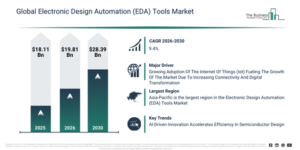
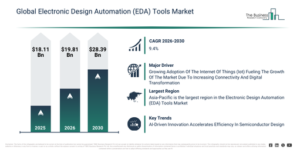
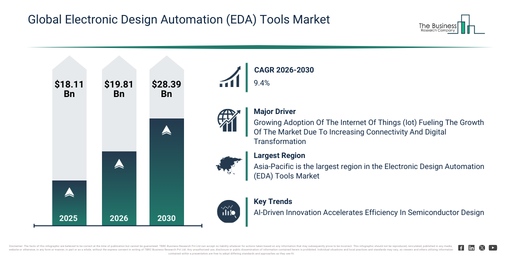
The electronic design automation (EDA) tools market has demonstrated robust growth in recent years. This market is expected to expand from $18.11 billion in 2025 to $19.81 billion in 2026, achieving a compound annual growth rate (CAGR) of 9.4%. The historical expansion of this market can be attributed to several factors, including the increasing uptake of PCB and IC design software, the rising complexity of semiconductor devices, the early adoption of design automation in both the automotive and consumer electronics industries, the demand for accelerated design cycles, and the necessity for accurate verification and simulation processes.
The electronic design automation (eda) tools market is projected to experience substantial expansion in the coming years. This market is anticipated to reach a value of $28.39 billion by 2030, exhibiting a compound annual growth rate (CAGR) of 9.4%. This projected growth is driven by factors such as the increasing adoption of cloud-based EDA, the integration of AI and machine learning into EDA tools, the rising complexity of semiconductor designs, the expanding use of electronics in the aerospace and automotive sectors, and the growing need for multi-chip module and PCB optimization. Key trends shaping this period encompass cloud-based EDA solutions, AI-powered design verification, advanced tools for high-performance PCB and MCM design, the integration of semiconductor IP cores, and sophisticated simulation and thermal analysis capabilities.
Looking For Reliable Electronic Design Automation (EDA) Tools Market Data? Request A Free Sample:
What Is Behind The Rising Demand In The Electronic Design Automation (EDA) Tools Market?
The expanding integration of the Internet of Things (IoT) is anticipated to drive forward the electronic design automation (EDA) tools market. IoT refers to a network of physical objects equipped with sensors, software, and connectivity, allowing them to gather, exchange, and process data across various environments. The surge in IoT adoption is fueled by advancements in wireless technology, edge computing, and enterprise digitization, leading to broader IoT deployment across consumer, industrial, and infrastructure sectors. EDA tools are instrumental in supporting this growth by enabling the design, verification, and testing of increasingly intricate and interconnected electronic systems, including integrated circuits and system-on-chips. For instance, in February 2023, BuildOps Inc., a US-based software-as-a-service (SaaS) company, reported that the number of IoT-connected devices grew by 28% from 2022 to 2023 and is projected to reach 16 billion by the end of 2023. Therefore, the increasing adoption of the Internet of Things (IoT) is a significant driver for the growth of the electronic design automation (EDA) tools market.
Electronic Design Automation (EDA) Tools Market Segment Coverage And Subsegment Analysis
The electronic design automation (eda) tools market covered in this report is segmented –
1) By Type: Computer-Aided Engineering (CAE), Integrated Circuit Physical Design And Verification, Printed Circuit Board And Multi-Chip Module (PCB And MCM), Semiconductor Intellectual Property (SIP), Services
2) By Deployment Modes: On-Premises, Cloud-Based
3) By End-Use: Aerospace And Defense, Automotive, Consumer Electronics, Industrial, Healthcare, Other End-Users
Subsegments:
1) By Computer-Aided Engineering (CAE): Simulation And Analysis Tools, Signal Integrity Analysis, Thermal Analysis Tools
2) By Integrated Circuit Physical Design And Verification: Place And Route Tools, Design Rule Checking (DRC) Tools, Layout Versus Schematic (LVS) Tools
3) By Printed Circuit Board And Multi-Chip Module (PCB And MCM): PCB Design Software, MCM Design Tools, Schematic Capture Tools
4) By Semiconductor Intellectual Property (SIP): Soft IP Cores, Hard IP Cores, Verification IP
5) By Services: Consulting Services, Training And Support Services, Custom Design Services
Electronic Design Automation (EDA) Tools Market Future Trends: Where Is The Industry Heading?
Leading companies operating in the electronic design automation (EDA) tools market are concentrating on developing innovative solutions, such as artificial intelligence (AI)-driven full-stack EDA suites. This focus is driven by the growing demand for quicker, more efficient, and automated semiconductor design workflows that can reduce time-to-market and improve chip performance. AI-driven EDA tools employ artificial intelligence and machine learning algorithms to optimize intricate chip design processes, automate verification, and forecast design outcomes, representing a notable advancement over traditional EDA tools which heavily rely on manual configuration and iterative simulations. As an illustration, in May 2023, Synopsys Inc., a US-based semiconductor design software company, launched SynopsysAI, positioning it as the industry’s first full-stack AI-driven EDA suite for chipmakers. SynopsysAI integrates AI throughout the entire chip design flow, covering logic design, physical design, verification, and testing, enabling designers to accelerate decision-making, optimize power, performance, and area (PPA), and decrease design iterations. Its distinctive features include AI-based predictive analysis, automated design recommendations, and adaptive learning models that consistently improve with design data, making it well-suited for designing advanced semiconductors for applications such as AI accelerators, mobile processors, and high-performance computing chips.
Electronic Design Automation (EDA) Tools Market Top Players List For 2026
Major companies operating in the electronic design automation (eda) tools market are Siemens AG; Intel Corporation; Arrow company; Agnisys Inc.; Keysight Technologies Inc.; Synopsys Inc.; Cadence Design Systems Inc.; Forte Design Systems; Xilinx Inc.; ANSYS Inc.; Microsemi Corporation; National Instruments Corporation; JEDA Technologies Inc.; Mentor Graphic Corporation; Altair Engineering Inc.; AWR Corporation; Faraday&Future Inc.; Zuken Inc.; Magwel NV; Altium Limited; Silvaco Inc.; Lauterbach GmbH; Computer Simulation Technology AG; EnSilica Limited; Aldec Inc.; EMA Design Automation Inc.; ELECTRO-SYSTEM CO. LTD.; MunEDA GmbH; Intercept Technology Inc.; Labcenter Electronics Ltd.; Pulsic Limited
Order Your Copy Of The Electronic Design Automation (EDA) Tools Market Report 2026:
How Does The Electronic Design Automation (EDA) Tools Market Vary By Region?
Asia-Pacific was the largest region in the electronic design automation (EDA) tools market in 2025. It is expected to be the fastest-growing region in the forecast period. The regions covered in the electronic design automation (eda) tools market report are Asia-Pacific, South East Asia, Western Europe, Eastern Europe, North America, South America, Middle East, Africa.
Reach Out To Our Team:
The Business Research Company: https://www.thebusinessresearchcompany.com/
Americas: +1 310-496-7795
Asia: +44 7882 955267 & +91 8897263534
Europe: +44 7882 955267
Email us at: marketing@tbrc.info
Follow us on:
LinkedIn: https://in.linkedin.com/company/the-business-research-company
YouTube: https://www.youtube.com/channel/UC24_fI0rV8cR5DxlCpgmyFQ
Global Market Model: https://www.thebusinessresearchcompany.com/global-market-model

Wasay has over a decade of experience in market research, data modelling, and analytics, with prior experience at GlobalData and Decision Tree Consulting Services. At The Business Research Company , he leads research operations across syndicated studies, customized consulting engagements, and the Global Market Model platform. His professional experience includes supporting organizations such as Boston Consulting Group, KPMG, and Ernst & Young. Wasay holds a degree in Electronics and Communications Engineering, postgraduate management qualifications from International Management Institute Belgium and Indian School of Business and Entrepreneurship, and completed the Integrated Program in Business Analytics from Indian Institute of Management Indore.