Through market attractiveness analysis, total addressable market evaluation, company benchmarking matrices, interactive Excel dashboards, expanded supply chain intelligence, emerging startup coverage, and detailed product insights, The Business Research Company’s 2026 market reports provide more actionable and strategically valuable research.
#Electronic Design Automation (EDA) Market Size And Revenue Forecast Through 2030
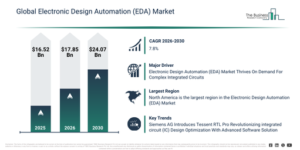
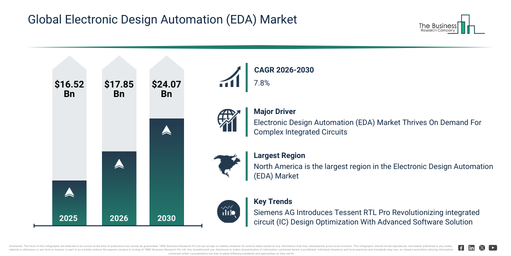
The electronic design automation (eda) market has shown strong growth in recent years. It is anticipated to increase from $16.52 billion in 2025 to $17.85 billion in 2026, reflecting a compound annual growth rate (CAGR) of 8.1%. The growth observed in the past can be attributed to several factors: a greater adoption of integrated circuit design tools, the escalating complexity of PCB and MCM systems, the early integration of software in automotive and consumer electronics, a consistent demand for design reusability, and the crucial requirement for faster time-to-market.
The electronic design automation (eda) market is projected to experience robust expansion over the coming years. Its valuation is set to reach $24.07 billion by 2030, demonstrating a compound annual growth rate (CAGR) of 7.8%. This anticipated growth is largely driven by factors such as the increasing embrace of cloud-based EDA solutions, the incorporation of AI into design verification processes, the surging demand within the semiconductor industry, the broadening scope of automotive and aerospace electronics, and the escalating intricacy of multi-chip modules. Key trends identified for this period encompass sophisticated verification and testing instruments, automation and reusability in design rules, cloud-based EDA platforms, seamless integration with semiconductor IP libraries, and solutions for designing high-performance PCBs and MCMs.
Download A Free Sample Report For Comprehensive Market Insights:
Electronic Design Automation (EDA) Market Growth Momentum: Which Factors Are Influencing Demand?
The electronic design automation (EDA) market is anticipated to expand due to the rising demand for sophisticated integrated circuits (ICs). These complex ICs are miniature electronic components comprising interconnected elements such as resistors, transistors, and capacitors, all fabricated on a unified semiconductor substrate, for example, silicon. EDA tools assist engineers in managing the intricate process of creating advanced integrated circuits, guaranteeing that their functionality, performance, and manufacturability adhere to required standards. Such tools are capable of compiling, analyzing, and simulating Hardware Description Language (HDL) descriptions to confirm design accuracy and compliance with specifications. Illustratively, global semiconductor sales reached $53.1 billion in August 2024, as reported in October 2024 by the Semiconductor Industry Association (SIA), a US-based trade association and lobbying group. This figure signifies a 20.6% increase when contrasted with the $44.0 billion recorded in August 2023, and a 3.5% rise from the $51.3 billion attained in July 2024. Consequently, the growing need for complex integrated circuits (ICs) is fueling the expansion of the electronic design automation market.
Electronic Design Automation (EDA) Market Segmentation And Category Breakdown
The electronic design automation (eda) market covered in this report is segmented –
1) By Type: Computer Aided Engineering (CAE), Semiconductor Intellectual Property (SIP), Integrated Circuit (IC) Physical Design And Verification, Printed Circuit Board (PCB) And Multi-Chip Module (MCM)
2) By Deployment Mode: Cloud-Based, On-Premises
3) By Application: Microprocessors And Microcontrollers, Memory Management Units, Other Applications
4) By End User: Automotive Industry, Healthcare Industry, Aerospace And Defense Industry, Telecom And Data Centre Industry, Consumer Electronics Industry, Industrial Sector, Other End-Users
Subsegments:
1) By Computer Aided Engineering (CAE): Simulation Software, Analysis Tools, Testing And Validation Tools
2) By Semiconductor Intellectual Property (SIP): Soft IP, Hard IP, Mixed-Signal IP
3) By Integrated Circuit (IC) Physical Design And Verification: Layout Design Tools, Place And Route Tools, Design Rule Checking (DRC) Tools, Layout Versus Schematic (LVS) Tools
4) By Printed Circuit Board (PCB) And Multi-Chip Module (MCM): PCB Design Tools, MCM Design Tools, Design For Manufacturing (DFM) Tools, Schematic Capture Tools
Electronic Design Automation (EDA) Market Growth Trends Influencing Competitive Dynamics
Leading firms within the electronic design automation (EDA) market are crafting novel solutions, including Tessent RTL Pro, to achieve a market advantage. This software, Tessent RTL Pro, serves as a tool intended to assist integrated circuit (IC) design teams in optimizing and speeding up numerous essential design-for-test (DFT) operations for their upcoming designs. An example of this is Siemens AG, a German automation enterprise involved in product design, development, and manufacturing, which introduced its advanced software solution, Tessent RTL Pro, in October 2023. The cutting-edge software automates the early-stage analysis and integration of test points, wrapper cells, and x-bounding logic within the design process, allowing engineers to pinpoint and resolve testability concerns during the initial design phases. When utilized alongside Siemens’ Tessent DFT tools, Tessent RTL Pro provides unparalleled functionality, thereby enabling clients to decrease design turnaround time and enhance their speed to market.
Electronic Design Automation (EDA) Market Competitive Analysis Of Major Industry Participants
Major companies operating in the electronic design automation (eda) market are Siemens AG; Oracle Corporation; SAP SE; Advanced Micro Devices Inc.; Dassault Systemes; Keysight Technologies Inc.; Synopsys Inc.; Autodesk Inc.; Cadence Design Systems Inc.; Werner Enterprises; Xilinx Inc.; Ansys Inc.; National Instruments Corp.; MathWorks Inc.; eInfochips Private Limited; Mentor Graphics Corporation; Altium Limited; BluJay Solutions Ltd.; Zuken Inc.; Silvaco Inc.; Aldec Inc.; Agnisys Inc.; Labcenter Electronics Ltd.; Intercept Technology Inc.; Sigasi NV; Altair Engineering Inc.; Boldport Limited; Dolphin Design; EasyEDA; EnSilica plc; Eremex Ltd.
Access The Complete Electronic Design Automation (EDA) Market Report:
Electronic Design Automation (EDA) Market Global Footprint: Which Region Holds Market Leadership?
North America was the largest region in the electronic design automation (EDA) market in 2025. Asia-Pacific is expected to be the fastest-growing region in the forecast period. The regions covered in the electronic design automation (eda) market report are Asia-Pacific, South East Asia, Western Europe, Eastern Europe, North America, South America, Middle East, Africa.
Get in touch with us:
The Business Research Company: https://www.thebusinessresearchcompany.com/
Americas: +1 310-496-7795
Asia: +44 7882 955267 & +91 8897263534
Europe: +44 7882 955267
Email us at: marketing@tbrc.info
Follow us on:
LinkedIn: https://in.linkedin.com/company/the-business-research-company
YouTube: https://www.youtube.com/channel/UC24_fI0rV8cR5DxlCpgmyFQ
Global Market Model: https://www.thebusinessresearchcompany.com/global-market-model

Wasay has over a decade of experience in market research, data modelling, and analytics, with prior experience at GlobalData and Decision Tree Consulting Services. At The Business Research Company , he leads research operations across syndicated studies, customized consulting engagements, and the Global Market Model platform. His professional experience includes supporting organizations such as Boston Consulting Group, KPMG, and Ernst & Young. Wasay holds a degree in Electronics and Communications Engineering, postgraduate management qualifications from International Management Institute Belgium and Indian School of Business and Entrepreneurship, and completed the Integrated Program in Business Analytics from Indian Institute of Management Indore.