Featuring market attractiveness scoring, total addressable market sizing, company benchmarking matrices, interactive Excel dashboards, deeper supply chain intelligence, emerging startup tracking, and granular product-level insights, The Business Research Company’s 2026 market reports are built to deliver research that is both more actionable and more strategically valuable.
Electronic Services Market Growth From $276.48 Billion In 2026 To $487.36 Billion By 2030 At A CAGR Of 15.2%
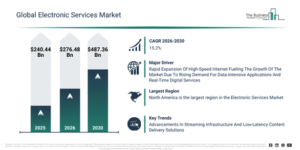
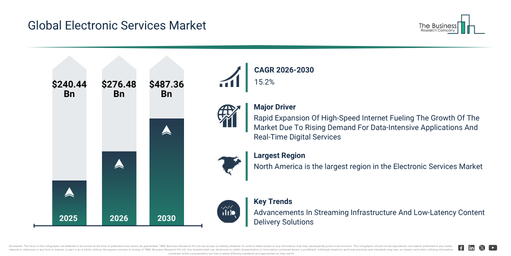
The electronic services market has seen a rapid expansion in its size over recent years. It is forecast to expand from $240.44 billion in 2025 to reach $276.48 billion in 2026, demonstrating a compound annual growth rate (CAGR) of 15.0%. This historical growth can be attributed to several factors including the increasing spread of internet penetration, the rising adoption of mobile devices, the evolution of the digital payment ecosystem, the emergence of e-commerce platforms, and various enterprise digitization initiatives.
The electronic services market size is anticipated to undergo significant expansion in the coming years. This market is projected to attain a valuation of $487.36 billion by 2030, fueled by a compound annual growth rate (CAGR) of 15.2%. The expansion during the forecast period is primarily driven by the increasing application of AI-powered digital service automation, growing demand for real-time service delivery, the rise of subscription-based digital ecosystems, increasing integration of cloud-native platforms, and the widespread adoption of connected devices and mobile applications. Prominent trends expected in this period include AI-driven automated digital service delivery, hyper-personalization within electronic services, the development of cloud-native service orchestration platforms, the integration of omnichannel digital service experiences, and real-time API-based service ecosystems.
Get A Free Sample Report With In-Depth Market Insights:
Electronic Services Market Growth Momentum: What Factors Are Shaping Demand?
The increasing availability of high-speed internet is anticipated to fuel the expansion of the electronic services market in the future. This type of internet connection offers rapid and dependable access, facilitating quick data transfers, smooth streaming, efficient browsing, and instant digital interactions. The proliferation of high-speed internet is primarily due to the extensive rollout of fiber-optic and 5G networks, which provide enhanced speed and reliability. Electronic services leverage high-speed internet to ensure swift and consistent access to digital platforms, thereby enhancing service provision, facilitating immediate communication, and enabling effective data exchange across various online applications. A notable example, as reported by Ookla LLC, a US-based network intelligence company, in December 2023, is the median 5G download speed experiencing a substantial 20% increase in the third quarter of 2023, climbing to 203.04 Mbps from 168.27 Mbps observed in the third quarter of 2022. Consequently, the rapid growth of high-speed internet is a key factor propelling the electronic services market forward.
Electronic Services Market Segmentation: How Does The Market Break Down By Category?
The electronic services market covered in this report is segmented –
1) By Service Type: Digital Content Delivery Services, Online Entertainment Services, Electronic Information Services, Cloud-Based Consumer Applications, Communication And Collaboration Services, E-Commerce And Transactional Services, Digital Financial Services, Value-Added Digital Services
2) By Related Goods And Hardware: Connected Devices, Proprietary Gaming Hardware, Bundled Networking Equipment (Routers, Modems), Internet of Things (IoT) And Wearable Peripherals
3) By Platform Or Access Channel: Web-Based Services, Mobile-Based Services, Connected Device Services, Multi-Platform Services
4) By Monetization Model: Subscription-Based Services, Advertisement-Supported Services, Transaction-Based Services, Freemium Services, Licensing-Based Services
5) By End-User Type: Individual Consumers (B2C), Professional And Enterprise Users (B2B), Institutional And Government Entities
Subsegments:
1) By Digital Content Delivery Services: Video Streaming Services, Music Streaming Services, Digital Publishing Services, E Book Distribution Services, Online News Distribution Services, Podcast Distribution Services
2) By Online Entertainment Services: Online Gaming Services, Live Streaming Entertainment Services, Virtual Event Services, Interactive Entertainment Platforms, Digital Media Sharing Services
3) By Electronic Information Services: Online Data Information Services, Digital Library Services, Research And Analytics Services, Online Educational Content Services, Information Aggregation Services
4) By Cloud-Based Consumer Applications: Cloud Storage Services, Online Productivity Applications, Personal Finance Management Applications, Cloud Photo And Video Management Applications, Cloud Based Learning Applications
5) By Communication And Collaboration Services: Instant Messaging Services, Video Conferencing Services, Email Communication Services, Team Collaboration Platforms, File Sharing And Collaboration Services
6) By E-Commerce And Transactional Services: Online Retail Services, Online Marketplace Platforms, Digital Booking Services, Online Auction Services, Subscription Based Commerce Services
7) By Digital Financial Services: Online Banking Services, Mobile Payment Services, Digital Wallet Services, Peer To Peer Payment Services, Online Investment Services
8) By Value-Added Digital Services: Digital Advertising Services, Location Based Services, Personalization And Recommendation Services, Cybersecurity Services For Consumers, Loyalty And Rewards Program Services
Electronic Services Market Trends Redefining Industry Growth
Leading entities within the electronic services sector are prioritizing the creation of sophisticated tools, notably content delivery networks, to meet the increasing need for superior digital media offerings. A content delivery network functions as a dispersed server infrastructure, ensuring rapid and effective delivery of digital content to users by channeling it via geographically proximate points. An illustrative example is from March 2026, when Synamedia Ltd., a software firm from the UK, collaborated with Monitorización y Medidas S.L. (MoMe), an engineering company based in Spain. Together, they launched their inaugural streaming-centric content delivery network (CDN) service, leveraging Fluid EdgeCDN technology. This solution is a proprietary, flexible CDN specifically engineered for video streaming. It offers complete transparency throughout the delivery pipeline, from the source to the end-user. Its AI-driven traffic forecasting allows for scalability ranging from 500Gbps to over 5 Tbps, with edge servers positioned near users to guarantee minimal latency and robust performance, even at the final delivery stage. Furthermore, the system integrates seamlessly into existing streaming workflows, encompassing content processing functionalities such as ingesting, encoding, and packaging at the network’s periphery. Concurrently, it upholds enterprise-level security, consistent with European data protection standards. This innovation eradicates the intricacies and expenses associated with broad-spectrum global CDNs, thereby offering broadcasters and OTT platforms cost predictability, superior operational command, and an improved quality of experience, all without the necessity of engaging numerous suppliers.
Electronic Services Market Key Players Shaping Industry Direction
Major companies operating in the electronic services market are Amazon.com Inc.; Apple Inc.; Alphabet Inc.; Microsoft Corporation; Tencent Holdings Ltd.; The Walt Disney Company; Cisco Systems Inc.; Oracle Corporation; Warner Bros. Discovery Inc.; Salesforce Inc.; SAP SE; Netflix Inc.; Adobe Inc.; Baidu Inc.; Spotify Technology S.A.; Zoom Video Communications Inc.; iQIYI Inc.; Atlassian Corporation Plc; Dropbox Inc.; Synamedia Ltd.; MediaKind.
View The Full Electronic Services Market Report:
Electronic Services Market Regional Analysis: Which Geography Leads On Revenue?
North America was the largest region in the electronic services market in 2025. Asia-Pacific is expected to be the fastest-growing region in the forecast period. The regions covered in the electronic services market report are Asia-Pacific, South East Asia, Western Europe, Eastern Europe, North America, South America, Middle East, Africa.
Reach Out To Our Team:
The Business Research Company: https://www.thebusinessresearchcompany.com/
Americas: +1 310-496-7795
Asia: +44 7882 955267 & +91 8897263534
Europe: +44 7882 955267
Email us at: marketing@tbrc.info
Follow us on:
LinkedIn: https://in.linkedin.com/company/the-business-research-company
YouTube: https://www.youtube.com/channel/UC24_fI0rV8cR5DxlCpgmyFQ
Global Market Model: https://www.thebusinessresearchcompany.com/global-market-model

Wasay has over a decade of experience in market research, data modelling, and analytics, with prior experience at GlobalData and Decision Tree Consulting Services. At The Business Research Company , he leads research operations across syndicated studies, customized consulting engagements, and the Global Market Model platform. His professional experience includes supporting organizations such as Boston Consulting Group, KPMG, and Ernst & Young. Wasay holds a degree in Electronics and Communications Engineering, postgraduate management qualifications from International Management Institute Belgium and Indian School of Business and Entrepreneurship, and completed the Integrated Program in Business Analytics from Indian Institute of Management Indore.