The Business Research Company’s 2026 market reports combine market attractiveness scoring, total addressable market sizing, company benchmarking matrices, interactive Excel dashboards, deeper supply chain intelligence, emerging startup tracking, and granular product-level insights to deliver research that is more actionable and strategically valuable.
Embodied Artificial Intelligence (AI) Market Size Review: What Shaped Past Growth And What Will Drive Future Expansion?
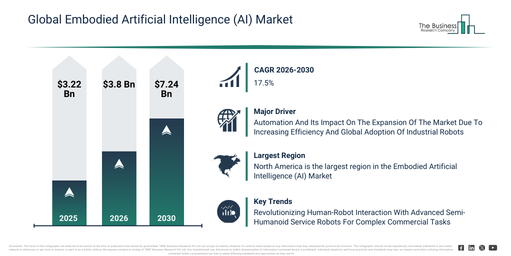
The embodied artificial intelligence (AI) market size has experienced rapid expansion in recent years. It is projected to increase from $3.22 billion in 2025 to $3.8 billion in 2026, exhibiting a compound annual growth rate (CAGR) of 18.1%. The growth observed in prior periods can be attributed to a rise in robotics adoption, increased demand for automation, expanded AI research funding, advancements in embedded computing hardware, and the growing utilization of smart sensors.
The embodied artificial intelligence (AI) market is anticipated to experience significant expansion over the coming years. Its valuation is projected to reach $7.24 billion by 2030, demonstrating a compound annual growth rate (CAGR) of 17.5%. This projected increase during the forecast period is driven by factors such as the integration of advanced robotics platforms, the increasing uptake of autonomous mobility solutions, the broadening use of robotics in healthcare, the advancement of intelligent logistics automation, and the implementation of human augmentation technologies. Key trends shaping this period encompass sophisticated human-robot interaction, the integration of multi-sensor fusion, adaptive learning within physical settings, the deployment of collaborative robots, and real-time environmental perception.
Access Free Sample Pages From The Embodied Artificial Intelligence (AI) Market Report 2026:
Understanding The Main Driver Of The Embodied Artificial Intelligence (AI) Market
The growing need for automation across diverse industries is set to fuel the expansion of the embodied artificial intelligence (AI) market in the coming years. Automation refers to the application of technology and control systems to perform tasks autonomously, typically enhancing efficiency, accuracy, and overall productivity. The heightened demand for automation is largely attributable to labor shortages, as many sectors face challenges in finding skilled workers, prompting businesses to adopt automated systems to maintain output and reduce dependency on human labor. Embodied artificial intelligence augments automation by integrating a physical presence and sensory perception, which allows machines to interact with and adjust to their environment spontaneously for more effective and autonomous decision-making. For instance, in September 2023, the International Federation of Robotics, a Germany-based non-profit organization, stated that annual industrial robot installations reached 290,258 units in 2023, surpassing the previous record established in 2021 with a 5% growth. Thus, the increasing demand for automation across industries is a key driver for the growth of the embodied artificial intelligence (AI) market.
Embodied Artificial Intelligence (AI) Market Segment Mapping For 2026 And Beyond
The embodied artificial intelligence (AI) market covered in this report is segmented –
1) By Component: Hardware, Software, Services
2) By Function: Real-Time, Standalone, Mobile, Networked
3) By System Size: Small Size, Medium Size, Large Size
4) By End-Use Industry: Automotive, Consumer Electronics, Aerospace And Defense, Healthcare, Telecommunication, Industrial, Other End-Use Industries
Subsegments:
1) By Hardware: Microcontrollers (MCUs), Microprocessors (MPUs), Digital Signal Processors (DSPs), Application-Specific Integrated Circuits (ASICs), Field-Programmable Gate Arrays (FPGAs), Sensors, Power Management ICs
2) By Software: Real-Time Operating Systems (RTOS), Embedded Software Development Tools, Middleware, Firmware
3) By Services: Design And Development Services, Consulting Services, Maintenance And Support Services
What Key Trend Is Expected To Shape The Embodied Artificial Intelligence (AI) Market Over The Forecast Period?
Leading firms within the embodied artificial intelligence (AI) market are concentrating on creating sophisticated technological solutions, including semi-humanoid embodied AI service robots, aimed at improving human-robot interaction and streamlining automation across diverse sectors. A semi-humanoid embodied AI service robot represents a robotic system engineered with human-like characteristics and functionalities, utilizing artificial intelligence to execute particular tasks or services in real-world settings, possessing a partial human-like physical form and interactive capacities. For example, in March 2025, Pudu Robotics, a commercial entity based in China, introduced a FlashBot Arm, which is engineered to autonomously carry out intricate delivery and manipulation operations in commercial contexts, thereby boosting efficiency and user engagement. This particular robot is equipped with two 7-degree-of-freedom robotic arms complemented by dexterous 11-degree-of-freedom hands, which allows it to execute precise manipulation activities like button-pressing, object-grasping, and autonomous deliveries, with an operational reach extending up to 2 meters. It integrates advanced embodied AI for capabilities such as real-time perception, decision-making, natural multimodal interaction, alongside high-precision sensors, and whole-body control, rendering it exceptionally adaptable and secure for intricate commercial environments including hotels, offices, and healthcare establishments.
Embodied Artificial Intelligence (AI) Market Major Players And Industry Competition Overview
Major companies operating in the embodied artificial intelligence (AI) market are Samsung Electronics Co. Ltd., DeepMind Technologies, Toshiba Corporation, NVIDIA Corporation, KUKA AG, Ocado Group plc, Unity Technologies Inc., UBTECH Robotics, Boston Dynamics Inc., Applied Intuition Inc., Avidbots Corp., Robotiq, Covariant.AI Inc., Apptronik Systems Inc., Keppler Robotics Inc., Agility Robotics Inc., Hanson Robotics Limited, Blue Frog Robotics SAS, PAL Robotics S.L.
Full Embodied Artificial Intelligence (AI) Market Report: Market Size, Trends, Segments And Key Players:
Embodied Artificial Intelligence (AI) Market Geographic Segmentation: Regions Covered In The Report
North America was the largest region in the embodied artificial intelligence (AI) market in 2025. The regions covered in the embodied artificial intelligence (AI) market report are Asia-Pacific, South East Asia, Western Europe, Eastern Europe, North America, South America, Middle East, Africa.
Reach Out To Our Team:
The Business Research Company: https://www.thebusinessresearchcompany.com/
Americas: +1 310-496-7795
Asia: +44 7882 955267 & +91 8897263534
Europe: +44 7882 955267
Email us at: marketing@tbrc.info
Follow us on:
LinkedIn: https://in.linkedin.com/company/the-business-research-company
YouTube: https://www.youtube.com/channel/UC24_fI0rV8cR5DxlCpgmyFQ
Global Market Model: https://www.thebusinessresearchcompany.com/global-market-model

Wasay has over a decade of experience in market research, data modelling, and analytics, with prior experience at GlobalData and Decision Tree Consulting Services. At The Business Research Company , he leads research operations across syndicated studies, customized consulting engagements, and the Global Market Model platform. His professional experience includes supporting organizations such as Boston Consulting Group, KPMG, and Ernst & Young. Wasay holds a degree in Electronics and Communications Engineering, postgraduate management qualifications from International Management Institute Belgium and Indian School of Business and Entrepreneurship, and completed the Integrated Program in Business Analytics from Indian Institute of Management Indore.