
Backed by market attractiveness analysis, total addressable market sizing, company benchmarking matrices, interactive Excel dashboards, wider supply chain intelligence, emerging startup coverage, and detailed product-level insights, The Business Research Company’s 2026 market reports are designed to offer research that is more actionable and strategically valuable than ever.
Enterprise Architecture Software Market Value Analysis: What Growth Lies Ahead Over The Forecast Period?
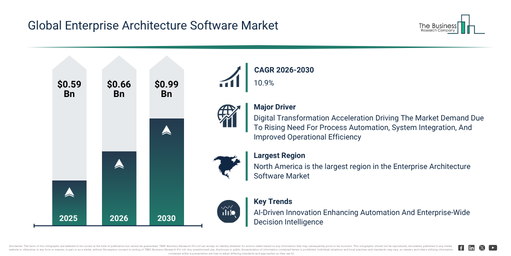
The enterprise architecture software market has witnessed significant expansion in recent years. It is anticipated to expand from $0.59 billion in 2025 to $0.66 billion in 2026, achieving a compound annual growth rate (CAGR) of 10.6%. The historical growth can be ascribed to the increasing complexity of enterprise IT environments, the growing necessity for business and technology alignment, the expanding adoption of digital transformation initiatives, the rising demand for structured IT governance, and the increasing requirement for improved enterprise planning and decision making.
The enterprise architecture software market is projected to experience substantial expansion over the upcoming years. This market is set to reach $0.99 billion by 2030, exhibiting a compound annual growth rate (CAGR) of 10.9%. The anticipated expansion during this period stems from the heightened uptake of cloud-based enterprise architecture solutions, a rising demand for AI-powered architecture analysis tools, an increasing emphasis on organizational agility and scalability, the growing requirement for real-time technology portfolio management, and the expanded implementation of automated governance and compliance solutions. Key developments expected throughout the forecast horizon encompass a wider embrace of enterprise architecture modeling platforms, a surging need for business and IT alignment tools, an amplified concentration on enterprise digital transformation strategies, greater incorporation of automated architecture management utilities, and an expanding inclination towards unified IT governance structures.
Get A Free Sample Report With In-Depth Market Insights:
Enterprise Architecture Software Market Industry Drivers: What’s Behind The Revenue Growth?
The rising number of digital transformation initiatives across various sectors is expected to propel the growth of the enterprise architecture software market going forward. These initiatives involve integrating digital technologies into business operations to enhance productivity, foster innovation, and improve service delivery. Digital transformation is increasingly adopted across industries primarily to boost operational efficiency by automating processes, reducing costs, and enabling faster, more accurate decision-making. Enterprise architecture software supports these transformation efforts by providing a structured framework to align IT systems with business goals, thereby enabling organizations to standardize processes, integrate technologies, improve visibility across operations, and make more informed decisions for efficient and scalable transformation. For instance, in May 2023, according to the U.S. Department of Defense (DoD), a US-based federal government agency, the DoD’s total IT and cyberspace activities budget rose from $53.0 billion in fiscal year (FY) 2022 to $55.1 billion in fiscal year (FY) 2023. A further request of $58.4 billion was made for FY2024, reflecting a sustained year-on-year increase in digital modernization investment. Therefore, the increasing digital transformation initiatives across industries are driving the growth of the enterprise architecture software market.
Enterprise Architecture Software Market Segment Performance And Emerging Opportunities
The enterprise architecture software market covered in this report is segmented –
1) By Component: Software, Services
2) By Deployment: Cloud Based, On Premises, Hybrid
3) By Organization Size: Large Enterprises, Small And Medium Enterprises
4) By Application: Information Technology Portfolio Management, Digital Transformation Planning, Risk And Compliance Management, Business Process Management, Strategic Planning And Governance, Infrastructure Management
5) By End User: Banking, Financial Services And Insurance, Information Technology And Telecommunications, Government And Public Sector, Healthcare And Life Sciences, Manufacturing, Retail And Electronic Commerce, Energy And Utilities, Transportation And Logistics, Education, Other End Users
Subsegments:
1) By Software: Enterprise Architecture Modeling Tools, Repository Management Solutions, Application Portfolio Management Software, Business Process Analysis Software, Technology Portfolio Management Software, Governance Risk And Compliance Solutions, Strategic Planning And Roadmapping Tools, Data Architecture Management Software
2) By Services: Consulting Services, Implementation Services, Integration Services, Training And Education Services, Support And Maintenance Services, Managed Services, Migration Services, Customization Services
Enterprise Architecture Software Market Trends Shaping Long-Term Demand
Leading firms within the enterprise architecture software market are prioritizing the creation of advanced solutions, specifically AI-enabled enterprise architecture capabilities, to boost automation, elevate visibility across the enterprise, and facilitate quicker strategic IT decisions. These AI-powered capabilities involve incorporating artificial intelligence into enterprise architecture platforms to automate the mapping of systems, examine IT environments, and produce foresighted insights for aligning business and technology. As an example, in May 2026, Ardoq AS, a software firm based in Norway, introduced its AI-first Enterprise Architecture Platform, which aims to simplify architecture modeling and improve the intelligence behind decisions. This platform provides advantages including greater data precision, more rapid architecture revisions, and heightened transparency within organizations. Its objective is to assist clients in expediting digital transformation and refining IT-business synchronization, concurrently fostering the increasing integration of AI into enterprise architecture management practices.
Enterprise Architecture Software Market Key Players: Which Companies Lead Industry Competition?
Major companies operating in the enterprise architecture software market are International Business Machines Corporation, Oracle Corporation, SAP SE, ServiceNow Inc., Open Text Corporation, Quest Software Inc., Planview Inc., Orbus Software Ltd., Bizzdesign B.V., Avolution Pty Ltd, Clausmark Software, Ardoq AS, QualiWare ApS, ValueBlue B.V., Sparx Systems Pty Ltd, Dragon1 Inc., Modeliosoft, Software AG, BOC Group, Collibra, Flexera
View The Full Enterprise Architecture Software Market Report:
Enterprise Architecture Software Market Regional Analysis And Top Geography
North America was the largest region in the enterprise architecture software market in 2025. Asia-Pacific is expected to be the fastest-growing region in the forecast period. The regions covered in the enterprise architecture software market report are Asia-Pacific, South East Asia, Western Europe, Eastern Europe, North America, South America, Middle East, Africa.
Reach Out To Our Team:
The Business Research Company: https://www.thebusinessresearchcompany.com/
Americas: +1 310-496-7795
Asia: +44 7882 955267 & +91 8897263534
Europe: +44 7882 955267
Email us at: marketing@tbrc.info
Follow us on:
LinkedIn: https://in.linkedin.com/company/the-business-research-company
YouTube: https://www.youtube.com/channel/UC24_fI0rV8cR5DxlCpgmyFQ
Global Market Model: https://www.thebusinessresearchcompany.com/global-market-model

Wasay has over a decade of experience in market research, data modelling, and analytics, with prior experience at GlobalData and Decision Tree Consulting Services. At The Business Research Company , he leads research operations across syndicated studies, customized consulting engagements, and the Global Market Model platform. His professional experience includes supporting organizations such as Boston Consulting Group, KPMG, and Ernst & Young. Wasay holds a degree in Electronics and Communications Engineering, postgraduate management qualifications from International Management Institute Belgium and Indian School of Business and Entrepreneurship, and completed the Integrated Program in Business Analytics from Indian Institute of Management Indore.