
Delivering more actionable and strategically valuable research, The Business Research Company’s 2026 market reports feature market attractiveness analysis, total addressable market evaluation, company benchmarking matrices, interactive Excel dashboards, expanded supply chain intelligence, emerging startup coverage, and detailed product insights.
Enterprise Large Language Models (LLM) Market CAGR Analysis And Future Market Development
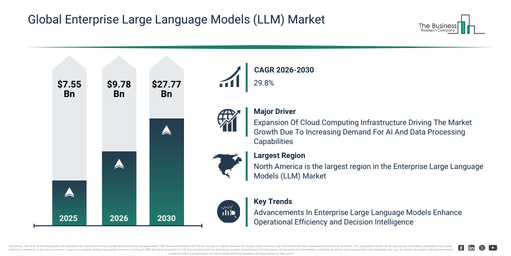
The market for enterprise large language models (LLM) has experienced substantial growth in recent years. It is forecast to increase from $7.55 billion in 2025 to $9.78 billion in 2026, achieving a compound annual growth rate (CAGR) of 29.6%. This historical growth can be attributed to increasing enterprise data digitization, growth in cloud-based enterprise software adoption, rising demand for advanced analytics and automation, expansion of enterprise AI pilot programs, and the availability of high-performance computing infrastructure.
The enterprise large language models (llm) market is anticipated to experience substantial growth in the upcoming years, with its valuation projected to reach $27.77 billion by 2030, driven by a compound annual growth rate (CAGR) of 29.8%. This expansion during the forecast period is attributable to factors such as increased regulatory scrutiny over AI implementation, rising investments in enterprise AI platforms, the expanding adoption of generative AI across various business functions, the proliferation of hybrid and on-premises AI deployments, and a growing demand for explainable and auditable AI systems. Significant trends in this period are expected to include the increasing embrace of domain-specific enterprise llms, a heightened demand for secure and private model deployment solutions, a stronger emphasis on AI governance and compliance tools, the broadening of llm orchestration and monitoring platforms, and a greater integration of multilingual enterprise language systems.
Download A Free Sample Report For Comprehensive Market Insights:
Enterprise Large Language Models (LLM) Market Development Factors: Which Trends Are Supporting Demand?
Moving forward, the expanding cloud computing infrastructure is anticipated to boost the growth of the enterprise large language model (LLM) market. This infrastructure encompasses the hardware and software elements, including servers, storage systems, networking equipment, and data centers, which facilitate the provision of computing services via the internet. Its growth is fueled by the swift integration of artificial intelligence applications, which demand substantial computational power and scalable resources that conventional on-premises setups struggle to supply efficiently. A larger cloud infrastructure allows organizations to effectively deploy and scale large language models, offering the essential computational resources, storage capacity, and processing capabilities needed for both training and operating advanced AI models. For example, in March 2025, the Office for National Statistics, a UK-based government department, reported that in 2023, 9% of firms had adopted artificial intelligence (AI), whereas 69% of firms in the UK had embraced cloud-based computing systems and applications. Consequently, the proliferation of cloud computing infrastructure is a key factor propelling the expansion of the enterprise large language models market.
#Enterprise Large Language Models (LLM) Market Segment Landscape And Growth Potential
The enterprise large language models (llm) market covered in this report is segmented –
1) By Component: Software; Hardware; Services
2) By Deployment Mode: Cloud; On-Premises; Hybrid
3) By Model Type: General-Purpose Large Language Models (LLMs); Domain-Specific Large Language Models (LLMs); Custom Or Proprietary Large Language Models (LLMs)
4) By Enterprise Size: Small And Medium Size; Large Enterprises
5) By Industry Vertical: Banking, Financial Services, And Insurance (BFSI); Healthcare; Retail And E-Commerce; Legal And Compliance; Manufacturing; Other Industry Verticals
Subsegments:
1) By Software: Natural Language Processing Platforms; Model Training And Fine Tuning Tools; Application Programming Interfaces And Integration Tools; Enterprise Knowledge Management Software; Monitoring And Governance Software
2) By Hardware: High Performance Computing Servers; Graphics Processing Unit Accelerators; Tensor Processing Unit Accelerators; Data Storage And Memory Systems; Edge Computing Infrastructure
3) By Services: Consulting And Strategy Services; Model Customization And Fine Tuning Services; System Integration Services; Managed And Support Services; Training And Capability Development Services
Enterprise Large Language Models (LLM) Market Transformation Trends: Which Innovations Are Driving Change?
Companies active in the enterprise large language model market are focusing on technological advancements, such as creating industry-specific large language models for insurance, to elevate claims processing accuracy and improve adherence to regulatory standards. Industry-specific large language models are defined as those fine-tuned with meticulously gathered, domain-relevant data to execute specialized functions within a particular industry, thereby enabling more exact data interpretation, automated workflows, and superior decision-making. For instance, in September 2024, EXL, a US-based data analytics and digital operations company, unveiled the EXL Insurance Large Language Model, engineered to handle tasks including claims reconciliation, data extraction, anomaly detection, and question answering. This model integrates retrieval augmented generation for extensive document processing, supervised fine-tuning utilizing proprietary insurance data, and NeMo Guardrails for regulated input-output management, delivering 30 percent higher task accuracy and reduced operational costs compared to standard pre-trained large language models.
Enterprise Large Language Models (LLM) Market Competitive Landscape: Who Are The Leading Companies?
Major companies operating in the enterprise large language models (llm) market are Google LLC, Microsoft Corporation, Meta Platforms Inc., Amazon Web Services Inc., International Business Machines Corporation, Oracle Corporation, SAP SE, Salesforce Inc., Baidu Inc., OpenAI LLC, ServiceNow Inc., Databricks Inc., Palantir Technologies Inc., Snowflake Inc., Anthropic PBC, Scale AI Inc., C3.AI Inc., Mistral AI SAS, Cohere Inc., Together Computer Inc., AI21 Labs Ltd., Writer Technologies Inc., Stability AI Ltd., Aleph Alpha GmbH, and Hugging Face Inc.
Access The Complete Enterprise Large Language Models (LLM) Market Report:
#Enterprise Large Language Models (LLM) Market Largest Region: Which Geography Holds The Highest Market Share?
North America was the largest region in the enterprise large language models (LLM) market in 2025. Asia-Pacific is expected to be the fastest-growing region in the forecast period. The regions covered in the enterprise large language models (llm) market report are Asia-Pacific, South East Asia, Western Europe, Eastern Europe, North America, South America, Middle East, Africa.
Get in touch with us:
The Business Research Company: https://www.thebusinessresearchcompany.com/
Americas: +1 310-496-7795
Asia: +44 7882 955267 & +91 8897263534
Europe: +44 7882 955267
Email us at: marketing@tbrc.info
Follow us on:
LinkedIn: https://in.linkedin.com/company/the-business-research-company
YouTube: https://www.youtube.com/channel/UC24_fI0rV8cR5DxlCpgmyFQ
Global Market Model: https://www.thebusinessresearchcompany.com/global-market-model

Wasay has over a decade of experience in market research, data modelling, and analytics, with prior experience at GlobalData and Decision Tree Consulting Services. At The Business Research Company , he leads research operations across syndicated studies, customized consulting engagements, and the Global Market Model platform. His professional experience includes supporting organizations such as Boston Consulting Group, KPMG, and Ernst & Young. Wasay holds a degree in Electronics and Communications Engineering, postgraduate management qualifications from International Management Institute Belgium and Indian School of Business and Entrepreneurship, and completed the Integrated Program in Business Analytics from Indian Institute of Management Indore.