Designed to make market research more actionable and strategically valuable, The Business Research Company’s 2026 market reports feature market attractiveness scoring, total addressable market sizing, company benchmarking matrices, interactive Excel dashboards, deeper supply chain intelligence, emerging startup tracking, and granular product-level insights.
How Big Is The Far Field Speech And Voice Recognition Market In 2026, And How Fast Will It Grow?
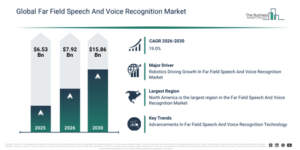
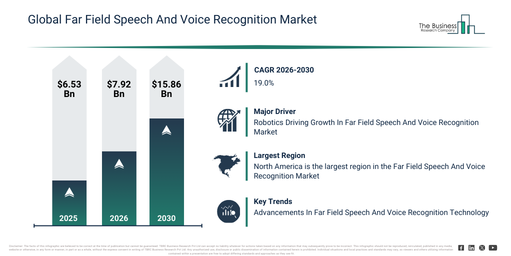
The far field speech and voice recognition market has seen substantial expansion in recent years. It is projected to grow from $6.53 billion in 2025 to $7.92 billion in 2026, exhibiting a compound annual growth rate (CAGR) of 21.4%. The historical increase can be attributed to the rising adoption of smart speakers and voice assistants, advancements in digital signal processing capabilities, increasing consumer demand for hands-free interfaces, the expansion of connected home ecosystems, and the integration of voice recognition in automotive systems.
The far field speech and voice recognition market is projected to experience significant growth in the coming years. This market is expected to reach $15.86 billion in 2030, exhibiting a compound annual growth rate (CAGR) of 19.0%. The anticipated expansion during this forecast period can be attributed to factors such as the increasing deployment of voice-enabled IoT devices, growing investments in conversational AI technologies, a rising demand for natural language interfaces, the broadening of voice-controlled industrial automation, and continuous improvements in far-field speech accuracy. Notable trends during this period include the increasing adoption of multi-microphone array solutions, a rise in the deployment of voice-enabled smart devices, a growing focus on noise and echo cancellation technologies, the expansion of far-field voice interfaces in vehicles, and enhanced accuracy of speech recognition software.
Download A Free Far Field Speech And Voice Recognition Market Sample Report With Size And Forecast Data:
Far Field Speech And Voice Recognition Market Growth Driver: The Key Factor Behind Rising Demand
The increasing need for robotics is anticipated to drive expansion in the far-field speech and voice recognition market. Robotics is an interdisciplinary domain encompassing the design, building, operation, and application of robots. This surge in robotics demand stems from automation’s advantages, such as boosted efficiency, cost reduction, improved safety, and fostering innovation. Far-field speech and voice recognition technology improves robotics by enabling more natural and effective interactions between humans and robots, thereby boosting productivity, safety, and access across diverse sectors and uses. For example, in April 2024, data from the International Federation of Robotics, a Germany-based automation machinery manufacturer, indicated that in 2023, manufacturing companies in the United States substantially increased their automation investments, demonstrated by a 12% increase in overall industrial robot installations, totaling 44,303 units. The automotive sector itself experienced a slight 1% growth in sales, achieving a new record of 14,678 robots installed that year. Consequently, the rising demand for robotics is stimulating expansion within the far-field speech and voice recognition market.
Far Field Speech And Voice Recognition Market Segmentation: Key Segments And Subsegments Covered
The far field speech and voice recognition market covered in this report is segmented –
1) By Component: Microphones, Digital Signal Processors (DSP), Software
2) By Solution: Linear Arrays, Circular Arrays
3) By Application: In-Vehicle Infotainment Systems, Smart Television (TV), Smart Speakers, Robotics, Other Applications
Subsegments:
1) By Microphones: Beamforming Microphones, Omnidirectional Microphones, Array Microphones
2) By Digital Signal Processors (Dsp): Standalone Dsp Units, Integrated Dsp Systems
3) By Software: Speech Recognition Software, Voice Command Software, Natural Language Processing (NLP) Software
Far Field Speech And Voice Recognition Market Trends: Key Developments Shaping 2026 And Beyond
Leading entities within the far-field speech and voice recognition market are developing sophisticated offerings, such as speech recognition technology, to boost accuracy, enhance user satisfaction, and broaden application possibilities. This technology improves far-field speech and voice recognition by employing advanced noise reduction, beamforming, and machine learning algorithms to precisely capture and process spoken commands from a distance, even in noisy environments. For example, in March 2023, Google AI, a US-based artificial intelligence company, unveiled the Universal Speech Model (USM), a machine learning model utilizing speech recognition technology to identify and comprehend spoken language across diverse languages and accents. This model forms part of Google’s efforts to support the 1,000 Languages Initiative. It aims to deliver automatic speech recognition (ASR) capabilities for both widely used languages, such as English and Mandarin, and under-resourced languages, including Amharic, Cebuano, Assamese, and Azerbaijani.
Leading Companies Operating In The Far Field Speech And Voice Recognition Market
Major companies operating in the far field speech and voice recognition market are Amazon.com Inc., Apple Inc., Google LLC, Microsoft Corporation, Samsung Electronics, Alibaba Group, Huawei Technologies Co. Ltd., Tencent Cloud, Sony India, Qualcomm Technologies Inc., Xiaomi, Texas Instruments Incorporated, STMicroelectronics N.V., Harman International, Cirrus Logic Inc., Sonos Inc., Synaptics Incorporated, Microsemi, Nuance Communications Inc., Knowles Electronics LLC, DSP GROUP, Fortemedia, Sensory Inc., Andrea Electronics, Alango Technologies Ltd.
Access The Full Far Field Speech And Voice Recognition Market Research Report:
Far Field Speech And Voice Recognition Market Regional Analysis: Largest Region And Key Geographies Covered
North America was the largest region in the far field speech and voice recognition market in 2025. Asia-Pacific is expected to be the fastest-growing region in the forecast period. The regions covered in the far field speech and voice recognition market report are Asia-Pacific, South East Asia, Western Europe, Eastern Europe, North America, South America, Middle East, Africa.
Reach Out To Our Team:
The Business Research Company: https://www.thebusinessresearchcompany.com/
Americas: +1 310-496-7795
Asia: +44 7882 955267 & +91 8897263534
Europe: +44 7882 955267
Email us at: marketing@tbrc.info
Follow us on:
LinkedIn: https://in.linkedin.com/company/the-business-research-company
YouTube: https://www.youtube.com/channel/UC24_fI0rV8cR5DxlCpgmyFQ
Global Market Model: https://www.thebusinessresearchcompany.com/global-market-model

Wasay has over a decade of experience in market research, data modelling, and analytics, with prior experience at GlobalData and Decision Tree Consulting Services. At The Business Research Company , he leads research operations across syndicated studies, customized consulting engagements, and the Global Market Model platform. His professional experience includes supporting organizations such as Boston Consulting Group, KPMG, and Ernst & Young. Wasay holds a degree in Electronics and Communications Engineering, postgraduate management qualifications from International Management Institute Belgium and Indian School of Business and Entrepreneurship, and completed the Integrated Program in Business Analytics from Indian Institute of Management Indore.