With a focus on actionable insights and strategic value, The Business Research Company’s 2026 market reports include market attractiveness scoring, total addressable market sizing, company benchmarking matrices, interactive Excel dashboards, deeper supply chain intelligence, emerging startup tracking, and granular product-level insights.
Firmware Signing Platform Market Size Snapshot: 2026 Valuation, 2030 Projection And Key Growth Factors
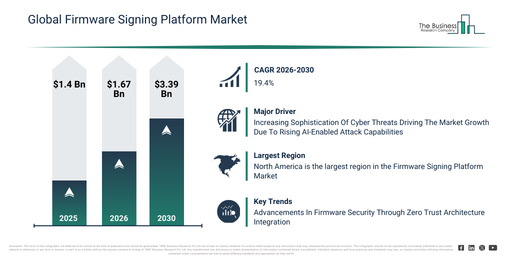
The firmware signing platform market has expanded significantly in recent years. This market is projected to grow from $1.4 billion in 2025 to $1.67 billion in 2026, demonstrating a compound annual growth rate (CAGR) of 19.6%. Historically, this growth can be attributed to the surge in IoT device deployments, an increase in firmware tampering incidents, the demand for secure device authentication, the development of connected automotive systems, and the necessity for cryptographic key management.
The firmware signing platform market is anticipated to experience substantial growth over the next few years. It is projected to reach $3.39 billion in 2030, demonstrating a compound annual growth rate (CAGR) of 19.4%. This expansion during the forecast period is primarily driven by more stringent device security regulations, the increasing adoption of industrial IoT, a rise in secure boot standards, the proliferation of over-the-air updates, and greater investment in cyber-resilient embedded systems. Significant trends expected during this period include the widespread adoption of secure firmware supply chains, the integration of hardware security modules, automated signing in DevSecOps pipelines, the expansion of zero-trust device authentication, and compliance-driven firmware governance.
Get A No-Cost Sample Of The Firmware Signing Platform Market Study:
Major Factor Fueling The Firmware Signing Platform Market Through 2030
The escalating complexity of cyber threats is anticipated to drive the expansion of the firmware signing platform market moving forward. Cyber threats encompass malevolent activities or assaults aimed at computers, networks, or digital information with the intent to steal, damage, or disrupt data and systems. The increased sophistication of these threats is largely attributable to the rapid advancements in artificial intelligence and machine learning, which empower attackers to automate their assaults, bypass existing security protocols, and conduct more convincing social engineering tactics. Firmware signing platforms counter cyber threats by offering cryptographic authentication that ensures firmware integrity and prevents malicious code injection into low-level system components, which are frequently exploited by advanced threats to establish persistent access. As an illustration, in April 2024, the Federal Bureau of Investigation (FBI), a US-based federal law enforcement agency, reported that cybercrime complaints rose from 800,944 in 2022 to 880,418 in 2023, indicating a 10% increase, with potential financial losses escalating from $10.3 billion to $12.5 billion, a 22% increase. Therefore, the heightened sophistication of cyber threats is a key factor propelling the growth of the firmware signing platform market.
Firmware Signing Platform Market Segment Landscape: Main Categories And Subcategories Covered
The firmware signing platform market covered in this report is segmented –
1) By Component: Software, Hardware, Services
2) By Deployment Mode: On-Premises, Cloud
3) By Organization Size: Small And Medium Enterprises, Large Enterprises
4) By End-User: Manufacturing, Automotive, Healthcare, Information Technology (IT) And Telecommunications, Consumer Electronics, Other End-Users
Subsegments:
1) By Software: Signing Management Software, Security And Encryption Tools, Version Control Software, Compliance And Reporting Tools
2) By Hardware: Secure Hardware Modules, Authentication Devices, Cryptographic Processors, Hardware Security Modules
3) By Services: Consulting Services, Implementation Support, Training And Workshops, Ongoing Maintenance Services
How Are Emerging Trends Influencing The Firmware Signing Platform Market’s Growth Path?
Leading companies within the firmware signing platform market are prioritizing the adoption of innovative approaches, such as zero trust architecture, to bolster device security, guarantee firmware integrity, and prevent unauthorized access. Zero Trust Architecture (ZTA) functions as a security paradigm that presumes no user or device is trusted by default, continuously verifies every access request, and helps mitigate risks, block unauthorized entry, and safeguard sensitive data across various networks and devices. For example, in November 2024, Lenovo Group Limited, a China-based electronics manufacturing company, introduced ThinkShield Firmware Assurance, a solution engineered to deliver profound visibility and protection below the operating system. This platform applies Zero Trust Architecture (ZTA) principles to validate critical hardware and firmware components during the boot process, avert unapproved BIOS and software modifications, and enforce specific device trust levels. By integrating firmware signing with automated integrity checks, it allows enterprises to enhance risk management, maintain firmware integrity, and strengthen their overall cybersecurity across PC fleets and networks. The solution extends beyond conventional software-based security through a dedicated embedded controller (EC) that confirms the integrity of firmware and hardware components, establishing a platform root of trust from the moment a device powers on. This enables IT teams to quickly obtain actionable insights into potential vulnerabilities, automatically recover BIOS policies when necessary, and enforce rules that restrict the installation of unauthorized firmware or software.
Firmware Signing Platform Market Leading Players And Key Industry Participants In 2026
Major companies operating in the firmware signing platform market are Amazon Web Services Inc., Apple Inc., Google LLC, Microsoft Corporation, Dell Technologies Inc., Siemens AG, Lenovo Group Limited, International Business Machines Corporation (IBM), Cisco Systems Inc., Intel Corporation, Broadcom Inc., Hewlett Packard Enterprise Company, Thales S.A., Texas Instruments Incorporated, Infineon Technologies AG, Nuvoton Technology Corporation, Entrust Corporation, Rambus Inc., Fortanix Inc., Futurex Inc., Keyfactor Inc.
Check Out The Full Firmware Signing Platform Market Report 2026:
Firmware Signing Platform Market By Geography: Revenue Leaders Among Global Regions
North America was the largest region in the firmware signing platform market in 2025. Asia-Pacific is expected to be the fastest-growing region in the forecast period. The regions covered in the firmware signing platform market report are Asia-Pacific, South East Asia, Western Europe, Eastern Europe, North America, South America, Middle East, Africa.
Reach Out To Our Team:
The Business Research Company: https://www.thebusinessresearchcompany.com/
Americas: +1 310-496-7795
Asia: +44 7882 955267 & +91 8897263534
Europe: +44 7882 955267
Email us at: marketing@tbrc.info
Follow us on:
LinkedIn: https://in.linkedin.com/company/the-business-research-company
YouTube: https://www.youtube.com/channel/UC24_fI0rV8cR5DxlCpgmyFQ
Global Market Model: https://www.thebusinessresearchcompany.com/global-market-model

Wasay has over a decade of experience in market research, data modelling, and analytics, with prior experience at GlobalData and Decision Tree Consulting Services. At The Business Research Company , he leads research operations across syndicated studies, customized consulting engagements, and the Global Market Model platform. His professional experience includes supporting organizations such as Boston Consulting Group, KPMG, and Ernst & Young. Wasay holds a degree in Electronics and Communications Engineering, postgraduate management qualifications from International Management Institute Belgium and Indian School of Business and Entrepreneurship, and completed the Integrated Program in Business Analytics from Indian Institute of Management Indore.