
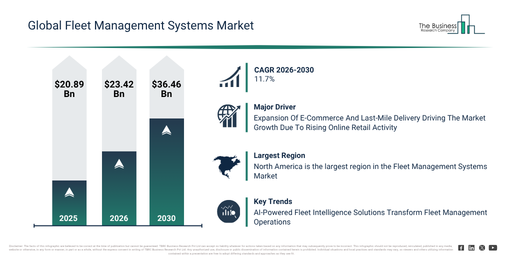
Featuring market attractiveness scoring, total addressable market sizing, company benchmarking matrices, interactive Excel dashboards, deeper supply chain intelligence, emerging startup tracking, and granular product-level insights, The Business Research Company’s 2026 market reports are built to deliver research that is both more actionable and more strategically valuable.
Fleet Management Systems Market Growth Potential: How Will Market Size Shift Through 2030?
The fleet management systems market size has shown rapid expansion in recent years. It is projected to increase from $20.9 billion in 2025 to $23.43 billion in 2026, achieving a compound annual growth rate (CAGR) of 12.1%. The historical growth can be attributed to the adoption of GPS-based vehicle tracking systems, the growth experienced by the logistics and transportation industry, rising fuel cost pressures driving the need for efficiency, regulatory compliance requirements concerning transport safety, and the initial use of onboard diagnostics systems.
The fleet management systems market is projected for substantial expansion in the coming years, with its size anticipated to reach $36.47 billion by 2030, reflecting a compound annual growth rate (CAGR) of 11.7%. This growth over the forecast period is primarily driven by the increasing deployment of electric and hybrid vehicle fleets, a rising demand for real-time fleet visibility and analytics, the expansion of autonomous and semi-autonomous vehicle operations, a greater emphasis on reducing carbon emissions in logistics, and the incorporation of AI and IoT into fleet management. Noteworthy trends during this period involve AI-powered predictive maintenance and breakdown prevention systems for fleets, real-time driver behavior analytics aimed at safety enhancement, the integration of electric vehicle fleet monitoring and charging optimization solutions, the proliferation of cloud-based fleet orchestration platforms, and the adoption of advanced telematics for improving fuel efficiency and route optimization.
Get A Free Sample Report With In-Depth Market Insights:
Fleet Management Systems Market Growth Factors: What’s Supporting Expansion?
The rising trend of e-commerce and last-mile delivery is projected to drive the fleet management systems market forward. These terms describe the growing volume of internet-based retail transactions and the increasing transfer of goods through logistical networks to deliver items from central hubs to consumers’ final destinations. The growth in e-commerce and last-mile delivery stems from consumers’ escalating preference for online shopping due to demands for enhanced convenience, a broader array of products, and more rapid delivery options. Fleet management systems offer capabilities such as real-time vehicle monitoring, optimized route planning, supervision of driver performance, and streamlined dispatch operations. These features help businesses improve the accuracy of deliveries, reduce transportation expenditures, and guarantee swifter, more dependable order fulfillment amidst expanding e-commerce and last-mile delivery operations. As an illustration, data from the US-based government agency, Census Bureau, indicated that in February 2025, total e-commerce sales for the fourth quarter of 2024 rose by 9.4% compared to the fourth quarter of 2023. Concurrently, total retail sales increased by 3.8% during the identical period, highlighting the continued expansion of online retail activities. Therefore, the broadening scope of e-commerce and last-mile delivery is indeed fostering the expansion of the fleet management systems market.
Fleet Management Systems Market Segmentation And Category Overview
The fleet management systems market covered in this report is segmented –
1) By Component: Software, Services, Hardware
2) By Fleet Type: Light Duty Vehicles, Medium Duty Vehicles, Heavy Duty Vehicles, Heavy Equipment, Specialty Vehicles
3) By Deployment Mode: Cloud-Based, On-Premises
4) By Application: Vehicle Tracking And Telematics, Fuel Management, Driver Management And Behavior Monitoring, Route Optimization, Maintenance And Diagnostics, Safety And Compliance Management
5) By End User: Transportation And Logistics, Retail And E-Commerce, Construction, Government And Public Sector, Oil And Gas, Utilities, Manufacturing, Automotive Leasing And Rental Companies
Subsegments:
1) By Software: Fleet Tracking Software, Route Optimization Software, Fuel Management Software, Driver Management Software, Maintenance Management Software, Compliance Management Software, Asset Management Software, Dispatch And Scheduling Software
2) By Services: Consulting Services, System Integration Services, Deployment Services, Training Services, Managed Services, Technical Support Services, Maintenance Services
3) By Hardware: Global Positioning System Tracking Devices, Telematics Control Units, Onboard Diagnostic Devices, Dashboard Cameras, Fuel Monitoring Devices, Vehicle Sensors, Driver Identification Devices, Asset Tracking Devices
Fleet Management Systems Market Industry Trends: What’s Reshaping Demand?
Companies operating in the fleet management systems market are prioritizing the development of innovative solutions, such as AI-powered fleet management assistants, to improve operational efficiency, enhance driver performance, lower fleet operating costs, and support data-driven decision-making. These AI-powered fleet management assistants are advanced software tools that employ artificial intelligence, machine learning, and real-time telematics data to equip fleet managers with actionable insights, predictive analytics, and automated recommendations. For instance, in May 2025, Webfleet, a Netherlands-based fleet management and telematics company, unveiled Fleet Advisor, an innovative AI-powered fleet intelligence solution designed to simplify access to crucial fleet information. This platform integrates generative AI with real-time operational data, enabling fleet managers to query metrics like fuel consumption, mileage trends, idling times, and vehicle performance through a conversational interface. Fleet Advisor offers contextual insights, visual analytics, risk identification, and recommended actions, facilitating quicker and more informed decision-making. The solution assists organizations in bolstering driver safety, cutting operational costs, boosting vehicle utilization, and streamlining fleet operations, while also making complex data accessible to users regardless of their technical expertise.
Fleet Management Systems Market Competitive Analysis Of Leading Industry Participants
Major companies operating in the fleet management systems market report are Trimble Inc., Alphabet International GmbH, Samsara Inc., Verizon Connect, Geotab Inc., Motive Technologies Inc., Lytx Inc., Zonar Systems Inc., Solera, Telenav Inc., Powerfleet, LocoNav, Fleetio, Quartix Technologies, GPS Insight LLC, Teletrac Navman US Ltd., Nauto Inc., TruckX Inc., Azuga Fleet, HCSS, Route4Me, Gurtam, KORE Wireless
View The Full Fleet Management Systems Market Report:
Fleet Management Systems Market Geographic Spread And Regional Opportunities
North America was the largest region in the fleet management systems market in 2025. Asia-Pacific is expected to be the fastest-growing region in the forecast period. The regions covered in the fleet management systems market report are Asia-Pacific, South East Asia, Western Europe, Eastern Europe, North America, South America, Middle East, Africa.
Reach Out To Our Team:
The Business Research Company: https://www.thebusinessresearchcompany.com/
Americas: +1 310-496-7795
Asia: +44 7882 955267 & +91 8897263534
Europe: +44 7882 955267
Email us at: marketing@tbrc.info
Follow us on:
LinkedIn: https://in.linkedin.com/company/the-business-research-company
YouTube: https://www.youtube.com/channel/UC24_fI0rV8cR5DxlCpgmyFQ
Global Market Model: https://www.thebusinessresearchcompany.com/global-market-model

Wasay has over a decade of experience in market research, data modelling, and analytics, with prior experience at GlobalData and Decision Tree Consulting Services. At The Business Research Company , he leads research operations across syndicated studies, customized consulting engagements, and the Global Market Model platform. His professional experience includes supporting organizations such as Boston Consulting Group, KPMG, and Ernst & Young. Wasay holds a degree in Electronics and Communications Engineering, postgraduate management qualifications from International Management Institute Belgium and Indian School of Business and Entrepreneurship, and completed the Integrated Program in Business Analytics from Indian Institute of Management Indore.