Featuring market attractiveness scoring, total addressable market sizing, company benchmarking matrices, interactive Excel dashboards, deeper supply chain intelligence, emerging startup tracking, and granular product-level insights, The Business Research Company’s 2026 market reports are built to deliver research that is both more actionable and more strategically valuable.
Generative Artificial Intelligence (AI) In Retail Stores Market Value Analysis: What Growth Lies Ahead Over The Forecast Period?
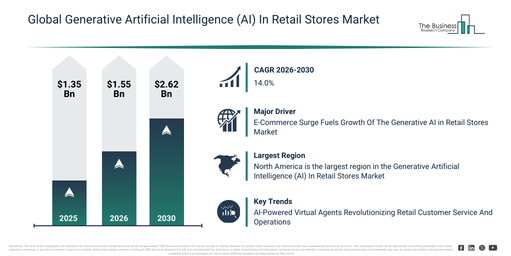
The market for generative artificial intelligence (AI) in retail stores has seen rapid expansion over recent years. It is anticipated to grow from $1.35 billion in 2025 to $1.55 billion in 2026, achieving a compound annual growth rate (CAGR) of 14.4%. The historical development of this market is attributable to the increasing uptake of e-commerce and digital platforms, a rise in customer data accessibility, the growing demand for personalized shopping experiences, the early deployment of AI-powered chatbots, and the expansion of retail analytics solutions.
The generative artificial intelligence (AI) in retail stores market is projected for significant expansion in the coming years. It is set to reach $2.62 billion in 2030, exhibiting a compound annual growth rate (CAGR) of 14.0%. This anticipated growth stems from several factors, including ongoing advancements in generative AI algorithms, the seamless integration of AI with IoT-enabled devices, the increasing prevalence of immersive retail experiences leveraging AR/XR technologies, the wider adoption of cloud-based AI platforms, and the heightened implementation of real-time predictive analytics within the retail sector. Key developments expected during this period encompass AI-powered personalized recommendations, sophisticated predictive sales and demand analytics, streamlined automated inventory management systems, optimized dynamic pricing strategies, and enhanced visual merchandising techniques.
Get A Free Sample Report With In-Depth Market Insights:
Generative Artificial Intelligence (AI) In Retail Stores Market Growth Factors: What’s Supporting Expansion?
The expanding e-commerce sector is anticipated to fuel the advancement of generative artificial intelligence (AI) within the retail stores market. This sector encompasses the transaction of products and services online, utilizing various digital platforms like websites and mobile applications. Its increasing demand stems from factors such as wider internet access, a preference for online purchasing, and the ease of 24-hour availability. Generative AI examines customer information and market patterns to tailor product recommendations, automate content creation, and refine pricing and stock management. Furthermore, AI-driven chatbots and virtual assistants enhance customer support and operational efficiency through immediate help and query resolution. As an illustration, in May 2024, data from the Census Bureau of the Department of Commerce, a US government agency, indicated that retail e-commerce sales in the first quarter of 2024 saw a 2.1% rise compared to the fourth quarter of 2023. Consequently, the expanding e-commerce sector is propelling the development of generative artificial intelligence (AI) in the retail stores market.
Generative Artificial Intelligence (AI) In Retail Stores Market Breakdown By Product Type And Application
The generative artificial intelligence (AI) in retail stores market covered in this report is segmented –
1) By Component: Software, Services
2) By Deployment: Cloud, On-Premise
3) By Application: Demand Forecasting And Inventory Management, Personalized Customer Experiences, Dynamic Pricing Strategies, Visual Merchandising Optimization, Chatbots For Customer Support, Fraud Detection And Security
Subsegments:
1) By Software: Inventory Management Solutions, Customer Relationship Management (CRM) Tools, Personalized Marketing Platforms, Virtual Fitting Room Applications, Pricing Optimization Software, Predictive Analytics For Sales Forecasting, Automated Checkout Solutions
2) By Services: Implementation And Integration Services, Consulting Services For AI Strategy, Training And Support Services, Data Analytics And Insights Services, Managed Services For AI Operations, Custom Software Development Services.
Generative Artificial Intelligence (AI) In Retail Stores Market Industry Trends: What’s Reshaping Demand?
Leading companies active in the generative artificial intelligence (AI) in retail stores market are developing AI-powered virtual agents to improve customer service, optimize inventory management, and streamline operations. These AI-powered virtual agents are software applications designed to simulate human interaction using artificial intelligence. They manage customer inquiries, provide product recommendations, offer real-time support, and automate tasks, thereby enhancing personalization and efficiency in shopping experiences. For instance, in March 2024, Talkdesk Inc., a US-based provider of AI-powered customer service solutions, launched Talkdesk Autopilot. This AI-driven platform independently manages routine customer inquiries, such as order status, cancellations, and delivery schedules, without requiring human involvement. It features preconfigured workflows, enabling retailers to address common customer issues immediately, bypassing the need for extensive training or custom model-building. Autopilot grants seamless access to order details, delivery schedules, and customer accounts, facilitating the efficient automation of various tasks like changing shipping addresses and rescheduling deliveries. Operating across both digital and voice channels, it offers 24/7 customer support, significantly reducing the necessity for live agent intervention and enhancing overall customer service in retail.
Generative Artificial Intelligence (AI) In Retail Stores Market Company Landscape And Competitive Strategy
Major companies operating in the generative artificial intelligence (AI) in retail stores market are Google LLC, Microsoft Corporation, Amazon Web Services Inc., Intel Corporation, International Business Machines Corporation, Oracle Corporation, NVIDIA Corporation, Salesforce Inc., TATA Consultancy Services Limited, Adobe Inc., Wayfair Inc., Zebra Technologies Corporation, SAS Institute Inc., Blue Yonder Inc., Quantiphi Inc., Talkdesk Inc., Everseen, Algolia Inc., Persado Inc., RetailNext Inc., Klevu Oy
View The Full Generative Artificial Intelligence (AI) In Retail Stores Market Report:
Generative Artificial Intelligence (AI) In Retail Stores Market Largest Region: Which Geography Holds The Biggest Share?
North America was he largest region in the generative artificial intelligence (AI) in retail stores market in 2025. Asia-Pacific is expected to be the fastest-growing region in the forecast period. The regions covered in the generative artificial intelligence (AI) in retail stores market report are Asia-Pacific, South East Asia, Western Europe, Eastern Europe, North America, South America, Middle East, Africa.
Reach Out To Our Team:
The Business Research Company: https://www.thebusinessresearchcompany.com/
Americas: +1 310-496-7795
Asia: +44 7882 955267 & +91 8897263534
Europe: +44 7882 955267
Email us at: marketing@tbrc.info
Follow us on:
LinkedIn: https://in.linkedin.com/company/the-business-research-company
YouTube: https://www.youtube.com/channel/UC24_fI0rV8cR5DxlCpgmyFQ
Global Market Model: https://www.thebusinessresearchcompany.com/global-market-model

Wasay has over a decade of experience in market research, data modelling, and analytics, with prior experience at GlobalData and Decision Tree Consulting Services. At The Business Research Company , he leads research operations across syndicated studies, customized consulting engagements, and the Global Market Model platform. His professional experience includes supporting organizations such as Boston Consulting Group, KPMG, and Ernst & Young. Wasay holds a degree in Electronics and Communications Engineering, postgraduate management qualifications from International Management Institute Belgium and Indian School of Business and Entrepreneurship, and completed the Integrated Program in Business Analytics from Indian Institute of Management Indore.