Enhanced with market attractiveness analysis, total addressable market evaluation, company benchmarking matrices, interactive Excel dashboards, expanded supply chain intelligence, emerging startup coverage, and detailed product insights, The Business Research Company’s 2026 market reports deliver more actionable and strategically valuable research.
Generative Artificial Intelligence (AI) In Product Design Market Value Analysis: What Growth Is Expected Over The Forecast Period?
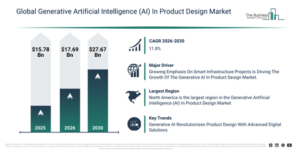
The market for generative artificial intelligence (AI) in product design has shown significant expansion over recent years. Its value is projected to rise from $15.78 billion in 2025 to $17.69 billion in 2026, reflecting a compound annual growth rate (CAGR) of 12.1%. The historical development of this market can be attributed to factors such as the demand for faster product development, increasing design complexity, the widespread adoption of CAD tools, the need for cost-efficient prototyping, and the ongoing digital transformation within manufacturing.
The generative artificial intelligence (AI) in product design market size is anticipated to experience substantial growth in the upcoming years. It is forecast to expand to $27.67 billion by 2030, achieving a compound annual growth rate (CAGR) of 11.8%. This expansion during the forecast period is primarily driven by the integration of AI into design workflows, the increasing demand for sustainable product design, the adoption of cloud-based collaboration tools, the proliferation of digital twins, and customization-driven manufacturing. Significant trends for the forecast period include AI-driven design exploration, automated design optimization, the use of generative simulation models, the enablement of mass customization, and AI-assisted prototyping.
Download A Free Sample Report For Comprehensive Market Insights:
#Generative Artificial Intelligence (AI) In Product Design Market Growth Factors: Which Forces Are Supporting Market Expansion?
An increasing focus on smart infrastructure projects is anticipated to boost the expansion of the generative artificial intelligence (AI) in product design market in the future. These projects involve efforts that utilize cutting-edge technologies and data-centric methods to enhance the creation, functioning, and administration of infrastructure systems. The heightened attention to smart infrastructure stems from the requirement for sustainable urban development to effectively handle population increases, alongside progress in Internet of Things (IoT) technology, which facilitates real-time surveillance and informed decision-making. Within smart infrastructure, generative AI in product design assists by streamlining design workflows, allowing for the development of inventive and effective solutions through swift analysis of extensive datasets and the simulation of diverse situations. As an illustration, information from February 2024, provided by the Institute of the Americas, a US-based non-profit, independent organization, indicates a rapid increase in global smart city momentum, with expenditures predicted to exceed $190 billion by the conclusion of 2023. Furthermore, regional IoT connections are anticipated to hit 1.2–1.3 billion by 2025, while IoT revenue in Latin America is projected to surpass $47 billion by 2025. Industrial IoT deployments are also becoming more focused on smart buildings and smart utilities, accounting for one-third and 23 percent, respectively, by 2025. Consequently, the increased focus on smart infrastructure projects is fueling the expansion of the generative artificial intelligence (AI) in product design market.
Generative Artificial Intelligence (AI) In Product Design Market Segmentation Trends And Revenue Drivers
The generative artificial intelligence (AI) in product design market covered in this report is segmented –
1) By Deployment Model: Cloud-Based, On-Premises
2) By Application: Design Exploration And Ideation, Design Optimization And Simulation, Customization And Personalization, Other Applications
3) By End-User: Automotive Manufacturers, Healthcare And Medical Device Manufacturers, Contraction And Architecture Firms, Other End-Users
Subsegments:
1) By Cloud-Based: Public Cloud Generative Artificial Intelligence (AI) Product Design Platforms, Private Cloud Generative Artificial Intelligence (AI) Product Design Platforms, Hybrid Cloud Generative Artificial Intelligence (AI) Product Design Solutions, Software-As-A-Service (SaaS) Generative Artificial Intelligence (AI) Design Tools
2) By On-Premises: Enterprise On-Premises Generative Artificial Intelligence (AI) Product Design Systems, Department-Level On-Premises Generative Artificial Intelligence (AI) Design Solutions, Custom-Deployed On-Premises Generative Artificial Intelligence (AI) Design Platforms, Secure In-House Generative Artificial Intelligence (AI) Product Design Tools
Generative Artificial Intelligence (AI) In Product Design Market Transformation Trends: Which Innovations Are Driving Change?
Leading companies within the generative artificial intelligence (AI) in product design market are developing advanced technological solutions, such as generative AI for digital product design, to enhance the design process across various industries. Generative AI for digital product design refers to the application of artificial intelligence technologies to assist in creating and developing digital products like websites, apps, and user interfaces. For instance, in June 2023, Flytxt, a Netherlands-based provider of AI-powered SaaS solutions, launched a Generative AI tool to improve digital product design by enabling the quicker and more effective creation of high-performing products. This innovative tool addresses the difficulties of rapidly producing successful products. It systematically evaluates numerous product designs to identify the best options, optimizing price points, product attributes, and bundling options to achieve business objectives such as revenue growth and customer retention. This application of generative AI is notable for providing transparency in decision-making, allowing product managers to review and comprehend the reasoning behind AI-generated designs before launching products.
#Generative Artificial Intelligence (AI) In Product Design Market Industry Leaders: Which Organizations Are Driving Competition?
Major companies operating in the generative artificial intelligence (AI) in product design market are Microsoft Corporation, Amazon Web Services Inc., Siemens AG, International Business Machines Corporation (IBM), NVIDIA Corporation, Adobe Inc., Dassault Systèmes SE, Hexagon AB, Autodesk Inc., ANSYS Inc., PTC Inc., Unity Technologies Inc., Bentley Systems Incorporated, Altair Engineering Inc., Xometry Inc., nTopology Inc., Onshape Inc., ParaMatters, Dyndrite, MSC Software, Spectral Labs, GenCAD‑3D, CADScribe, Shapr3D, SimScale
Access The Complete Generative Artificial Intelligence (AI) In Product Design Market Report:
Generative Artificial Intelligence (AI) In Product Design Market Regional Distribution: Which Areas Drive Market Expansion?
North America was the largest region in the generative artificial intelligence (AI) in product design market in 2025. The regions covered in the generative artificial intelligence (AI) in product design market report are Asia-Pacific, South East Asia, Western Europe, Eastern Europe, North America, South America, Middle East, Africa.
Get in touch with us:
The Business Research Company: https://www.thebusinessresearchcompany.com/
Americas: +1 310-496-7795
Asia: +44 7882 955267 & +91 8897263534
Europe: +44 7882 955267
Email us at: marketing@tbrc.info
Follow us on:
LinkedIn: https://in.linkedin.com/company/the-business-research-company
YouTube: https://www.youtube.com/channel/UC24_fI0rV8cR5DxlCpgmyFQ
Global Market Model: https://www.thebusinessresearchcompany.com/global-market-model

Wasay has over a decade of experience in market research, data modelling, and analytics, with prior experience at GlobalData and Decision Tree Consulting Services. At The Business Research Company , he leads research operations across syndicated studies, customized consulting engagements, and the Global Market Model platform. His professional experience includes supporting organizations such as Boston Consulting Group, KPMG, and Ernst & Young. Wasay holds a degree in Electronics and Communications Engineering, postgraduate management qualifications from International Management Institute Belgium and Indian School of Business and Entrepreneurship, and completed the Integrated Program in Business Analytics from Indian Institute of Management Indore.