Delivering more actionable and strategically valuable research, The Business Research Company’s 2026 market reports feature market attractiveness analysis, total addressable market evaluation, company benchmarking matrices, interactive Excel dashboards, expanded supply chain intelligence, emerging startup coverage, and detailed product insights.
Generative Design Market Value Analysis: What Growth Is Expected Over The Forecast Period?
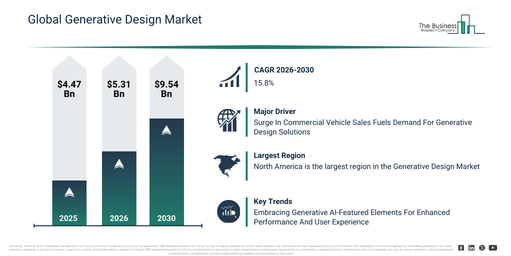
The generative design market size has seen rapid growth in recent years. It is expected to expand from $4.47 billion in 2025 to $5.31 billion in 2026, reflecting a compound annual growth rate (CAGR) of 18.7%. In the past, this expansion was driven by aspects like manual design processes, reliance on traditional CAD tools, the increasing complexity of product designs, a rising demand for lightweight and efficient structures, and the adoption of computer-aided engineering tools.
The generative design market is anticipated to experience substantial expansion over the upcoming years. It is projected to reach a valuation of $9.54 billion by 2030, exhibiting a compound annual growth rate (CAGR) of 15.8%. This projected growth throughout the forecast period stems from factors such as the incorporation of artificial intelligence into design workflows, the uptake of cloud-powered generative design solutions, a strong need for material and cost efficiency, an increase in automotive and aerospace sector applications, and the broadening of consulting and integration services tailored for design automation. Key developments expected during this period involve topology optimization and structural design, parametric and geometry-driven design, analysis and testing propelled by simulation, algorithmic approaches to design and pattern creation, and designs focused on evolution and performance.
Download A Free Sample Report For Comprehensive Market Insights:
Generative Design Market Demand Drivers: What Is Fueling Industry Growth?
The generative design market is anticipated to expand propelled by increasing sales of commercial vehicles. Commercial vehicles are defined as any motorized vehicle primarily utilized for transporting goods, passengers, or delivering services for financial gain or business objectives. The uptick in commercial vehicle sales is attributed to heightened consumer demand, the growth of the EV industry, and accessible financing options, thereby fostering a need for innovative engineering solutions. Generative design enhances the structural integrity and efficiency of commercial vehicles, leading to reduced weight and fuel consumption while simultaneously improving performance and safety. For instance, in August 2024, the U.S. Energy Information Administration, a United States government agency for energy information, reported growth in the sales of new light-duty vehicles (LDVs) powered by alternative fuel types. Wards Intelligence further indicated that LDV sales with alternative fuels increased from 17.8% of total LDV sales in Q1 2024 to 18.7% in Q2. Hybrid electric vehicle (HEV) sales surged by 30.7% year-over-year, accounting for 8.6% of the light-duty market in Q1 and 9.6% in Q2. Plug-in hybrid electric vehicle sales observed a modest increase, rising from 1.7% to 2.0% of the total market. Thus, the growing sales of commercial vehicles are driving the expansion of the generative design market.
#Generative Design Market Segment Landscape And Growth Potential
The generative design market covered in this report is segmented –
1) By Software Solutions: Topology Optimization, Parametric Design Tools, Simulation And Analysis, Algorithmic Design Platforms
2) By Deployment Models: On-Premises, Cloud-Based
3) By Services: Consulting And Training, Implementation And Integration
4) By Industry: Automotive, Aerospace And Defense, Architecture And Construction, Industrial Manufacturing, Other Industries
Subsegments:
1) By Topology Optimization: Structural Design Optimization, Lightweight Design, Material Usage Optimization
2) By Parametric Design Tools: Shape And Form Customization, Geometry-Based Design, Performance-Driven Design Parameters
3) By Simulation And Analysis: Stress And Strain Testing, Fluid Dynamics And Thermal Analysis, Structural Integrity And Performance Simulation
4) By Algorithmic Design Platforms: Algorithmic Pattern Generation, Design Space Exploration, Evolutionary Design And Optimization
#Generative Design Market Trends Influencing Long-Term Demand
Major companies operating in the generative design market are increasingly focusing on developing innovative technological solutions, such as generative AI-featured elements, to gain a competitive advantage. A generative AI-featured element refers to the integration of artificial intelligence (AI) capabilities within the generative design process, enhancing its functionality and performance. This enables generative design software to utilize advanced AI algorithms and machine learning techniques for autonomously generating, evaluating, and refining design solutions. For example, in May 2023, Evolv AI, a US-based software company, launched a series of generative AI features accessible in beta. The initial feature introduced was a description-to-design element, which permitted businesses to instantly create visual web page changes from simple text descriptions within Evolv AI’s web editor. This innovation dramatically altered the landscape of personalization and experimentation. The core technology employed is generative AI, which leverages machine learning techniques to automatically produce design variations based on textual descriptions. This advancement ultimately empowers businesses to swiftly create visual web page changes from text descriptions, revolutionizing personalization and experimentation.
Generative Design Market Competitive Landscape: Who Are The Leading Companies?
Major companies operating in the generative design market are Dassault Systèmes SE; Hexagon AB; Synopsys Inc.; Autodesk Inc.; Cadence Design Systems Inc.; ANSYS Inc.; Parametric Technology Corporation; The MathWorks Inc.; Bentley Systems Inc.; Altair Engineering Inc.; Materialise NV; MSC Software Corporation; Desktop Metal Inc.; ESI Group; CoreTech System Co. Ltd.; Innovyze Inc.; SoftInWay Inc.; ESTECO SpA; Concepts NREC; HBM nCode; Volume Graphics GmbH; Opticore AB; SimScale GmbH; Onshape Inc.; Caracol AM; nTopology Inc.; Diabatix; Granta Design Limited; Lattice Technology Inc.
Access The Complete Generative Design Market Report:
Generative Design Market Global Footprint: Which Region Holds Market Leadership?
North America was the largest region in the generative design market in 2025. Asia-Pacific is expected to be the fastest-growing region in the forecast period. The regions covered in the generative design market report are Asia-Pacific, South East Asia, Western Europe, Eastern Europe, North America, South America, Middle East, Africa.
Get in touch with us:
The Business Research Company: https://www.thebusinessresearchcompany.com/
Americas: +1 310-496-7795
Asia: +44 7882 955267 & +91 8897263534
Europe: +44 7882 955267
Email us at: marketing@tbrc.info
Follow us on:
LinkedIn: https://in.linkedin.com/company/the-business-research-company
YouTube: https://www.youtube.com/channel/UC24_fI0rV8cR5DxlCpgmyFQ
Global Market Model: https://www.thebusinessresearchcompany.com/global-market-model

Wasay has over a decade of experience in market research, data modelling, and analytics, with prior experience at GlobalData and Decision Tree Consulting Services. At The Business Research Company , he leads research operations across syndicated studies, customized consulting engagements, and the Global Market Model platform. His professional experience includes supporting organizations such as Boston Consulting Group, KPMG, and Ernst & Young. Wasay holds a degree in Electronics and Communications Engineering, postgraduate management qualifications from International Management Institute Belgium and Indian School of Business and Entrepreneurship, and completed the Integrated Program in Business Analytics from Indian Institute of Management Indore.