Market attractiveness scoring, total addressable market sizing, company benchmarking matrices, interactive Excel dashboards, deeper supply chain intelligence, emerging startup tracking, and granular product-level insights are among the key offerings featured in The Business Research Company’s 2026 market reports, designed to deliver more actionable and strategically valuable research.
Generative Design Software Market On Course To Reach $5.64 Billion By 2030: Size And Growth Overview
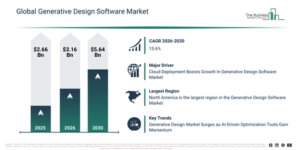
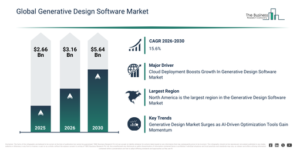
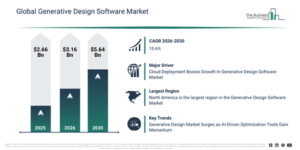
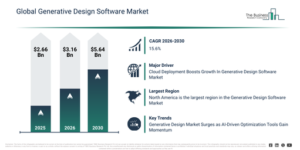
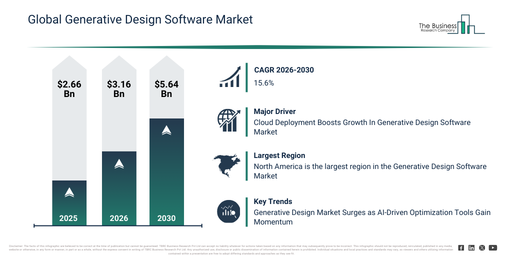
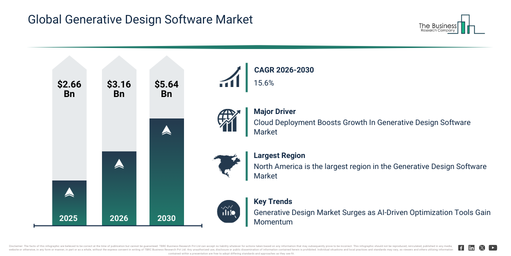
The generative design software market has experienced rapid growth in recent years. It is forecast to expand from $2.66 billion in 2025 to $3.16 billion in 2026, achieving a compound annual growth rate (CAGR) of 18.5%. Historically, this market’s expansion was influenced by elements such as manual design workflows, the reliance on traditional CAD tools, constrained computational power, the increasing complexity of product designs, and the integration of basic simulation tools.
The generative design software market is anticipated to experience substantial expansion over the upcoming years. The market is set to expand to $5.64 billion in 2030, driven by a compound annual growth rate (CAGR) of 15.6%. This anticipated growth during the forecast period can be attributed to several factors, including the incorporation of artificial intelligence (AI) and machine learning into design software, the rise of cloud-based generative design platforms, increased uptake within the automotive and aerospace industries, a growing need for optimizing costs and materials, and the broadening of consulting and integration services. Key trends expected within the same period encompass topology optimization and structural design software, parametric and geometry-based design tools, simulation and performance analysis solutions, algorithmic design platforms and pattern generation, alongside 3D modeling and CAD integration.
Need Generative Design Software Market Forecasts? Get Your Free Sample Report Here:
Generative Design Software Market Growth Factors: What Is Strengthening Demand Worldwide?
The rising implementation of cloud-based solutions is projected to fuel the generative design software market moving forward. These solutions involve software, services, or resources hosted and accessed remotely via the Internet, offering attributes like scalability, flexibility, and accessibility from any internet-connected device. The increased adoption of cloud-based solutions is driven by the necessity for enhanced scalability, cost-effectiveness, adaptability, and broad accessibility, empowering businesses to respond to evolving technological requirements and boost operational efficiency. For generative design software, cloud deployment provides scalable computing capabilities and fosters collaborative design environments, facilitating quick iteration and streamlining the optimization of complex designs. As an example, in April 2025, according to the American Bar Association, a U.S.-based professional organization, roughly 75% of attorneys reported employing cloud computing for professional tasks, an increase from 69% in 2023 and approximately 70% in 2022. Thus, the growing deployment of cloud-based solutions is a primary catalyst for the expansion of the generative design software market.
Generative Design Software Market By Segment: Complete Category And Subcategory Breakdown
The generative design software market covered in this report is segmented –
1) By Component: Software, Services
2) By Deployment: On-Premises, Cloud
3) By Organization Size: Small And Medium-sized Businesses (SMBs), Large Enterprises
4) By Application: Automotive, Aerospace And Defense, Industrial Manufacturing, Building, Healthcare, Education, Energy, Electronics And Consumer Goods
Subsegments:
1) By Software: Topology Optimization Software, Parametric Design Tools, Simulation And Analysis Software, Algorithmic Design Platforms, 3D Modeling And CAD Integration Software
2) By Services: Generative Design Consulting, Custom Software Development, Implementation And Integration Services, Training And Support Services
Generative Design Software Market Trend Outlook: Developments Defining The Forecast Period
Leading companies in the generative design software market are focusing on developing innovative solutions, such as field-optimization and AI-assisted generative engines, to meet the increasing demand for quicker iteration, lighter-weight parts, and manufacturable topologies, driven by additive manufacturing and sustainability objectives. Field Optimization is a generative design technology that utilizes spatially varying fields to guide automated geometry generation and optimization. For instance, in May 2023, nTopology Inc., a United States–based engineering software company, launched nTop 4, which introduced Field Optimization as a new generative design capability to assist engineers in navigating extensive design parameter spaces more intuitively and reproducibly. nTop 4’s Field Optimization comprises modular computational building blocks and implicit modeling kernels that generate editable, high-fidelity CAD geometry directly from optimized fields; it operates by allowing users to define multi-objective constraints and field-driven rules, then produces manufacturable lattice and organic structures as outputs; its distinctive features include reusable workflows, explicit control of local mechanical properties, and close integration with additive-manufacturing toolchains.
Who Is Competing For Share In The Generative Design Software Market?
Major companies operating in the generative design software market are Siemens AG; Accenture PLC; Dassault Systèmes SE; Hexagon AB; Autodesk Inc.; ANSYS Inc.; PTC Inc.; Bentley Systems Inc.; Altair Engineering Inc.; ESI Group; Caracol AM; nTopology Inc.; Paramatters Inc; MSC Software; Carbon Inc; Bricsys NV (BricsCAD); Hyperganic Group GmbH; Vectorworks Inc.; CORTIME
Get The Full Picture With The Generative Design Software Market Report:
Generative Design Software Market Regional Snapshot: Leading Geography In 2025
North America was the largest region in the generative design software market in 2025. Asia-Pacific is expected to be the fastest-growing region in the forecast period. The regions covered in the generative design software market report are Asia-Pacific, South East Asia, Western Europe, Eastern Europe, North America, South America, Middle East, Africa.
Reach Out To Our Team:
The Business Research Company: https://www.thebusinessresearchcompany.com/
Americas: +1 310-496-7795
Asia: +44 7882 955267 & +91 8897263534
Europe: +44 7882 955267
Email us at: marketing@tbrc.info
Follow us on:
LinkedIn: https://in.linkedin.com/company/the-business-research-company
YouTube: https://www.youtube.com/channel/UC24_fI0rV8cR5DxlCpgmyFQ
Global Market Model: https://www.thebusinessresearchcompany.com/global-market-model

Wasay has over a decade of experience in market research, data modelling, and analytics, with prior experience at GlobalData and Decision Tree Consulting Services. At The Business Research Company , he leads research operations across syndicated studies, customized consulting engagements, and the Global Market Model platform. His professional experience includes supporting organizations such as Boston Consulting Group, KPMG, and Ernst & Young. Wasay holds a degree in Electronics and Communications Engineering, postgraduate management qualifications from International Management Institute Belgium and Indian School of Business and Entrepreneurship, and completed the Integrated Program in Business Analytics from Indian Institute of Management Indore.