Market attractiveness scoring, total addressable market sizing, company benchmarking matrices, interactive Excel dashboards, deeper supply chain intelligence, emerging startup tracking, and granular product-level insights are among the key offerings featured in The Business Research Company’s 2026 market reports, designed to deliver more actionable and strategically valuable research.
Geospatial Analytics Market Growth Outlook: How Much Bigger Will The Market Be By 2030?
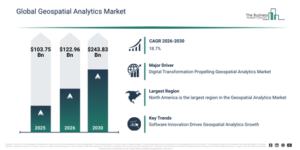
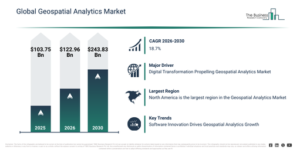
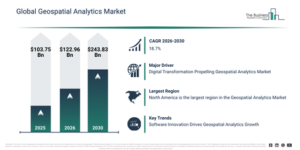
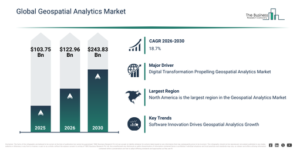
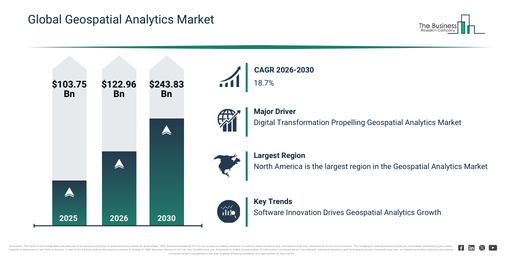
The geospatial analytics market has experienced rapid growth in its size during recent years. It is forecast to increase from $103.75 billion in 2025 to $122.96 billion in 2026, achieving a compound annual growth rate (CAGR) of 18.5%. The expansion witnessed historically can be linked to the adoption of GIS technologies, the growth of satellite imaging, the demand for spatial data analysis, government mapping initiatives, and the broader expansion of GPS usage.
The geospatial analytics market is projected to experience substantial expansion over the coming years. This market is anticipated to reach a valuation of $243.83 billion by 2030, exhibiting a compound annual growth rate (CAGR) of 18.7%. This forecasted growth is primarily driven by factors such as the demand for smart city planning, necessities for climate monitoring, the rise of autonomous navigation, the integration of artificial intelligence with GIS, and the increasing utilization of real-time spatial data. Key trends identified for this period encompass AI-driven spatial analysis, real-time location intelligence, satellite and remote sensing analytics, geospatial visualization platforms, and predictive location-based insights.
Request A Free Geospatial Analytics Market Sample From The Business Research Company:
How Is The Key Growth Driver Influencing The Geospatial Analytics Market?
The rising trend of digital transformation is expected to significantly advance the growth of the geospatial analytics market in the foreseeable future. Digital transformation involves the integration of digital technologies throughout an organization’s operations, processes, and activities to fundamentally alter its functioning and value delivery to stakeholders. This transformation empowers geospatial analytics by providing the necessary tools and infrastructure to extract meaningful insights from spatial data, ultimately leading to better-informed decision-making and improved operational efficiency. For instance, according to US-based Backlinko Digital Transformation Statistics in September 2024, spending on digital transformation reached $2.5 trillion in 2024 and is forecast to reach $3.9 trillion by 2027. Therefore, the increasing adoption of digital transformation is a primary driver for the expansion of the geospatial analytics market.
Geospatial Analytics Market Segmentation By Category: What Does The 2026 Report Cover?
The geospatial analytics market covered in this report is segmented –
1) By Components: Solutions, Services
2) By Type: Surface And Field Analytics, Network And Location Analytics, Geovisualization, Other Types
3) By Technology: Remote Sensing, GIS, GPS, Other Technologies
4) By Application: Surveying, Medicine And Public Safety, Disaster Risk Reduction And Management, Climate Change Adaptation, Other Applications
5) By End-User Industry: Agriculture, Utility And Communication, Defense And Intelligence, Government, Natural Resources, Other End User Industries
Subsegments:
1) By Solutions: Software, Platforms, Tools
2) By Services: Consulting, Implementation, Support And Maintenance
How Are Industry Players Changing The Geospatial Analytics Market Landscape?
Leading firms within the geospatial analytics sector are introducing novel software, such as geospatial production software, to enhance their market profitability. Within geospatial analytics, geospatial production software refers to a collection of tools and applications designed to process, analyze, and visualize spatial data. For instance, in March 2023, Mach9 Robotics Inc., a US-based geospatial solution provider, unveiled a revolutionary software platform that generates 2D and 3D maps using mobile LiDAR technology, operating at a staggering 30 times the speed of current solutions. By employing AI and computer vision, the platform swiftly transforms massive-scale LiDAR data into high-quality engineering models, providing a significant cost advantage. This accelerates the production of CAD and GIS deliverables, enabling engineering and construction organizations to focus on strategic planning rather than tedious data processing. The result is improved accessibility to top-notch maps and actionable data for efficient infrastructure management.
Geospatial Analytics Market Global Key Players And Competitive Overview
Major companies operating in the geospatial analytics market are Esri; Hexagon AB; Trimble Inc.; Google LLC; IBM Corporation; Microsoft Corporation; TomTom International BV; HERE Technologies; Bentley Systems Incorporated; Alteryx Inc.; Maxar Technologies; RMSI Pvt. Ltd.; TIBCO Software Inc.; Orbital Insight Inc.; CARTO; Pitney Bowes Inc.; DigitalGlobe Inc.; Precisely; GeoIQ; Mapbox Inc.; Fugro N.V.; Critigen LLC; Blue Marble Geographics; AAM Pty Ltd; TerraGo
Explore Comprehensive Geospatial Analytics Market Coverage In The Full Report:
Regional Analysis Of The Geospatial Analytics Market: Where Is The Industry Concentrated?
North America was the largest region in the geospatial analytics market in 2025. Asia-Pacific is expected to be the fastest-growing region in the forecast period. The regions covered in the geospatial analytics market report are Asia-Pacific, South East Asia, Western Europe, Eastern Europe, North America, South America, Middle East, Africa.
Reach Out To Our Team:
The Business Research Company: https://www.thebusinessresearchcompany.com/
Americas: +1 310-496-7795
Asia: +44 7882 955267 & +91 8897263534
Europe: +44 7882 955267
Email us at: marketing@tbrc.info
Follow us on:
LinkedIn: https://in.linkedin.com/company/the-business-research-company
YouTube: https://www.youtube.com/channel/UC24_fI0rV8cR5DxlCpgmyFQ
Global Market Model: https://www.thebusinessresearchcompany.com/global-market-model

Wasay has over a decade of experience in market research, data modelling, and analytics, with prior experience at GlobalData and Decision Tree Consulting Services. At The Business Research Company , he leads research operations across syndicated studies, customized consulting engagements, and the Global Market Model platform. His professional experience includes supporting organizations such as Boston Consulting Group, KPMG, and Ernst & Young. Wasay holds a degree in Electronics and Communications Engineering, postgraduate management qualifications from International Management Institute Belgium and Indian School of Business and Entrepreneurship, and completed the Integrated Program in Business Analytics from Indian Institute of Management Indore.