Market attractiveness scoring, total addressable market sizing, company benchmarking matrices, interactive Excel dashboards, deeper supply chain intelligence, emerging startup tracking, and granular product-level insights are among the key offerings featured in The Business Research Company’s 2026 market reports, designed to deliver more actionable and strategically valuable research.
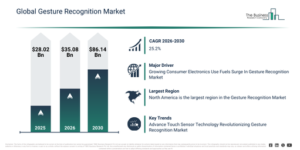
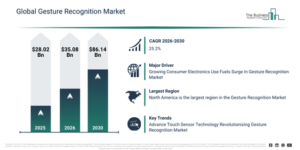
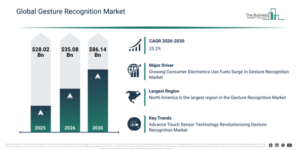
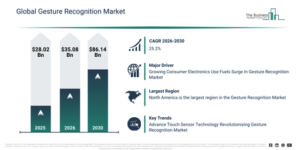
Gesture Recognition Market Valued At $35.08 Billion In 2026, Projected To Reach $86.14 Billion By 2030
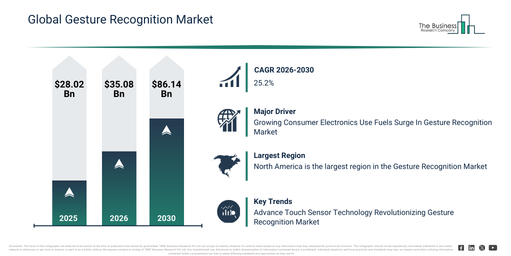
The gesture recognition market has experienced substantial growth in recent years. Projections indicate it will expand from $28.02 billion in 2025 to $35.08 billion in 2026, demonstrating a compound annual growth rate (CAGR) of 25.2%. Historically, this expansion is linked to factors such as the rise of touch-based interfaces, greater adoption of consumer electronics, the advancement of camera-based sensing technologies, the initial integration of gesture control in gaming, and an escalating need for user-friendly interfaces.
The gesture recognition market is expected to experience substantial growth over the next few years, projected to reach $86.14 billion in 2030 with a compound annual growth rate (CAGR) of 25.2%. This anticipated growth is driven by factors such as increasing adoption in autonomous vehicles, the expansion of immersive digital experiences, a growing demand for contactless interaction solutions, rising investments in AI-based human-computer interaction (HCI) systems, and the integration of gesture recognition into smart environments. Key trends for the forecast period include a greater adoption of touchless human-machine interfaces, the increasing integration of gesture control in automotive systems, the wider use of vision-based recognition technologies, the expansion of gesture-based smart consumer devices, and an enhanced focus on real-time gesture accuracy.
Request A Complimentary Gesture Recognition Market Research Sample:
Key Factor Propelling The Gesture Recognition Market Forward
The increased adoption of consumer electronics is anticipated to propel the growth of the gesture recognition market moving forward. Consumer electronics encompasses electronic devices and gadgets designed for personal use, such as smartphones, televisions, and laptops. In these devices, gesture recognition enables users to control or interact with them through hand and body movements. For instance, in May 2023, according to the Japan Electronics and Information Technology Industries Association, a Japan-based trade association, the total electronic equipment production in Japan reached $52,36,535 million (¥771,457 million). Additionally, consumer electronics production amounted to $2,178,430 million (¥32,099 million) in May 2023, an increase compared to $1,714,724 million (¥25,268 million) in May 2022. Thus, the expanding use of consumer electronics will contribute significantly to the growth of the gesture recognition market.
Gesture Recognition Market Segments And Subsegments Explained
The gesture recognition market covered in this report is segmented –
1) By Type: Online Gesture, Offline Gesture
2) By Technology: Touch-Based, Touchless
3) By Industry: Automotive, Consumer Electronics, Sports, Healthcare, Advertisement And Communication, Aerospace And Defense, Other Industries
Subsegments:
1) By Online Gesture: Real-Time Gesture Recognition, Gesture Tracking And Analysis
2) By Offline Gesture: Pre-Recorded Gesture Recognition, Gesture Database And Pattern Recognition
Emerging Trends Transforming The Gesture Recognition Market
Key players in the gesture recognition market are concentrating on technological enhancements, such as the 3D Gesture Touch sensor feature, to improve user interactions and streamline customer service processes. The 3D Gesture Touch sensor feature describes a technology that facilitates touchless device control and engagement through hand and finger movements in three-dimensional space. In May 2023, Doublepoint Technologies, a Finland-based startup specializing in gesture and touch interfaces for wearable devices, released an evaluation kit providing advanced gesture recognition for smartwatches and other wearables. This kit contains a software development kit (SDK) and gesture-detection models, allowing OEMs or ODMs to integrate “pinch, surface interactions, and micro-gestures” into their next-generation devices.
Gesture Recognition Market Key Players: Major Companies In The 2026 Report
Major companies operating in the gesture recognition market are Apple Inc.; Intel Corporation; Microchip Technology Inc.; Qualcomm Technologies Inc.; Synaptics Inc.; Google LLC; GestureTek; PointGrab Ltd.; Ultraleap Ltd.; Oblong Inc.; Sony Corporation; EyeSight Technologies; Omron Corporation; Elliptic Labs; Crunchfish AB; XYZ Interactive Technologies Inc.; Pebbles Interfaces; Vayyar Imaging Ltd.; Intel RealSense Technology; Gestoos; Gestigon GmbH; pmdtechnologies AG
Explore The Full Gesture Recognition Market Report With Forecasts To 2030:
Gesture Recognition Market By Region: Where Is Demand Strongest?
North America was the largest region in the gesture recognition market in 2025. The regions covered in the gesture recognition market report are Asia-Pacific, South East Asia, Western Europe, Eastern Europe, North America, South America, Middle East, Africa.
Reach Out To Our Team:
The Business Research Company: https://www.thebusinessresearchcompany.com/
Americas: +1 310-496-7795
Asia: +44 7882 955267 & +91 8897263534
Europe: +44 7882 955267
Email us at: marketing@tbrc.info
Follow us on:
LinkedIn: https://in.linkedin.com/company/the-business-research-company
YouTube: https://www.youtube.com/channel/UC24_fI0rV8cR5DxlCpgmyFQ
Global Market Model: https://www.thebusinessresearchcompany.com/global-market-model

Wasay has over a decade of experience in market research, data modelling, and analytics, with prior experience at GlobalData and Decision Tree Consulting Services. At The Business Research Company , he leads research operations across syndicated studies, customized consulting engagements, and the Global Market Model platform. His professional experience includes supporting organizations such as Boston Consulting Group, KPMG, and Ernst & Young. Wasay holds a degree in Electronics and Communications Engineering, postgraduate management qualifications from International Management Institute Belgium and Indian School of Business and Entrepreneurship, and completed the Integrated Program in Business Analytics from Indian Institute of Management Indore.