With a focus on actionable insights and strategic value, The Business Research Company’s 2026 market reports include market attractiveness scoring, total addressable market sizing, company benchmarking matrices, interactive Excel dashboards, deeper supply chain intelligence, emerging startup tracking, and granular product-level insights.
How Much Will The Cellular Telephones Market Be Worth By 2030?
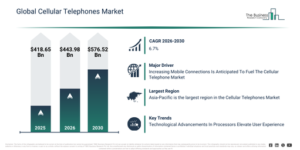
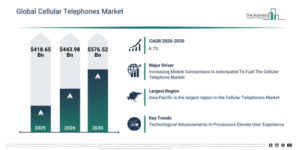
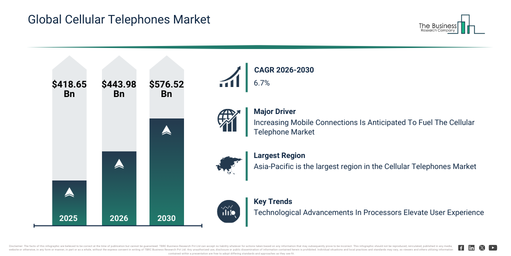
The cellular telephone market has demonstrated robust expansion recently. It is projected to increase from $418.65 billion in 2025 to $443.98 billion in 2026, achieving a compound annual growth rate (CAGR) of 6.0%. Factors such as an expanding mobile subscriber base, decreasing handset prices, broader mobile network coverage, the flourishing of app ecosystems, and rising consumer communication requirements have historically driven this growth.
The market for cellular telephones is projected to experience substantial expansion in the coming years. By 2030, its size is forecast to reach $576.52 billion, expanding at a compound annual growth rate (CAGR) of 6.7%. This anticipated growth during the forecast period is primarily driven by factors such as the deployment of advanced mobile networks, a growing demand for high-performance devices, the expansion of mobile gaming, continuous innovation in smartphone designs, and increasing device replacement cycles. Key trends expected during this period involve the swift embrace of 5G smartphones, an increase in feature phone usage within emerging markets, the integration of sophisticated camera technologies, the broadening availability of foldable smartphone designs, and an escalating demand for gaming-focused smartphones.
Get Access To A Free Cellular Telephones Market Report Sample:
The Key Driver Behind The Cellular Telephones Market’s 6.7% CAGR
The growing number of mobile connections is expected to propel the cellular telephone market. Mobile connections refer to the active SIM cards or phone lines that can access a cellular network for making calls, sending texts, or utilizing data services. A cellular telephone is the device used to establish these mobile connections to a cellular network, enabling voice communication, texting, and data services. For instance, Ericsson, a Sweden-based telecommunications company, predicted in May 2025 that 5G mobile subscriptions are projected to rise from 1.62 billion in 2023 to 6.29 billion by 2030. Therefore, the expansion of mobile connections is a key driver for the cellular telephone market.
Cellular Telephones Market Classification: Main Segments And Detailed Subsegments
The cellular telephones market covered in this report is segmented –
1) By Product Type: Smartphone, Feature Phone
2) By Age-Group: Under 18 Years Old, 18-45 Years Old, 45-60 Years Old, Above 60 Years Old
3) By Distribution channel: OEM, Retailer, E-Commerce
Subsegments:
1) By Smartphone: Android Smartphones, IOS Smartphones, 5G Smartphones, 4G Smartphones, Foldable Smartphones, Gaming Smartphones
2) By Feature Phone: Bar Phones, Flip Phones, Slider Phones, Smart Feature Phones
Cellular Telephones Market Strategic Shifts: What Leading Players Are Prioritizing
Leading companies within the cellular telephone market are concentrating on developing technologically advanced solutions, such as cellular smartphones, to improve user experiences and address the increasing consumer demand for sophisticated functionalities. Cellular smartphones are defined as mobile devices that integrate the features of traditional cell phones with advanced computing capabilities. For instance, in January 2024, Samsung Electronics Co., Ltd., a South Korea-based consumer electronics corporation, unveiled its flagship smartphone, the Galaxy S24 Ultra. This premium device comes with an impressive 6.8-inch QHD+ Dynamic AMOLED 2X display featuring a 120 Hz refresh rate and is powered by the Qualcomm Snapdragon 8 Gen 3 processor. Its camera system includes a notable 200 MP primary camera, alongside three supplementary lenses for diverse photographic opportunities. Equipped with a robust 5000 mAh battery, fast charging capabilities, and an IP68 rating for water and dust resistance, the S24 Ultra is engineered for enduring performance and resilience.
Cellular Telephones Market Company Analysis: Major Industry Participants
Major companies operating in the cellular telephones market are Samsung Electronics Co. Ltd., Apple, Huawei, LG Electronics, Lenovo, Xiaomi, OPPO, Vivo, Motorola Mobility Holdings Inc, TCL Corporation, Research In Motion Limited, Sony Mobile Communications Inc., ZTE Corporation, Nokia, HTC Corporation, Gionee, LeEco/Coolpad, Micromax Informatics Ltd., Transsion, Tecno Mobile, Honor, Asus, Nothing, Fairphone
Get Full Access To The Cellular Telephones Market Report 2026:
Cellular Telephones Market Global Regional Breakdown: Key Regions Analyzed
Asia-Pacific was the largest region in the cellular telephones market in 2025. Western Europe is expected to be the fastest-growing region in the forecast period. The regions covered in the cellular telephones market report are Asia-Pacific, South East Asia, Western Europe, Eastern Europe, North America, South America, Middle East, Africa.
Reach Out To Our Team:
The Business Research Company: https://www.thebusinessresearchcompany.com/
Americas: +1 310-496-7795
Asia: +44 7882 955267 & +91 8897263534
Europe: +44 7882 955267
Email us at: marketing@tbrc.info
Follow us on:
LinkedIn: https://in.linkedin.com/company/the-business-research-company
YouTube: https://www.youtube.com/channel/UC24_fI0rV8cR5DxlCpgmyFQ
Global Market Model: https://www.thebusinessresearchcompany.com/global-market-model

Wasay has over a decade of experience in market research, data modelling, and analytics, with prior experience at GlobalData and Decision Tree Consulting Services. At The Business Research Company , he leads research operations across syndicated studies, customized consulting engagements, and the Global Market Model platform. His professional experience includes supporting organizations such as Boston Consulting Group, KPMG, and Ernst & Young. Wasay holds a degree in Electronics and Communications Engineering, postgraduate management qualifications from International Management Institute Belgium and Indian School of Business and Entrepreneurship, and completed the Integrated Program in Business Analytics from Indian Institute of Management Indore.