Backed by market attractiveness analysis, total addressable market sizing, company benchmarking matrices, interactive Excel dashboards, wider supply chain intelligence, emerging startup coverage, and detailed product-level insights, The Business Research Company’s 2026 market reports are designed to offer research that is more actionable and strategically valuable than ever.
Radio Frequency Identification (RFID) Smart Cabinets Market Forecast: Value Set To Climb From $1.32 Billion To $1.89 Billion
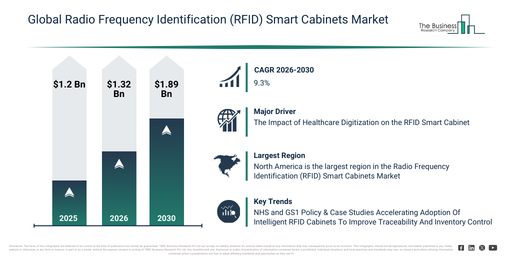
The radio frequency identification (rfid) smart cabinets market size has seen rapid expansion in recent years. It is anticipated to grow from $1.2 billion in 2025 to $1.32 billion in 2026, achieving a compound annual growth rate (CAGR) of 10.5%. The market’s historical growth can be attributed to several factors, including the initial adoption of rfid technology in healthcare and retail, a growing requirement for inventory traceability, the widespread availability of passive rfid tagging solutions, the development of automated storage systems, and increasing demands for operational efficiency.
The radio frequency identification (rfid) smart cabinets market size is anticipated to experience substantial growth over the next few years. It is projected to expand to $1.89 billion in 2030, achieving a compound annual growth rate (CAGR) of 9.3%. This growth during the forecast period can be attributed to the increasing integration of AI-enabled inventory analytics, the expansion of smart manufacturing facilities, a rising demand for contactless inventory management, its growing adoption in aerospace and defense sectors, and an increasing focus on compliance-driven asset tracking. Major trends expected in this period include the increasing deployment of automated inventory cabinets, the rising adoption of cloud-connected rfid systems, a growing demand for real-time asset visibility, the expansion of secure access-controlled storage, and an enhanced focus on inventory accuracy and loss prevention.
Get A Free Sample Report With In-Depth Market Insights:
Radio Frequency Identification (RFID) Smart Cabinets Market Growth Backed By Core Demand Fundamentals
The increasing integration of digital technology in healthcare is set to propel the growth of the radio frequency identification (RFID) smart cabinet market in the future. Healthcare digitization involves embedding digital technologies into healthcare systems and processes to boost efficiency, accuracy, and patient outcomes. The expansion of healthcare digitization stems from the necessity for enhanced efficiency, precision, and patient results. RFID smart cabinets play a vital role in healthcare digitalization by improving efficiency, accuracy, security, and compliance within medical establishments. They help optimize operations, reduce expenses, and ultimately improve patient safety and care provision. For instance, in January 2024, the National Health Service (NHS) UK-based government department reported that 33.6 million adults in England had downloaded the NHS App, representing over 75% of the adult population. Additionally, monthly logins increased by 53% between December 2022 and November 2023, and 3.1 million repeat prescriptions were ordered via the app in December 2023, a 44% rise compared to December 2022. Consequently, the rising digitization of healthcare systems is driving the growth of the radio frequency identification (RFID) smart cabinet market.
Radio Frequency Identification (RFID) Smart Cabinets Market Segmentation: How Does The Market Break Down By Category?
The radio frequency identification (rfid) smart cabinets market covered in this report is segmented –
1) By Component: Radio-frequency Identification (RFID) Tags, Radio-frequency Identification (RFID) Readers, Radio-frequency Identification (RFID) Antenna, Other Components
2) By Type Of Radio Frequency Identification (RFID) Technology: Passive Radio-Frequency Identification (RFID), Active Radio-Frequency Identification (RFID), Semi-Passive Radio-frequency Identification (RFID)
3) By Deployment: On-Premises, Cloud
4) By End-User Industry: Healthcare, Retail, Industrial Manufacturing, Automotive, Aerospace and Defense, Hospitality And Entertainment
Subsegments:
1) By Radio-Frequency Identification (RFID) Tags: Passive RFID Tags, Active RFID Tags
2) By Radio-Frequency Identification (RFID) Readers: Fixed Readers, Handheld Readers
3) By Radio-Frequency Identification (RFID) Antenna: Near-Field Antennas, Far-Field Antennas
4) By Other Components: RFID Software, Enclosures Or Cabinets, Power Supply Components
Radio Frequency Identification (RFID) Smart Cabinets Market Growth Trends Reshaping The Competitive Landscape
Major companies and healthcare providers operating in the RFID smart cabinet market are focusing on aligning intelligent cabinet solutions with national traceability programs and standardized identification systems. This effort aims to enhance inventory visibility, reduce medical supply waste, and support efficient point-of-care scanning and recall management. Traceability alignment entails integrating GS1-compliant identifiers, such as GTINs and UDI-DIs, into smart cabinet workflows, enabling automated tracking of implants, consumables, and high-value clinical products. For instance, in May 2024, NHS Supply Chain, a UK-based national procurement and logistics organization for the National Health Service, published a Data Standards policy. This policy mandates that suppliers implement GS1 identifiers across all packaging levels and include these identifiers in product data submissions, with compulsory compliance milestones on 30 September 2024 and 31 March 2025. These requirements bolster automated scanning processes that are fundamental to RFID-enabled smart cabinet and point-of-use inventory management systems, consequently improving traceability and operational efficiency across healthcare settings.
Radio Frequency Identification (RFID) Smart Cabinets Market Competitive Overview And Top Companies
Major companies operating in the radio frequency identification (rfid) smart cabinets market are Nexess, CAEN RFID S.r.l., Pensa Systems, Bioconnect Inc., Turck Vilant Systems, Mobile Aspects, LogiTag Systems, Logiquip L.L.C., Terso Solutions Inc., Censis Technologies Inc., Alien Technology LLC, TAGSYS RFID, Skytron LLC, Invengo Technology Pte. Ltd., Palex Medical S.A., Impinj Inc., Smartrac N.V., SATO Holdings Corporation, Avery Dennison Corporation, Identi Medical, GAO Group Inc., American RFID Solutions LLC, Solstice Medical
View The Full Radio Frequency Identification (RFID) Smart Cabinets Market Report:
Radio Frequency Identification (RFID) Smart Cabinets Market Global Footprint: Which Region Leads The Market?
North America was the largest region in the radio frequency identification (RFID) smart cabinets market in 2025. Asia-Pacific is expected to be the fastest-growing region in the forecast period. The regions covered in the radio frequency identification (rfid) smart cabinets market report are Asia-Pacific, South East Asia, Western Europe, Eastern Europe, North America, South America, Middle East, Africa.
Reach Out To Our Team:
The Business Research Company: https://www.thebusinessresearchcompany.com/
Americas: +1 310-496-7795
Asia: +44 7882 955267 & +91 8897263534
Europe: +44 7882 955267
Email us at: marketing@tbrc.info
Follow us on:
LinkedIn: https://in.linkedin.com/company/the-business-research-company
YouTube: https://www.youtube.com/channel/UC24_fI0rV8cR5DxlCpgmyFQ
Global Market Model: https://www.thebusinessresearchcompany.com/global-market-model

Wasay has over a decade of experience in market research, data modelling, and analytics, with prior experience at GlobalData and Decision Tree Consulting Services. At The Business Research Company , he leads research operations across syndicated studies, customized consulting engagements, and the Global Market Model platform. His professional experience includes supporting organizations such as Boston Consulting Group, KPMG, and Ernst & Young. Wasay holds a degree in Electronics and Communications Engineering, postgraduate management qualifications from International Management Institute Belgium and Indian School of Business and Entrepreneurship, and completed the Integrated Program in Business Analytics from Indian Institute of Management Indore.