Built to provide research that’s more actionable and strategically valuable, The Business Research Company’s 2026 market reports include market attractiveness analysis, total addressable market sizing, company benchmarking matrices, interactive Excel dashboards, broader supply chain intelligence, emerging startup tracking, and in-depth product insights.
Real-Time Pipeline Monitoring Market Revenue Outlook: What CAGR Lies Ahead Through 2030?
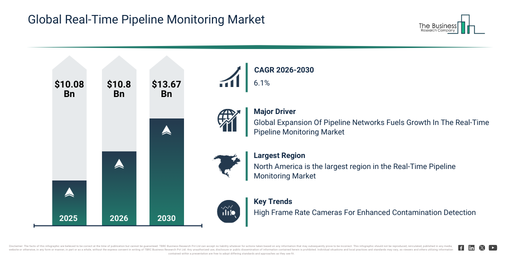
The real-time pipeline monitoring market has experienced significant growth in recent years. Its value is forecast to increase from $10.08 billion in 2025 to $10.8 billion in 2026, achieving a compound annual growth rate (CAGR) of 7.1%. This historical expansion can be attributed to several factors including the expansion of oil and gas pipeline networks, a rise in incidents of pipeline leakage, the implementation of regulatory requirements for pipeline safety, the adoption of inline inspection technologies, and the growth of long-distance pipeline infrastructure.
The real-time pipeline monitoring market is projected to experience substantial expansion in the coming years. Its valuation is anticipated to reach $13.67 billion by 2030, exhibiting a compound annual growth rate (CAGR) of 6.1%. This growth during the forecast period is propelled by factors such as increased capital allocation towards smart pipeline infrastructure, escalating requirements for real-time integrity surveillance, the broadening of water and wastewater pipeline networks, the expanding implementation of AI-driven anomaly detection, and a heightened emphasis on mitigating environmental risks. Key developments expected over this period include the wider deployment of fiber optic sensing systems, the growing embrace of acoustic and smart ball technologies, increased incorporation of predictive analytics platforms, the expansion of drone and remote sensing capabilities for monitoring, and a strengthened focus on continuous leak detection.
Get A Free Sample Report With In-Depth Market Insights:
Real-Time Pipeline Monitoring Market Development Factors: What’s Supporting Demand?
The global expansion of pipeline infrastructure is anticipated to drive forward the real-time pipeline monitoring market. Pipeline networks are defined as interconnected systems of pipes specifically engineered for moving liquids, gases, or other substances from one point to another. These networks are highly sought after due to their capability to effectively move fluids and gases across extensive distances, providing an economical and dependable distribution method for various industries. Real-time pipeline monitoring is essential for these networks to guarantee safe and efficient operation through continuous observation of parameters like pressure, flow rates, and temperature, thereby enabling the swift identification and resolution of potential leaks, blockages, or other problems to prevent accidents and reduce operational downtime. As an illustration, in December 2023, the Global Energy Monitor, a US-based non-governmental organization, reported that 69,700 kilometers of gas transmission pipelines are currently under construction worldwide, at a cost of $193.9 billion, representing an 18% increase from the previous year. Asia is at the forefront, accounting for 82% of this construction, totaling $117.2 billion, primarily driven by China and India. Furthermore, plans exist for an additional 228,700 kilometers of pipelines, valued at $723 billion. Consequently, the worldwide growth in pipeline networks is stimulating the expansion of the real-time pipeline monitoring market.
Real-Time Pipeline Monitoring Market Segment Analysis And Revenue Potential
The real-time pipeline monitoring market covered in this report is segmented –
1) By Technology: Pipeline Inspection Gauges (PIGs), Smart Ball, Acoustic, Fiber Optic Technology, Mass Volume, Light Detection And Ranging (LIDAR), Vapor Sensing, Other Technologies
2) By Pipe Type: Metallic, Non-Metallic, Other Pipes
3) By Application: Leak Detection, Operating Condition, Pipeline Break Detection, Other Applications
4) By Industrial Vertical: Oil And Gas, Water And Wastewater, Other Industrial Verticals
Subsegments:
1) By Pipeline Inspection Gauges (Pigs): Magnetic Flux Leakage (MFL) Pigs, Ultrasonic Pigs, Eddy Current Pigs
2) By Smart Ball: Battery-Powered Smart Ball, Gas Leak Detection Smart Ball, Pipeline Integrity Smart Ball
3) By Acoustic: Acoustic Emission Technology, Ultrasonic Acoustic Monitoring, Acoustic Leak Detection
4) By Fiber Optic Technology: Distributed Temperature Sensing (DTS), Distributed Acoustic Sensing (DAS), Fiber Optic Pressure Sensors
5) By Mass Volume: Mass Flow Measurement, Volume Flow Monitoring Systems
6) By Light Detection And Ranging (LIDAR): Lidar For Pipeline Inspection, Lidar For Topography And Mapping
7) By Vapor Sensing: Gas Vapor Detection Systems, VOC (Volatile Organic Compound) Sensors
8) By Other Technologies: Remote Sensing Technologies, Drone-Based Monitoring Systems
Real-Time Pipeline Monitoring Market Transformation Trends: What Innovations Are Driving Change?
Major companies within the real-time pipeline monitoring market are prioritizing the development of advanced technological solutions, such as cameras featuring a high frame rate of 150 frames per second. For effective real-time pipeline monitoring, a camera with a high frame rate like 150 frames per second (fps) ensures precise and rapid event capture, which is essential for identifying fast-moving issues or flow changes and facilitating timely interventions. For instance, in February 2024, Process Vision Ltd, a UK-based manufacturer of electronic industrial process control equipment, unveiled the LineVu camera. The new LineVu camera provides real-time, high-resolution color imaging with high frame rates and includes automated alarms for contamination detection that operate 24/7. It possesses thermal performance capabilities ranging from 30°C (86°F) to 55°C (131°F). This enhanced visual clarity enables the accurate identification of contamination in gas pipelines. The camera can be easily installed on pipelines using a flanged (3” #900 RTJ) connection, with additional options for threaded (1” NPT) or other flange connections via adaptors.
Real-Time Pipeline Monitoring Market Key Players Shaping Industry Direction
Major companies operating in the real-time pipeline monitoring market are Huawei Technologies Co. Ltd., Hitachi Ltd., Siemens AG, General Electric Company, Cisco Systems Inc., Mitsubishi Electric Corporation, Schneider Electric SE, Honeywell International Inc., Enbridge Inc., ABB Ltd., Toshiba Corporation, Emerson Electric Co., TC Energy Corporation, Wabtec Corporation, Rockwell Automation Inc., Xylem, Atmos Energy Corporation, Yokogawa Electric Corporation, QinetiQ Group plc, Kamstrup AS, ORBCOMM Inc., Perma-Pipe International Holdings Inc., Syrinix Ltd.
View The Full Real-Time Pipeline Monitoring Market Report:
Real-Time Pipeline Monitoring Market Geographic Landscape: Which Region Leads Industry Growth?
North America was the largest region in the real-time pipeline monitoring market in 2025. Asia-Pacific is expected to be the fastest-growing region in the forecast period. The regions covered in the real-time pipeline monitoring market report are Asia-Pacific, South East Asia, Western Europe, Eastern Europe, North America, South America, Middle East, Africa.
Reach Out To Our Team:
The Business Research Company: https://www.thebusinessresearchcompany.com/
Americas: +1 310-496-7795
Asia: +44 7882 955267 & +91 8897263534
Europe: +44 7882 955267
Email us at: marketing@tbrc.info
Follow us on:
LinkedIn: https://in.linkedin.com/company/the-business-research-company
YouTube: https://www.youtube.com/channel/UC24_fI0rV8cR5DxlCpgmyFQ
Global Market Model: https://www.thebusinessresearchcompany.com/global-market-model

Wasay has over a decade of experience in market research, data modelling, and analytics, with prior experience at GlobalData and Decision Tree Consulting Services. At The Business Research Company , he leads research operations across syndicated studies, customized consulting engagements, and the Global Market Model platform. His professional experience includes supporting organizations such as Boston Consulting Group, KPMG, and Ernst & Young. Wasay holds a degree in Electronics and Communications Engineering, postgraduate management qualifications from International Management Institute Belgium and Indian School of Business and Entrepreneurship, and completed the Integrated Program in Business Analytics from Indian Institute of Management Indore.