Built to provide research that’s more actionable and strategically valuable, The Business Research Company’s 2026 market reports include market attractiveness analysis, total addressable market sizing, company benchmarking matrices, interactive Excel dashboards, broader supply chain intelligence, emerging startup tracking, and in-depth product insights.
Graphics Processing Unit (GPU) Pooling for Large Language Models (LLMs) Market Poised To Hit $8.11 Billion By 2030 With A 27.1% CAGR
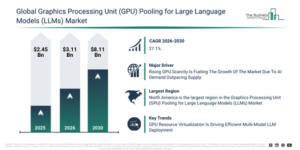
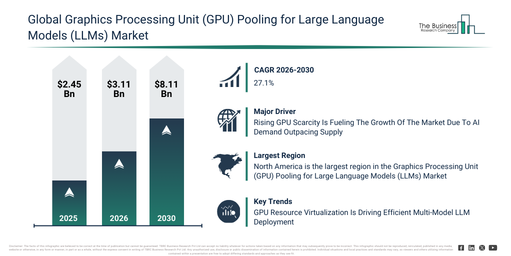
The market size for graphics processing unit (gpu) pooling for large language models (llms) has experienced substantial growth in recent years. It is projected to expand from $2.45 billion in 2025 to $3.11 billion in 2026, demonstrating a compound annual growth rate (CAGR) of 26.8%. This historical growth can be attributed to factors such as the expansion of large language model development, the proliferation of cloud-based AI infrastructure, the increasing challenges of GPU utilization inefficiencies, a growing demand for scalable AI compute, and the availability of high-performance gpus.
The graphics processing unit (gpu) pooling for large language models (llms) market is forecasted to witness considerable expansion in the forthcoming years. It is projected to reach $8.11 billion in 2030, exhibiting a compound annual growth rate (CAGR) of 27.1%. This anticipated growth during the forecast period is fueled by the rising adoption of generative AI applications, increased investments in AI data centers, a greater focus on energy-efficient compute utilization, the expansion of enterprise AI deployment, and advancements in gpu virtualization technologies. Significant trends for the forecast period include the increasing uptake of dynamic gpu resource allocation, growing demand for on-demand gpu pooling services, broader use of multi-tenant gpu architectures, the development of performance optimization and monitoring tools, and an enhanced emphasis on cost-efficient AI infrastructure.
Get A Free Sample Report With In-Depth Market Insights:
Graphics Processing Unit (GPU) Pooling for Large Language Models (LLMs) Market Growth Catalysts And Demand Drivers
The increasing shortage of graphics processing units (GPUs) is projected to foster the expansion of the graphics processing unit (GPU) pooling for large language models (LLMs) market. GPU scarcity refers to an insufficient supply or constrained availability of GPUs relative to demand, particularly for high-performance tasks and scientific computing needs. This scarcity primarily stems from the widespread adoption of artificial intelligence (AI) and data-intensive technologies that demand substantial GPU resources, exacerbated by limited manufacturing capabilities and intricate semiconductor supply chains. Graphics processing unit (GPU) pooling for large language models (LLMs) offers a solution to GPU scarcity by forming a virtualized collection of GPU resources that can be dynamically assigned to various models and users. For example, in June 2024, according to HPCWire, a US-based company, Nvidia experienced explosive growth in data-center GPU shipments in 2023, totaling approximately 3.76 million units, according to a study by semiconductor analyst firm TechInsights. This represented an increase of more than 1 million units compared to 2022, when Nvidia’s data-center GPU shipments stood at 2.64 million units. Consequently, the escalating graphics processing unit (GPU) scarcity is propelling the growth of the graphics processing unit (GPU) pooling for large language models (LLMs) market.
Graphics Processing Unit (GPU) Pooling for Large Language Models (LLMs) Market Segment Analysis: What Are The Core Market Categories?
The graphics processing unit (gpu) pooling for large language models (llms) market covered in this report is segmented –
1) By Component: Hardware; Software; Services
2) By Deployment Mode: On-Premises; Cloud
3) By Enterprise Size: Small And Medium Enterprises; Large Enterprises
4) By Application: Model Training; Inference; Research; Enterprise Solutions; Other Applications
5) By End-User: Banking, Financial Services, And Insurance (BFSI); Healthcare; Information Technology (IT) And Telecommunications; Media And Entertainment; Research Institutes; Other End-Users
Subsegments:
1) By Hardware: High Performance Graphics Processors; Data Center Servers; High Speed Interconnect Systems; Storage And Memory Systems; Power And Cooling Infrastructure
2) By Software: Resource Management Software; Workload Scheduling Software; Performance Monitoring Software; Virtualization And Orchestration Software; Usage Analytics And Reporting Software
3) By Services: Consulting Services; Deployment And Integration Services; Resource Optimization Services; Maintenance And Support Services; Training And Advisory Services
Graphics Processing Unit (GPU) Pooling for Large Language Models (LLMs) Market Trends Shaping Long-Term Demand
Leading companies operating in the graphics processing unit (GPU) pooling for large language models (LLMs) market are concentrating on integrating with token-aware load balancing, including GPU resource virtualization advancement, to achieve greater GPU utilization, improved inference efficiency, lower operational costs, and scalable multi-model deployment capabilities. GPU resource virtualization advancement involves using software-defined techniques to abstract, partition, and dynamically allocate GPU resources across multiple large language models (LLMs) and users. As an example, in October 2025, Alibaba Cloud, a China-based company, introduced Aegaeon, a multi-model GPU pooling solution that allows numerous LLMs to be served concurrently on shared GPU resources, substantially boosting utilization efficiency. Developed by Alibaba Cloud, Aegaeon utilizes token-level scheduling to dynamically assign GPU compute power based on real-time inference demand. Its architecture combines a proxy layer, GPU pool, and an intelligent memory manager to reduce idle GPU time caused by models with low traffic. This system tackles the problem of LLM proliferation, where most models receive infrequent requests yet still consume dedicated resources.
Graphics Processing Unit (GPU) Pooling for Large Language Models (LLMs) Market Competitive Landscape: Who Leads The Industry?
Major companies operating in the graphics processing unit (gpu) pooling for large language models (llms) market are Microsoft Corporation, Amazon Web Services Inc., International Business Machines Corporation, Oracle Corporation, CoreWeave Inc., DigitalOcean Inc., Cyfuture AI, NVIDIA Corporation, Vast.ai, GMI Cloud, Nebius Group N.V., Salad Technologies Inc., Vultr Holdings LLC, Hivenet, AceCloud Hosting Pvt. Ltd., Paperspace Inc., Jarvis Labs, Hyperstack Cloud, Lambda Labs Inc., Akash Network, NodeGoAI, Neysa, and RunPod Inc.
View The Full Graphics Processing Unit (GPU) Pooling for Large Language Models (LLMs) Market Report:
Graphics Processing Unit (GPU) Pooling for Large Language Models (LLMs) Market Geographic Landscape: Which Region Leads Industry Growth?
North America was the largest region in the graphics processing unit (GPU) pooling for large language models (LLMs) market in 2025. Asia-Pacific is expected to be the fastest-growing region in the forecast period. The regions covered in the graphics processing unit (gpu) pooling for large language models (llms) market report are Asia-Pacific, South East Asia, Western Europe, Eastern Europe, North America, South America, Middle East, Africa.
Reach Out To Our Team:
The Business Research Company: https://www.thebusinessresearchcompany.com/
Americas: +1 310-496-7795
Asia: +44 7882 955267 & +91 8897263534
Europe: +44 7882 955267
Email us at: marketing@tbrc.info
Follow us on:
LinkedIn: https://in.linkedin.com/company/the-business-research-company
YouTube: https://www.youtube.com/channel/UC24_fI0rV8cR5DxlCpgmyFQ
Global Market Model: https://www.thebusinessresearchcompany.com/global-market-model

Wasay has over a decade of experience in market research, data modelling, and analytics, with prior experience at GlobalData and Decision Tree Consulting Services. At The Business Research Company , he leads research operations across syndicated studies, customized consulting engagements, and the Global Market Model platform. His professional experience includes supporting organizations such as Boston Consulting Group, KPMG, and Ernst & Young. Wasay holds a degree in Electronics and Communications Engineering, postgraduate management qualifications from International Management Institute Belgium and Indian School of Business and Entrepreneurship, and completed the Integrated Program in Business Analytics from Indian Institute of Management Indore.