
Through market attractiveness analysis, total addressable market evaluation, company benchmarking matrices, interactive Excel dashboards, expanded supply chain intelligence, emerging startup coverage, and detailed product insights, The Business Research Company’s 2026 market reports provide more actionable and strategically valuable research.
Headless CMS for Commerce Market Forecast Highlighting Growth From $2.55 Billion To $5.49 Billion
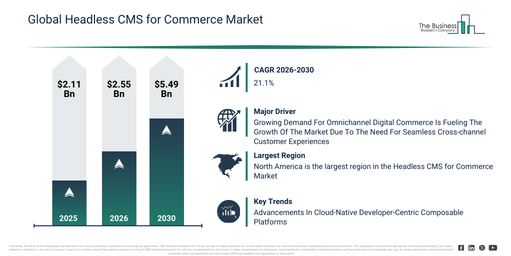
The headless CMS for commerce market has seen considerable growth in recent years. It is anticipated to expand from $2.11 billion in 2025 to $2.55 billion in 2026, showing a compound annual growth rate (CAGR) of 20.8%. This historical growth can be attributed to the proliferation of online retail platforms, the expansion of digital commerce ecosystems, a rise in the use of modular commerce technologies, the adoption of cloud-hosted CMS solutions, and an increasing demand for flexible commerce content management.
The headless cms for commerce market size is anticipated to experience substantial growth in the next few years. It is projected to expand to $5.49 billion by 2030, exhibiting a compound annual growth rate (CAGR) of 21.1%. The growth observed throughout the forecast period can be attributed to several factors, including increasing investments in composable commerce stacks, a rising emphasis on personalized shopping experiences, the expansion of mobile and social commerce channels, broader adoption of headless commerce by enterprises, and the increasing integration of analytics-driven content optimization. Key trends expected in this period encompass the growing adoption of API-first commerce architectures, an increasing demand for omnichannel commerce experiences, expanded integration with e-commerce engines, the proliferation of cloud-based commerce CMS platforms, and an enhanced focus on content-driven personalization.
Download A Free Sample Report For Comprehensive Market Insights:
Headless CMS for Commerce Market Expansion Drivers: What Is Shaping Future Growth?
The increasing need for omnichannel digital commerce experiences is anticipated to drive the expansion of the headless content management system (CMS) for commerce market in the coming years. Omnichannel digital commerce, defined as a cohesive method for selling products and services across various online and offline channels, offers customers a fluid, consistent, and integrated shopping journey regardless of their interaction point with a brand. This rise in demand for omnichannel experiences stems from evolving consumer behaviors and heightened expectations for effortless and convenient shopping across diverse platforms. A headless content management system (CMS) for commerce effectively supports these omnichannel digital commerce experiences through its decoupled, API-first architecture, which separates content management from its frontend display. For example, Firework, a US-based company specializing in commerce and customer engagement technology, reported in December 2024 that brands with robust omnichannel strategies achieve an average annual revenue growth of 9.5%, which substantially surpasses the 3.4% growth observed in brands with less effective approaches. Furthermore, offline retail sales in the U.S. reached $3.6 trillion in 2022. Consequently, the growing demand for omnichannel digital commerce experiences is projected to fuel the growth of the headless content management system (CMS) for commerce market.
Headless CMS for Commerce Market Segmentation And Category Breakdown
The headless cms for commerce market covered in this report is segmented –
1) By Component: Platform; Services
2) By Deployment Mode: Cloud; Onpremises
3) By Organization Size: Small And Medium Enterprises; Large Enterprises
4) By Application: Website Management; Mobile Application; Digital Commerce; Social Media Management; Other Applications
5) By End User: Retail And E-Commerce; Banking, Financial Services, And Insurance; Media And Entertainment; Healthcare; Information Technology And Telecommunications; Other End Users
Subsegments:
1) By Platform: Content Repository And Modeling; Application Programming Interface Delivery Layer; Content Orchestration And Workflow Management; Digital Asset Management; Security And Access Control
2) By Services: Consulting And Strategy Services; Implementation And Integration Services; Customization And Development Services; Training And Enablement Services; Support And Maintenance Services
Headless CMS for Commerce Market Strategic Trends: What Is Defining The Next Phase Of Growth?
Leading companies active in the headless CMS for commerce market are concentrating on advancements in cloud-native headless platforms, specifically through enhancements to the developer experience. This is aimed at accelerating storefront development, improving performance and scalability, and enabling seamless omnichannel commerce experiences across various digital touchpoints. Developer experience enhancement refers to the betterment of tools, frameworks, and workflows, making it simpler, quicker, and more efficient for developers to build, customize, and scale headless commerce applications. For example, in February 2024, BigCommerce Holdings Inc., a US-based public Software-as-a-Service (SaaS) company, launched its Catalyst Storefront Technology. This technology provides a next-generation, composable storefront framework designed to expedite the creation of headless commerce experiences. It features a ready-to-use reference architecture built on modern technologies such as Next.js, React Server Components, and GraphQL APIs, allowing for faster and more efficient storefront launches. The solution includes fully customizable components, giving developers flexibility while adhering to proven best practices.
Headless CMS for Commerce Market Competitive Analysis Of Major Industry Participants
Major companies operating in the headless cms for commerce market are Shopify Inc., Magnolia International Ltd., BigCommerce Holdings Inc., Jahia Solutions Group SA, Bloomreach Inc., VTEX, Contentful GmbH, Builder.io Inc., Spryker Systems GmbH, Contentstack Inc., Kibo Software Inc., Storyblok GmbH, Elastic Path Software Inc., Amplience Ltd., Sanity AS, Hygraph GmbH, Strapi Solutions SAS, Prismic.io Inc., Oro Inc., and Directus Software Inc.
Access The Complete Headless CMS for Commerce Market Report:
Headless CMS for Commerce Market Global Footprint: Which Region Holds Market Leadership?
North America was the largest region in the headless content management system (CMS) for commerce market in 2025. Asia-Pacific is expected to be the fastest-growing region in the forecast period. The regions covered in the headless cms for commerce market report are Asia-Pacific, South East Asia, Western Europe, Eastern Europe, North America, South America, Middle East, Africa.
Get in touch with us:
The Business Research Company: https://www.thebusinessresearchcompany.com/
Americas: +1 310-496-7795
Asia: +44 7882 955267 & +91 8897263534
Europe: +44 7882 955267
Email us at: marketing@tbrc.info
Follow us on:
LinkedIn: https://in.linkedin.com/company/the-business-research-company
YouTube: https://www.youtube.com/channel/UC24_fI0rV8cR5DxlCpgmyFQ
Global Market Model: https://www.thebusinessresearchcompany.com/global-market-model

Wasay has over a decade of experience in market research, data modelling, and analytics, with prior experience at GlobalData and Decision Tree Consulting Services. At The Business Research Company , he leads research operations across syndicated studies, customized consulting engagements, and the Global Market Model platform. His professional experience includes supporting organizations such as Boston Consulting Group, KPMG, and Ernst & Young. Wasay holds a degree in Electronics and Communications Engineering, postgraduate management qualifications from International Management Institute Belgium and Indian School of Business and Entrepreneurship, and completed the Integrated Program in Business Analytics from Indian Institute of Management Indore.