Delivering more actionable and strategically valuable research, The Business Research Company’s 2026 market reports feature market attractiveness analysis, total addressable market evaluation, company benchmarking matrices, interactive Excel dashboards, expanded supply chain intelligence, emerging startup coverage, and detailed product insights.
Healthcare Cloud Computing Market Value Analysis: What Growth Is Expected Over The Forecast Period?
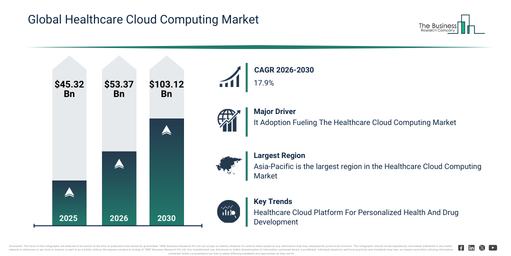
The healthcare cloud computing market size has experienced rapid expansion in recent years. This market is anticipated to expand from $45.32 billion in 2025 to $53.37 billion in 2026, demonstrating a compound annual growth rate (CAGR) of 17.8%. Historically, this growth can be attributed to several factors including the rising adoption of digital health records, increasing volumes of healthcare data, a growing requirement for cost-efficient IT infrastructure, the proliferation of telehealth services, and the implementation of cloud-based clinical systems.
The healthcare cloud computing market is projected to experience substantial expansion in the coming years. This market is anticipated to reach $103.12 billion by 2030, exhibiting a compound annual growth rate (CAGR) of 17.9%. Several factors will fuel this growth during the forecast period, including a heightened need for interoperable healthcare systems, increased capital in healthcare analytics, the proliferation of remote patient monitoring tools, an intensified emphasis on healthcare cybersecurity, and the wider integration of cloud-native healthcare applications. Key trends defining this period are the greater uptake of cloud-based electronic health records, an escalating requirement for secure storage of healthcare data, the increasing incorporation of analytics and AI services, the broadening use of hybrid and multi-cloud strategies, and a stronger commitment to regulatory adherence and data privacy.
Download A Free Sample Report For Comprehensive Market Insights:
#Healthcare Cloud Computing Market Growth Factors: Which Forces Are Supporting Market Expansion?
The increased integration of information technology within the healthcare sector is significantly driving the expansion of the healthcare cloud computing market. Information technology has opened doors for more precise healthcare services, helping patients achieve easy and quick access to various healthcare facilities. Common examples of health information technology include electronic health records (EHRs), e-prescriptions, and other tech tools that assist patients in meeting health goals such as managing blood sugar levels or quitting smoking. For instance, in April 2024, CorCom, an Italy-based online daily publication, indicated that healthcare ambitions for increasing mixed-IT usage in the next one to three years are considerably greater. A projected jump from 73% to 89% usage penetration, or 16 percentage points, is expected among healthcare organizations. Comparatively, the global response pool expects usage to grow to 72% in the same time frame, which is a margin of 17 percentage points less than the healthcare sector. Therefore, a rise in the adoption of information technology in the healthcare sector is anticipated to drive the healthcare cloud computing market growth, with increased digital transformation propelling the healthcare cloud computing market.
Healthcare Cloud Computing Market Segmentation: How Is The Market Structured Across Key Categories?
The healthcare cloud computing market covered in this report is segmented –
1) By Service Model: Software-As-A-Service (SaaS), Infrastructure-As-A-Service (IaaS), Platform-As-A-Service (PaaS)
2) By Pricing Model: Pay-As-you-go, Spot Pricing
3) By Deployment Model: Private Cloud, Hybrid Cloud, Public Cloud
4) By End User: Healthcare Providers, Healthcare Payers
5) By Application: Clinical Information System, Non-Clinical Information System
Subsegments:
1) By Software-as-a-Service (SaaS) Subsegments: Clinical Information Systems (CIS), Non-clinical Information Systems (NCIS), Electronic Health Records (EHR), Pharmacy Information Systems, Telehealth Solutions, Billing and Claims Management, Practice Management
2) By Infrastructure-as-a-Service (IaaS) Subsegments: Data Storage and Backup, Computing Power (Virtual Machines), Network Services, Disaster Recovery
3) By Platform-as-a-Service (PaaS) Subsegments: Application Development Platforms, Data Integration Platforms, Interoperability Platforms, Healthcare Analytics Platforms
#Healthcare Cloud Computing Market Trends Influencing Long-Term Demand
Leading entities within the healthcare cloud computing sector are introducing innovative offerings, such as advanced healthcare cloud platforms, as a strategy to sustain profitability in this market. A healthcare cloud platform functions as a digital backbone, designed to integrate and analyze diverse healthcare data, thereby enabling the customization of medical interventions and drug development strategies to cater to individual patient requirements. For example, in March 2023, Fujitsu Limited, an information and communications technology firm based in Japan, unveiled a cloud-driven platform intended to foster personalized healthcare and advancements in drug development. This new platform empowers users to securely gather and utilize health-related data, driving digital transformation within the medical domain. It facilitates the secure compilation of health-related data and the automated conversion of medical information from electronic medical records in healthcare facilities, ensuring compliance with the HL7 FHIR next-generation standards framework. Patients are able to safely store their personal health details, including vital signs, step counts, and caloric intake, subject to their consent. This capability assists pharmaceutical companies and medical institutions in undertaking data analysis and research and development (R&D) efforts to identify novel medications and formulate more personalized healthcare solutions.
Healthcare Cloud Computing Market Competitive Landscape And Leading Companies
Major companies operating in the healthcare cloud computing market are International Business Machines Corporation; Siemens AG; GE Healthcare Company; Cisco Systems Inc.; Microsoft Corporation; Oracle Corporation; CareCloud Corporation; ClearDATA; Dell Technologies Inc.; Agfa-Gevaert N. V; VMware Inc.; Allscripts Healthcare Solutions Inc.; Amazon Web Services Inc.; eClinicalWorks; Salesforce Inc.; Google LLC; Hewlett Packard Enterprise Development LP; Fujitsu Limited; NTT DATA Corporation; Citrix Systems Inc.; Nutanix Inc.; Hitachi Ltd.; Pure Storage Inc.; Lenovo Group Limited; Huawei Technologies Co. Ltd.; Zscaler Inc.
Access The Complete Healthcare Cloud Computing Market Report:
Healthcare Cloud Computing Market Leading Geography: Which Region Generates The Most Revenue?
Asia-Pacific was the largest region in the healthcare cloud computing market in 2025.North America is expected to be the fastest-growing region in the forecast period. The regions covered in the healthcare cloud computing market report are Asia-Pacific, South East Asia, Western Europe, Eastern Europe, North America, South America, Middle East, Africa.
Get in touch with us:
The Business Research Company: https://www.thebusinessresearchcompany.com/
Americas: +1 310-496-7795
Asia: +44 7882 955267 & +91 8897263534
Europe: +44 7882 955267
Email us at: marketing@tbrc.info
Follow us on:
LinkedIn: https://in.linkedin.com/company/the-business-research-company
YouTube: https://www.youtube.com/channel/UC24_fI0rV8cR5DxlCpgmyFQ
Global Market Model: https://www.thebusinessresearchcompany.com/global-market-model

Wasay has over a decade of experience in market research, data modelling, and analytics, with prior experience at GlobalData and Decision Tree Consulting Services. At The Business Research Company , he leads research operations across syndicated studies, customized consulting engagements, and the Global Market Model platform. His professional experience includes supporting organizations such as Boston Consulting Group, KPMG, and Ernst & Young. Wasay holds a degree in Electronics and Communications Engineering, postgraduate management qualifications from International Management Institute Belgium and Indian School of Business and Entrepreneurship, and completed the Integrated Program in Business Analytics from Indian Institute of Management Indore.