Featuring market attractiveness scoring, total addressable market sizing, company benchmarking matrices, interactive Excel dashboards, deeper supply chain intelligence, emerging startup tracking, and granular product-level insights, The Business Research Company’s 2026 market reports are built to deliver research that is both more actionable and more strategically valuable.
Human Activity Recognition Market Size, Value And Growth Trajectory Through 2030
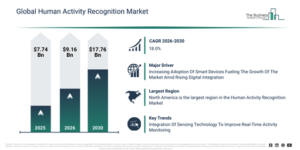
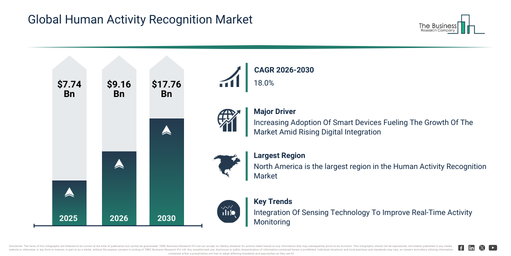
The human activity recognition market size has experienced rapid growth in recent years. Projections indicate it will expand from $7.74 billion in 2025 to $9.16 billion in 2026, achieving a compound annual growth rate (CAGR) of 18.3%. Historically, this growth can be ascribed to the growth of wearable device adoption, advances in smartphone sensors, demand for remote patient monitoring, increasing sports analytics usage, and improvements in edge AI inference.
The human activity recognition market is poised for significant expansion in the upcoming years. Its size is expected to reach $17.76 billion in 2030, demonstrating a compound annual growth rate (CAGR) of 18.0%. This growth during the forecast period is driven by aspects such as AI-driven preventive healthcare, smart home context awareness, the expansion of industrial safety monitoring, privacy-preserving on-device analytics, and multimodal HAR incorporating vision and wearables. Prominent trends for this period include multimodal sensor fusion for activity detection, on-device activity recognition models, privacy-preserving HAR analytics, real-time fall detection and alert systems, and context-aware personalization for wearables.
Get A Free Sample Report With In-Depth Market Insights:
Human Activity Recognition Market Growth Factors Behind Sustained Expansion
The expanding usage of smart devices is anticipated to bolster the future expansion of the human activity recognition (HAR) market. These include electronic systems like smartphones, wearables, and smart home appliances that are linked to the internet, gathering and analyzing data to execute functions intelligently and efficiently. Their uptake is increasing because consumers are looking for more convenience, personalized experiences, and efficiency within interconnected digital environments. The rising deployment of smart devices produces ongoing motion and behavioral data, thereby improving the precision and utility of human activity recognition technologies. As an illustration, figures from August 2025, provided by Eurostat, the European Union’s statistical office, indicated that approximately 70.9% of individuals across the European Union utilized internet-connected or smart devices in 2024, with the Netherlands showing the highest penetration at 94.8%, which highlights significant regional trends in adoption. Consequently, the increased proliferation of smart devices is propelling the expansion of the human activity recognition market.
Human Activity Recognition Market Segment Breakdown: Which Categories Lead On Revenue?
The human activity recognition market covered in this report is segmented –
1) By Component: Hardware, Software, Services
2) By Technology: Wearable Sensors, Vision-Based, Smartphone-Based, Other Technologies
3) By Application: Healthcare, Sports And Fitness, Smart Home, Security And Surveillance, Industrial, Other Applications
Subsegments:
1) By Hardware: Sensors, Cameras, Processor Units, Power Management Units, Memory Devices
2) By Software: Data Management Software, Signal Processing Software, Real-Time Monitoring Software, Machine Learning Software, Predictive Analytics Software
3) By Services: Consulting Services, Integration And Deployment Services, Support And Maintenance Services, Training And Education Services, Managed Services
Human Activity Recognition Market Industry Trends Fueling Future Revenue Growth
Leading companies within the human activity recognition market are concentrating on technological advancements in sensing technologies to enhance real-time activity monitoring, motion detection, and behavioral analysis. Sensing technologies utilize combinations of motion, physiological, and environmental sensors, including accelerometers, gyroscopes, temperature sensors, and heart-rate monitors, to capture and interpret human movement patterns. These systems facilitate automatic activity recognition, personalized health insights, and continuous physiological tracking. For instance, in October 2024, Oura Health Oy, a Finland-based wearable technology company specializing in health and activity monitoring, introduced the Oura Ring 4. This smart sensing device is engineered to detect and classify user activities while also overseeing sleep, stress, and general wellness. The product incorporates an upgraded 3D accelerometer and gyroscope for motion tracking, enhanced smart sensing algorithms for improved signal accuracy, and automatic detection spanning more than 40 activity types. The Oura Ring 4 demonstrates how progress in sensing technologies enhances activity recognition accuracy, user comfort, and the personalization of health insights.
Human Activity Recognition Market Leading Players And Competitive Positioning
Major companies operating in the human activity recognition market are Apple Inc., Google LLC, Microsoft Corporation, Samsung Electronics Co. Ltd., Huawei Technologies Co. Ltd., Robert Bosch GmbH, Sony Corporation, Intel Corporation, Xiaomi Corporation, Qualcomm Technologies Inc., NEC Corporation, Nokia Corporation, STMicroelectronics N.V., NXP Semiconductors N.V., Hangzhou Hikvision Digital Technology Co. Ltd., Garmin Ltd., Polar Electro Oy, Oura Health Oy, Whoop Inc., Movella Holdings Inc.
View The Full Human Activity Recognition Market Report:
Human Activity Recognition Market Geographic Landscape: Which Region Leads Industry Growth?
North America was the largest region in the human activity recognition market in 2025. Asia-Pacific is expected to be the fastest-growing region in the forecast period. The regions covered in the human activity recognition market report are Asia-Pacific, South East Asia, Western Europe, Eastern Europe, North America, South America, Middle East, Africa.
Reach Out To Our Team:
The Business Research Company: https://www.thebusinessresearchcompany.com/
Americas: +1 310-496-7795
Asia: +44 7882 955267 & +91 8897263534
Europe: +44 7882 955267
Email us at: marketing@tbrc.info
Follow us on:
LinkedIn: https://in.linkedin.com/company/the-business-research-company
YouTube: https://www.youtube.com/channel/UC24_fI0rV8cR5DxlCpgmyFQ
Global Market Model: https://www.thebusinessresearchcompany.com/global-market-model

Wasay has over a decade of experience in market research, data modelling, and analytics, with prior experience at GlobalData and Decision Tree Consulting Services. At The Business Research Company , he leads research operations across syndicated studies, customized consulting engagements, and the Global Market Model platform. His professional experience includes supporting organizations such as Boston Consulting Group, KPMG, and Ernst & Young. Wasay holds a degree in Electronics and Communications Engineering, postgraduate management qualifications from International Management Institute Belgium and Indian School of Business and Entrepreneurship, and completed the Integrated Program in Business Analytics from Indian Institute of Management Indore.