The Business Research Company’s 2026 market reports combine market attractiveness scoring, total addressable market sizing, company benchmarking matrices, interactive Excel dashboards, deeper supply chain intelligence, emerging startup tracking, and granular product-level insights to deliver research that is more actionable and strategically valuable.
What Is The Hybrid Cloud Networking Market Growth Rate? A 22.6% CAGR Outlook Through 2030
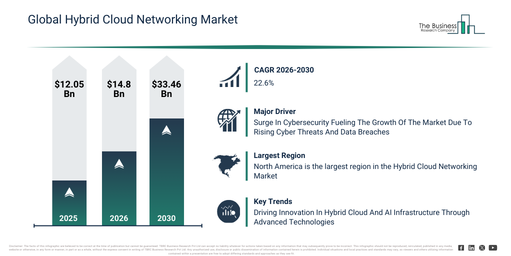
The hybrid cloud networking market has experienced significant expansion in recent years. It is anticipated to expand from $12.05 billion in 2025 to $14.8 billion in 2026, achieving a compound annual growth rate (CAGR) of 22.9%. This past growth can be attributed to several factors including the shift from legacy networks to SD-WAN, the increasing prevalence of public cloud workloads, the growing requirements for remote work connectivity, escalating network security concerns, and the demand for superior cloud performance.
The hybrid cloud networking market is projected to experience rapid expansion in the coming years. Its size is forecast to reach $33.46 billion by 2030, exhibiting a compound annual growth rate (CAGR) of 22.6%. This growth during the prediction period is primarily driven by factors such as the adoption of SASE across enterprises, the expansion of application-aware routing, the implementation of AIOps for network operations, efforts in multi-cloud connectivity optimization, and the rise of zero-trust network segmentation. Key trends anticipated for the same period encompass software-defined hybrid connectivity, unified network policy management, secure cloud on-ramp optimization, enhanced hybrid network observability, and application-aware traffic steering.
Access A Free Sample Of The Latest Hybrid Cloud Networking Market Analysis:
Why Is The Hybrid Cloud Networking Market Growing? The Key Demand Driver Explained
A heightened emphasis on cybersecurity is anticipated to boost the expansion of the hybrid cloud networking market in the future. Cybersecurity involves safeguarding computer systems, networks, and data against illicit access, cyberattacks, and digital dangers. The growing concern for cybersecurity stems from escalating cyber threats, necessitating robust protection for organizations to secure sensitive information and uphold confidence. Hybrid cloud networking contributes to cybersecurity by ensuring secure connections between public and private cloud environments, facilitating enhanced data security, threat surveillance, and regulatory adherence, concurrently diminishing susceptibilities. For example, in June 2025, GOV.UK, a UK government body, reported that small businesses improved various cyber hygiene practices, such as an increase in cyber security risk assessments to 48%, rising from 41% in 2024; cyber insurance uptake to 62%, an increase from 49% in 2024; formal cyber security policies addressing cyber security risks to 59%, up from 51% in 2024; and business continuity plans incorporating cyber security to 53%, an increase from 44% in 2024. Consequently, the escalating focus on cybersecurity is propelling the growth of the hybrid cloud networking market.
What Are The Main Segments Of The Hybrid Cloud Networking Market?
The hybrid cloud networking market covered in this report is segmented –
1) By Component: Solutions, Services
2) By Deployment Mode: Public Cloud, Private Cloud, Hybrid Cloud
3) By Organization Size: Small and Medium Enterprises, Large Enterprises
4) By End-User: Banking, Financial Services And Insurance (BFSI), Healthcare, IT And Telecommunications, Retail, Manufacturing, Government, Other End Users
Subsegments:
1) By Solutions: Network Management, Security And Compliance, Automation And Orchestration, Cloud Routing And Connectivity, Monitoring And Analytics
2) By Services: Professional Services, Consulting Services, Integration And Implementation Services, Support And Maintenance Services, Managed Services
Hybrid Cloud Networking Market Trend Analysis: Where Leading Companies Are Focusing
Leading companies within the hybrid cloud networking market are prioritizing innovation and progress in both hybrid cloud networking and AI infrastructure. This includes developments like AI-ready hybrid cloud platforms, seamless edge-to-cloud integration, adaptable as-a-service models, high-performance computing with sophisticated processors, and embedded AI accelerators, all designed to efficiently manage intricate workloads across public, private, and multi-cloud settings. Specifically, an AI-ready hybrid cloud platform denotes a cloud infrastructure engineered to facilitate artificial intelligence workloads, by integrating high-performance computing, expandable storage, and hybrid cloud connectivity to ensure effective AI training and inferencing. As an illustration, in December 2023, Lenovo Group Limited, a technology firm based in China known for PCs, laptops, servers, storage, and hybrid cloud infrastructure, launched its newest ThinkAgile hybrid cloud solutions and ThinkSystem servers with the aim of accelerating AI adoption. These new platforms, utilizing 5th Gen Intel Xeon Scalable processors, offer improved cloud deployment capabilities, robust hybrid connectivity, and superior performance for AI workloads. Their integrated AI acceleration and energy-efficient designs allow them to efficiently manage extensive AI training and inference operations. Furthermore, Lenovo’s TruScale as-a-Service offerings and professional services deliver adaptable, scalable, and economical hybrid cloud solutions, encompassing seamless integration from the edge to the cloud. This introduction significantly bolsters Lenovo’s standing in hybrid cloud networking and AI infrastructure, empowering businesses to more rapidly deploy AI, optimize their IT assets, and attain improved business results.
Which Companies Are Major Players In The Hybrid Cloud Networking Market?
Major companies operating in the hybrid cloud networking market are Google LLC, Microsoft Corporation, Amazon Web Services (AWS), Dell Technologies, Huawei Technologies Co. Ltd., IBM Corporation, Oracle Corporation, Cisco Systems, Hewlett Packard Enterprise (HPE), Equinix Inc., Palo Alto Networks, Arista Networks, Fortinet Inc., Juniper Networks, Snowflake Inc., VMware Inc., F5 Networks, Check Point Software Technologies Ltd., Nutanix Inc., Extreme Networks, NetApp Inc., Citrix Systems, Alibaba Cloud.
Get The Complete Hybrid Cloud Networking Market Analysis Here:
Which Region Held The Largest Share Of The Hybrid Cloud Networking Market In 2025?
North America was the largest region in the hybrid cloud networking market in 2025. Asia-Pacific is expected to be the fastest-growing region in the forecast period. The regions covered in the hybrid cloud networking market report are Asia-Pacific, South East Asia, Western Europe, Eastern Europe, North America, South America, Middle East, Africa.
Reach Out To Our Team:
The Business Research Company: https://www.thebusinessresearchcompany.com/
Americas: +1 310-496-7795
Asia: +44 7882 955267 & +91 8897263534
Europe: +44 7882 955267
Email us at: marketing@tbrc.info
Follow us on:
LinkedIn: https://in.linkedin.com/company/the-business-research-company
YouTube: https://www.youtube.com/channel/UC24_fI0rV8cR5DxlCpgmyFQ
Global Market Model: https://www.thebusinessresearchcompany.com/global-market-model

Wasay has over a decade of experience in market research, data modelling, and analytics, with prior experience at GlobalData and Decision Tree Consulting Services. At The Business Research Company , he leads research operations across syndicated studies, customized consulting engagements, and the Global Market Model platform. His professional experience includes supporting organizations such as Boston Consulting Group, KPMG, and Ernst & Young. Wasay holds a degree in Electronics and Communications Engineering, postgraduate management qualifications from International Management Institute Belgium and Indian School of Business and Entrepreneurship, and completed the Integrated Program in Business Analytics from Indian Institute of Management Indore.