
Through market attractiveness analysis, total addressable market evaluation, company benchmarking matrices, interactive Excel dashboards, expanded supply chain intelligence, emerging startup coverage, and detailed product insights, The Business Research Company’s 2026 market reports provide more actionable and strategically valuable research.
Hybrid Databases Market Expansion From $16.26 Billion In 2026 To $21.56 Billion In 2030
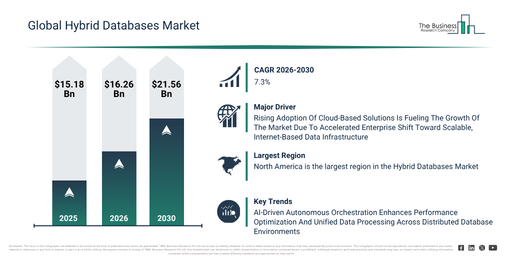
The hybrid databases market has experienced robust growth recently. It is anticipated to increase from $15.18 billion in 2025 to $16.26 billion in 2026, at a compound annual growth rate (CAGR) of 7.1%. This historical expansion can be attributed to factors such as the growth of enterprise data volumes, the adoption of cloud computing platforms, the rise of NoSQL databases for unstructured data, increasing demand for real-time analytics, and the expansion of distributed computing systems.
The hybrid databases market is projected to experience substantial expansion in the coming years. This market is forecast to reach $21.56 billion by 2030, exhibiting a compound annual growth rate (CAGR) of 7.3%. Several factors are driving this anticipated growth, including the wider embrace of hybrid cloud strategies, an increasing need for AI-powered data processing, the growing requirement for consolidated data governance, the expansion of edge computing and IoT data, and a heightened emphasis on data security and regulatory compliance. Key trends expected during this period involve the increasing uptake of multi-model database architectures, a surging demand for real-time data processing and analytics, a growing inclination towards unified data platforms in hybrid settings, the greater integration of transactional and analytical workloads (HTAP), and a rising necessity for scalable and adaptable data management solutions.
Download A Free Sample Report For Comprehensive Market Insights:
https://www.thebusinessresearchcompany.com/sample_request?id=85644652&type=smp
Hybrid Databases Market Growth Factors Supporting Long-Term Expansion
The increasing adoption of cloud-based solutions is anticipated to stimulate the expansion of the hybrid databases market in the future. Cloud-based solutions are computing services that provide storage, processing power, software, and data management over the internet, rather than relying on local infrastructure. Organizations are progressively implementing cloud-based solutions because they reduce capital expenditure on IT infrastructure and improve operational scalability and deployment speed for digital applications. This shift subsequently drives hybrid databases, as they enable seamless data management across on-premises and cloud environments while ensuring consistency across structured and unstructured workloads within distributed systems. For instance, in February 2026, according to Eurostat, Luxembourg-based intergovernmental statistics authority, 52.7% of EU enterprises used paid cloud computing services in 2025, an increase from 45.5% in 2023. This trend highlights a continued acceleration in cloud-based infrastructure adoption across enterprises, encompassing data storage, database hosting, and application deployment workloads that demand flexible and integrated data management solutions such as hybrid databases. Consequently, the growing integration of cloud-based solutions is fostering the growth of the hybrid databases market.
Hybrid Databases Market Segment Analysis Highlighting Growth Areas
The hybrid databases market covered in this report is segmented –
1) By Type: Relational (SQL), Non-Relational (NoSQL), Multi-Model Databases, Time-Series Databases, Other Types
2) By Deployment: On-Premise, Cloud-Based, Hybrid
3) By Application: Customer Relationship Management (CRM), Fraud Detection And Risk Management, Internet of Things (IoT) Data Management, Supply Chain And Inventory Optimization, Other Applications
4) By End User: Large Enterprises, Small And Medium Enterprises (SMEs), Government And Public Sector Organizations, Non-Profit Organizations, Other End Users
Subsegments:
1) By Relational (SQL): Row-Based Relational Databases, Column-Oriented Relational Databases, Distributed SQL Databases, Cloud-Native Relational Databases, In-Memory Relational Databases
2) By Non-Relational (NoSQL): Key-Value Stores, Document Databases, Wide-Column Stores, Graph Databases, Distributed NoSQL Databases
3) By Multi-Model Databases: Document + Graph Model, Key-Value + Document Model, Relational + NoSQL Hybrid Model, Graph + Relational Model, Unified Multi-Model Platforms
4) By Time-Series Databases: Real-Time Time-Series Databases, Event-Based Time-Series Databases, Cloud-Native Time-Series Databases, Edge Time-Series Databases, High-Frequency Data Storage Systems
5) By Other Types: Object-Oriented Databases, NewSQL Databases, Ledger/Blockchain Databases, Embedded Databases, Spatial Databases
Hybrid Databases Market Industry Trends Shaping Future Revenue Growth
Leading companies in the hybrid databases market are concentrating on integrating AI-powered database management, including AI-driven autonomous database orchestration platforms that incorporate machine learning models to automate indexing, query optimization, anomaly detection, and workload scaling across both SQL and NoSQL environments. This trend signifies a foundational shift aimed at reducing manual database administration and boosting the efficiency of real-time decisions across distributed data systems. For example, in October 2025, Oracle Corporation, a technology company based in the US, introduced Oracle AI Database 26ai on Oracle Cloud Infrastructure. This solution merges relational and non-relational data processing within a single database system and integrates AI-driven autonomous management features for workload tuning, indexing, and real-time optimization. It additionally supports agentic AI execution, allowing enterprises to query structured SQL data and semi-structured JSON or vector data via natural language interfaces, while preserving automated performance scaling across distributed cloud and on-premises settings.
Hybrid Databases Market Leading Companies: Who Holds Significant Market Presence?
Major companies operating in the hybrid databases market are Google LLC, Microsoft Corporation, Amazon Web Services Inc, International Business Machines Corporation, Oracle Corporation, SAP SE, Snowflake Inc., Databricks Inc., Teradata Corporation, Cloudera Inc., Cockroach Labs Inc., SingleStore, Actian, PingCAP Inc, Yugabyte Inc, Aerospike Inc., Altibase Corporation, Crate Technology GmbH., Apache Software Foundation, NuoDB Inc., Redis Ltd.
Access The Complete Hybrid Databases Market Report:
https://www.thebusinessresearchcompany.com/report/hybrid-databases-market-report
Hybrid Databases Market Geographic Landscape: Which Region Dominates Industry Growth?
North America was the largest region in the hybrid databases market in 2025. Asia-Pacific is expected to be the fastest-growing region in the forecast period. The regions covered in the hybrid databases market report are Asia-Pacific, South East Asia, Western Europe, Eastern Europe, North America, South America, Middle East, Africa.
Get in touch with us:
The Business Research Company: https://www.thebusinessresearchcompany.com/
Americas: +1 310-496-7795
Asia: +44 7882 955267 & +91 8897263534
Europe: +44 7882 955267
Email us at: marketing@tbrc.info
Follow us on:
LinkedIn: https://in.linkedin.com/company/the-business-research-company
YouTube: https://www.youtube.com/channel/UC24_fI0rV8cR5DxlCpgmyFQ
Global Market Model: https://www.thebusinessresearchcompany.com/global-market-model

Wasay has over a decade of experience in market research, data modelling, and analytics, with prior experience at GlobalData and Decision Tree Consulting Services. At The Business Research Company , he leads research operations across syndicated studies, customized consulting engagements, and the Global Market Model platform. His professional experience includes supporting organizations such as Boston Consulting Group, KPMG, and Ernst & Young. Wasay holds a degree in Electronics and Communications Engineering, postgraduate management qualifications from International Management Institute Belgium and Indian School of Business and Entrepreneurship, and completed the Integrated Program in Business Analytics from Indian Institute of Management Indore.