Backed by market attractiveness analysis, total addressable market sizing, company benchmarking matrices, interactive Excel dashboards, wider supply chain intelligence, emerging startup coverage, and detailed product-level insights, The Business Research Company’s 2026 market reports are designed to offer research that is more actionable and strategically valuable than ever.
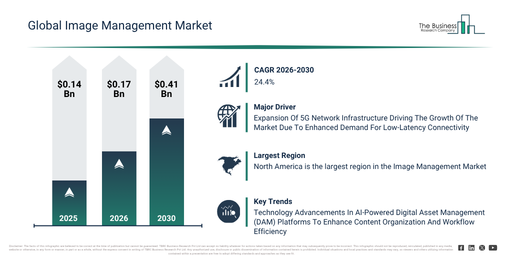
Image Management Market Growth From $0.17 Billion In 2026 To $0.41 Billion By 2030 At A CAGR Of 24.4%
The image management market has experienced substantial growth in recent years and is projected to expand from $0.14 billion in 2025 to $0.17 billion in 2026, exhibiting a compound annual growth rate (CAGR) of 24.1%. Historically, this expansion has been driven by factors such as the increase in digital content creation, the digitization of media archives by enterprises, the surge in e-commerce product imaging, the implementation of on-premise storage systems, and the growing adoption of enterprise content management systems.
The image management sector is projected to experience substantial growth in the upcoming years. This market is anticipated to reach $0.41 billion by 2030, showing a compound annual growth rate (CAGR) of 24.4%. This expansion during the forecast period is driven by factors such as the proliferation of AI-driven image analytics, the quick migration of media assets to the cloud, a heightened demand for real-time visual processing, the incorporation of computer vision into enterprise operations, and the rise of omnichannel digital content distribution. Significant trends for this period involve AI-powered image recognition and automatic tagging, the adoption of cloud-based digital asset management (DAM), real-time image processing and optimization, API-driven image integration across various platforms, and automated metadata management coupled with intelligent indexing.
Get A Free Sample Report With In-Depth Market Insights:
Image Management Market Growth Backed By Core Demand Fundamentals
The increasing uptake of 5G connectivity is anticipated to fuel the expansion of the image management market in the future. 5G connectivity, representing the fifth generation of mobile network technology, offers considerably quicker data transfer rates, reduced latency, and enhanced network capacity compared to its predecessors. The embrace of 5G connectivity is growing due to its capacity for ultra-rapid data transmission with minimal delay, thereby facilitating high-performance applications like real-time streaming, autonomous systems, and sophisticated IoT networks that demand uninterrupted and dependable communication. The proliferation of 5G connectivity boosts the need for image management because its faster data speeds and low latency foster the extensive generation and dissemination of high-resolution images, necessitating robust systems to effectively store, arrange, and retrieve significant quantities of visual information. For example, data from November 2025, provided by the International Telecommunication Union, a UN agency located in Switzerland, indicated that worldwide 5G population coverage rose from 51% in 2024 to 55% in 2025, demonstrating a notable year-over-year expansion in network accessibility. Consequently, the escalating acceptance of 5G connectivity is a key factor propelling the expansion of the image management market.
Image Management Market Segment Trends And Revenue Contributors
The image management market covered in this report is segmented –
1) By Type: Image Storage And Archiving Solutions, Image Processing And Editing Software, Digital Asset Management (DAM) Systems, Image Recognition And Analytics Solutions, Image Sharing And Distribution Platforms
2) By Deployment Mode: On-Premise, Cloud-Based, Hybrid
3) By Application: Media And Entertainment, Healthcare, Retail And E-Commerce, Marketing And Advertising, Education And Research, Government And Defense
4) By End User: Enterprise, Consumer
Subsegments:
1) By Image Storage and Archiving Solutions: Cloud-based image storage, On-premise storage systems, Hybrid storage solutions, Long-term archival systems (cold storage), Backup and disaster recovery solutions
2) By Image Processing and Editing Software: Basic editing tools (cropping, resizing, filters), Advanced editing software (layer-based editing, retouching), Batch processing tools, AI-powered enhancement tools (auto-correction, noise reduction), Format conversion tools
3) By Digital Asset Management (DAM) Systems: Enterprise DAM platforms, Cloud-based DAM systems, Brand asset management systems, Media libraries with metadata tagging, Workflow-integrated DAM solutions
4) By Image Recognition and Analytics Solutions: Facial recognition systems, Object detection and classification tools, Optical Character Recognition (OCR), Image tagging and auto-classification tools, Visual search engines
5) By Image Sharing and Distribution Platforms: Cloud sharing platforms, Content delivery networks (CDNs), Collaboration tools with image sharing, Social media publishing tools, Secure file transfer solutions
Image Management Market Growth Trends Reshaping The Competitive Landscape
Major companies within the image management market are concentrating on developing advanced solutions, such as AI-powered DAM, to satisfy the need for scalable digital content creation, faster workflows, and efficient handling of unstructured visual data. AI-powered DAM denotes sophisticated image management systems that utilize machine learning, computer vision, and generative AI to automatically organize, tag, enhance, and even create images, thereby replacing traditional manual tagging, editing, and storage systems with intelligent, automated, and scalable solutions. For instance, in January 2024, Rimage, a US-based data management company, introduced SOPHIA, an AI-enabled digital asset management solution. SOPHIA is engineered to ingest and manage any type of data from multiple sources, enabling organizations to automate the organization and enrichment of digital assets into a centralized repository. It leverages AI to classify, tag, and optimize images, reducing manual effort and improving accessibility across enterprise systems. The platform also enhances collaboration through customizable workflows, secure access controls, and scalable storage infrastructure, making it suitable for enterprises dealing with large volumes of unstructured visual content.
Image Management Market Key Participants And Competitive Landscape
Major companies operating in the image management market are Amazon Web Services Inc., Google LLC, Microsoft Corporation, International Business Machines Corporation, Oracle Corporation, Adobe Inc., OpenText Corporation, Cloudinary Ltd., Acquia Inc., Aprimo LLC, Bynder B.V., Canto Inc., Frontify AG, Contentserv Group AG, CELUM GmbH, Celartem Inc., IntelligenceBank Pty Ltd., MediaValet Inc., Smartsheet Inc., Daminion Software Ltd., ImageKit.io Inc.
View The Full Image Management Market Report:
Image Management Market Geographic Analysis: Where Is Demand Accelerating Fastest?
North America was the largest region in the Image management market in 2025. Asia-Pacific is expected to be the fastest-growing region in the forecast period. The regions covered in the image management market report are Asia-Pacific, South East Asia, Western Europe, Eastern Europe, North America, South America, Middle East, Africa.
Reach Out To Our Team:
The Business Research Company: https://www.thebusinessresearchcompany.com/
Americas: +1 310-496-7795
Asia: +44 7882 955267 & +91 8897263534
Europe: +44 7882 955267
Email us at: marketing@tbrc.info
Follow us on:
LinkedIn: https://in.linkedin.com/company/the-business-research-company
YouTube: https://www.youtube.com/channel/UC24_fI0rV8cR5DxlCpgmyFQ
Global Market Model: https://www.thebusinessresearchcompany.com/global-market-model

Wasay has over a decade of experience in market research, data modelling, and analytics, with prior experience at GlobalData and Decision Tree Consulting Services. At The Business Research Company , he leads research operations across syndicated studies, customized consulting engagements, and the Global Market Model platform. His professional experience includes supporting organizations such as Boston Consulting Group, KPMG, and Ernst & Young. Wasay holds a degree in Electronics and Communications Engineering, postgraduate management qualifications from International Management Institute Belgium and Indian School of Business and Entrepreneurship, and completed the Integrated Program in Business Analytics from Indian Institute of Management Indore.