The Business Research Company’s 2026 market reports combine market attractiveness scoring, total addressable market sizing, company benchmarking matrices, interactive Excel dashboards, deeper supply chain intelligence, emerging startup tracking, and granular product-level insights to deliver research that is more actionable and strategically valuable.
Is The Industrial Metaverse Market Expanding? Latest Size Estimates And 2030 Projections
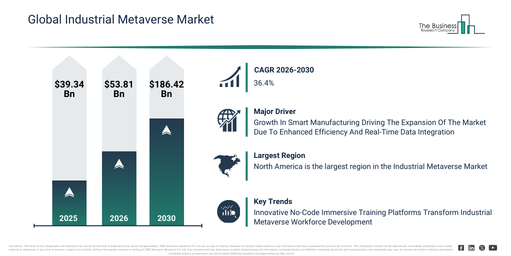
The industrial metaverse market has seen significant expansion in recent years. It is projected to grow from $39.34 billion in 2025 to $53.81 billion in 2026, achieving a compound annual growth rate (CAGR) of 36.8%. This historical growth can be attributed to several factors including the embrace of industrial automation, the wider application of digital twin technology, the proliferation of remote operations tools, the increasing demand for virtual training platforms, and the rise of smart manufacturing systems.
The industrial metaverse market size is anticipated to experience substantial growth over the next few years, expanding to $186.42 billion by 2030, demonstrating a compound annual growth rate (CAGR) of 36.4%. This projected growth can be attributed to the integration of AI-powered industrial simulations, the expansion of private 5G networks, the adoption of immersive collaboration tools, the increase in digital factory initiatives, and the growing application of mixed reality platforms. Key trends expected during this forecast period encompass virtual factory simulation, digital twin-based collaboration, remote workforce training, immersive maintenance platforms, and metaverse-based process optimization.
Free Industrial Metaverse Market Sample: Market Size, Growth Drivers And Competitive Landscape:
Industrial Metaverse Market Drivers Explained: What Is Supporting A 36.4% CAGR?
The industrial metaverse market is anticipated to expand, largely propelled by the advancement of smart manufacturing. Smart manufacturing involves employing advanced technologies like IoT, AI, robotics, and data analytics to optimize and automate real-time production processes. Its increasing prevalence stems from the wider adoption of IoT-enabled devices, which deliver real-time data insights, thereby boosting operational efficiency and automation. The industrial metaverse further enhances smart manufacturing by providing immersive, real-time digital environments that facilitate virtual prototyping, predictive maintenance, and streamlined production workflows. For instance, in February 2025, Gov.UK, a UK-based government department, reported that smart machines could significantly increase the UK’s Gross Value Added (GVA) across various sectors from approximately $8.1 billion (£6.4 billion) to an impressive $190 billion (£150 billion) by 2035. Consequently, the expansion of smart manufacturing is a key driver for the industrial metaverse market.
Industrial Metaverse Market Segment Guide: Main Divisions And Subsegments
The industrial metaverse market covered in this report is segmented –
1) By Component: Hardware, Software, Services
2) By Technology: Virtual Reality (VR), Artificial Intelligence (AI), Digital Twin, Blockchain, Private 5G, Edge Computing
3) By Organization Size: Large Enterprises, Small And Medium-Sized Enterprises (SME)
4) By Application: Product Design And Development, Virtual Prototyping, Training And Simulation, Remote Collaboration, Supply Chain Optimization, Other Applications
5) By End Use: Automotive, Healthcare, Logistics And Transportation, Manufacturing, Energy And Utilities, Other End Users
Subsegments:
1) By Hardware: AR Or VR Headsets, Sensors And IoT Devices, Edge Computing Devices, Mixed Reality Devices, Haptic Devices
2) By Software: Simulation Software, 3D Modeling And Design Software, Industrial IoT Platforms, Digital Twin Software, Artificial Intelligence (AI) And Machine Learning Software
3) By Services: Consulting And Integration Services, Maintenance And Support Services, Training And Education Services, Custom Software Development, Managed Services
Industrial Metaverse Market Trends And Opportunities For 2026–2030
Major companies operating within the industrial metaverse market are prioritizing the development of cutting-edge solutions, such as sophisticated immersive training platforms. These initiatives aim to significantly boost workforce productivity, mitigate operational risks, and decrease expenses associated with training. Advanced immersive training platforms are defined as technology-driven systems that utilize virtual, augmented, or mixed reality to replicate real-world industrial settings, thereby enabling safe, efficient, and interactive training for employees. A notable example is Altoura 6, an advanced immersive training platform specifically designed for the industrial metaverse, which was introduced by Altoura, a US-based information technology services provider, in March 2023. This platform empowers organizations to develop interactive 3D training experiences without requiring coding, leveraging artificial intelligence to automate content generation and analytics to monitor performance. Its accessibility across personal computers, mobile devices, and AR/VR headsets facilitates flexible, remote learning opportunities for frontline workers. Featuring enterprise-level security and self-service analytics, Altoura 6 is already utilized by prominent industrial corporations and is available as a Software-as-a-Service (SaaS) offering through Altoura and the Microsoft Azure Marketplace.
Which Major Players Are Active In The Industrial Metaverse Market?
Major companies operating in the industrial metaverse market are Microsoft Corporation, Amazon Web Services Inc., Robert Bosch GmbH, Siemens AG, Intel Corporation, International Business Machines Corporation, Schneider Electric SE, ABB Ltd., NVIDIA Corp., Nokia Corp., HCL Technologies Limited, Rockwell Automation Inc., Dassault Systèmes SE, Hexagon AB, Autodesk Inc., Ansys Inc., PTC Inc., AVEVA Group plc, Unity Technologies, HTC Corporation
Unlock The Complete Industrial Metaverse Market Report With Company Benchmarking:
Industrial Metaverse Market World Regions Compared: Which Leads In Revenue?
North America was the largest region in the industrial metaverse market in 2025. Asia-Pacific is expected to be the fastest-growing region in the forecast period. The regions covered in the industrial metaverse market report are Asia-Pacific, South East Asia, Western Europe, Eastern Europe, North America, South America, Middle East, Africa.
Reach Out To Our Team:
The Business Research Company: https://www.thebusinessresearchcompany.com/
Americas: +1 310-496-7795
Asia: +44 7882 955267 & +91 8897263534
Europe: +44 7882 955267
Email us at: marketing@tbrc.info
Follow us on:
LinkedIn: https://in.linkedin.com/company/the-business-research-company
YouTube: https://www.youtube.com/channel/UC24_fI0rV8cR5DxlCpgmyFQ
Global Market Model: https://www.thebusinessresearchcompany.com/global-market-model

Wasay has over a decade of experience in market research, data modelling, and analytics, with prior experience at GlobalData and Decision Tree Consulting Services. At The Business Research Company , he leads research operations across syndicated studies, customized consulting engagements, and the Global Market Model platform. His professional experience includes supporting organizations such as Boston Consulting Group, KPMG, and Ernst & Young. Wasay holds a degree in Electronics and Communications Engineering, postgraduate management qualifications from International Management Institute Belgium and Indian School of Business and Entrepreneurship, and completed the Integrated Program in Business Analytics from Indian Institute of Management Indore.