Featuring market attractiveness scoring, total addressable market sizing, company benchmarking matrices, interactive Excel dashboards, deeper supply chain intelligence, emerging startup tracking, and granular product-level insights, The Business Research Company’s 2026 market reports are built to deliver research that is both more actionable and more strategically valuable.
Industrial Precision Time Protocol (PTP) Time Synchronization Market Set To Climb From $1.71 Billion In 2026 To $2.66 Billion By 2030
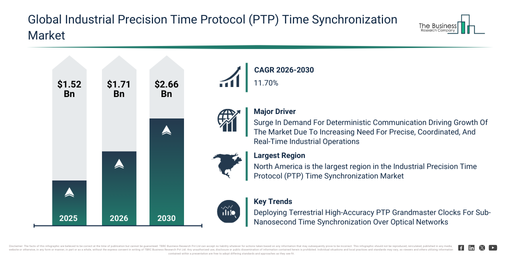
In recent years, the industrial precision time protocol (PTP) time synchronization market has seen substantial expansion in its size. It is projected to grow from $1.52 billion in 2025 to $1.71 billion in 2026, at a compound annual growth rate (CAGR) of 12.0%. Factors contributing to its historical growth include the wider adoption of industrial automation, an elevated requirement for precise time synchronization in manufacturing settings, the increasing deployment of ethernet based communication networks, the advancement of smart grid modernization initiatives, and an enhanced emphasis on minimizing operational downtime.
The industrial precision time protocol (PTP) time synchronization market is projected to experience substantial growth over the next few years, reaching $2.66 billion by 2030, with a compound annual growth rate (CAGR) of 11.7%. This expansion during the forecast period is attributed to factors such as increased integration with Industrial Internet of Things (IIoT) technologies, a growing demand for ultra-low latency industrial communication, the wider adoption of autonomous and connected industrial systems, the expansion of high-precision control applications, and an increase in smart factory and digital twin deployments. Significant trends expected in this period include technology-driven precision timing innovations, advancements in hardware-based timestamping solutions, developments in network timing accuracy and security technologies, rising research and development in deterministic industrial networking, and innovations in scalable and interoperable precision time protocol architectures.
Get A Free Sample Report With In-Depth Market Insights:
Industrial Precision Time Protocol (PTP) Time Synchronization Market Demand Drivers: What’s Powering Industry Growth?
The growing requirement for deterministic communication in fields such as robotics, process control, and industrial IoT is projected to fuel the expansion of the industrial precision time protocol time synchronization market. Deterministic communication involves sending data across a network within very specific timeframes, guaranteeing consistent latency and minimal variation, which is vital for synchronized control in real-time industrial settings. The heightened need for this type of communication stems from the increased use of advanced automation, collaborative robots, and process control systems that demand exact timing to uphold operational safety, reduce mistakes, and enhance efficiency. Industrial precision time protocol time synchronization facilitates deterministic communication by achieving sub-microsecond time synchronization among devices, ensuring controllers, sensors, and actuators function in perfect coordination. An illustration of this is the September 2024 report by the International Federation of Robotics, a Switzerland-based robotics association, which indicated that the global number of operational industrial robots rose from around 3.9 million in 2022 to more than 4.28 million in 2023, representing a 9.7% increase from 2022. Consequently, the increasing need for deterministic communication across robotics, process control, and industrial IoT sectors is stimulating the growth of the industrial precision time protocol time synchronization market. The growing emphasis on improving reliability and minimizing downtime within industrial environments is projected to stimulate the expansion of the industrial precision time protocol time synchronization market. Industrial reliability pertains to the steady and continuous functioning of equipment and processes, essential for achieving production targets and upholding safety and quality benchmarks. Industrial operators are increasingly prioritizing reliability and downtime reduction because unforeseen stoppages and unexpected breakdowns directly diminish productivity, revenue, and competitive advantage. Industrial precision time protocol time synchronization aids this objective by allowing for accurate, deterministic clock synchronization across controllers, sensors, machinery, and networks, thereby enhancing system coordination, improving real-time oversight, and facilitating quicker identification and resolution of operational problems. As an illustration, a MaintainX report from August 2024, by a US-based software firm, indicated that 85% of facilities noted either stable or reduced unplanned downtime in the preceding year, even as operational expenses linked to downtime grew, leading maintenance leaders to stress proactive approaches for asset reliability and disruption reduction; the report highlighted typical unplanned downtime costs of approximately $25,000 per hour, with major corporations facing expenses exceeding $500,000 per hour. Thus, the heightened focus on boosting reliability and cutting downtime in industrial settings is propelling the growth of the industrial precision time protocol time synchronization market.
Industrial Precision Time Protocol (PTP) Time Synchronization Market Segmentation: How Does The Market Break Down By Category?
The industrial precision time protocol (ptp) time synchronization market covered in this report is segmented –
1) By Component: Hardware, Software, Services
2) By Deployment Mode: On-Premises, Cloud
3) By Application: Industrial Automation, Smart Factories, Process Control, Robotics And Manufacturing, Power And Energy, Telecommunications, Transportation, Aerospace And Defense
4) By End-User: Manufacturing Industries, Energy And Utilities, Automotive Industry, Aerospace And Defense, Oil And Gas, Information Technology And Telecom, Financial Services
Subsegments:
1) By Hardware: Grandmaster Clocks, Boundary Clocks, Slave Clocks
2) By Software: PTP Management Software, Network Monitoring Software, Synchronization Control Software
3) By Services: Installation And Integration Services, Maintenance And Support Services, Consulting And Training Services
Industrial Precision Time Protocol (PTP) Time Synchronization Market Innovation Trends: What Developments Are Reshaping The Industry?
Leading companies within the industrial precision time protocol time synchronization market are prioritizing the creation of land-based, highly accurate grandmaster clock systems. These systems aim to furnish sub-nanosecond coordinated time across extensive optical networks, without relying on GNSS. Such terrestrial high-accuracy grandmaster clock solutions represent ground-based timing systems engineered to deliver exceptionally precise and stable time and frequency references to networks. They achieve this using local oscillators and synchronization protocols, such as PTP, bypassing the need for satellite-derived signals. As an illustration, in October 2025, Microchip Technology Inc., a semiconductor and timing systems firm based in the United States, introduced the TimeProvider 4500 v3 grandmaster clock. This device offers sub-nanosecond precision through High Accuracy Time Transfer (HA-TT) across optical networks, is compatible with standard Ethernet and optical interfaces, and provides a land-based substitute for GNSS timing by leveraging UTC(k) references sourced from national metrology laboratories. This particular clock attains an approximate 5 ns time delay across 800 km (equating to roughly 500 ps on average per node), supports various operational configurations including virtual Primary Reference Time Clock (vPRTC) architectures, and adheres to the developing carrier-grade PTP standards vital for synchronizing critical infrastructure.
Industrial Precision Time Protocol (PTP) Time Synchronization Market Competitive Landscape: Which Companies Lead The Industry?
Major companies operating in the industrial precision time protocol (ptp) time synchronization market are Siemens AG, Cisco Systems Inc., Safran S.A., Microchip Technology Inc., Juniper Networks Inc, Trimble Inc., Seiko Solutions Inc., World Time Solutions Ltd., EndRun Technologies Inc., Brandywine Communications Inc., FEI-Zyfer Inc., Moxa Inc., Oscilloquartz SA, Calnex Solutions Ltd., Galleon Systems Limited, Meinberg Funkuhren GmbH & Co. KG, Moser-Baer AG, National Instruments Corp., Elproma Elektronika Sp. z o.o., Masterclock Inc., Chronos Technology Ltd., Scientific Devices Australia Pty Ltd., BDStar Time Technology Co. Ltd.
View The Full Industrial Precision Time Protocol (PTP) Time Synchronization Market Report:
Industrial Precision Time Protocol (PTP) Time Synchronization Market Regional Outlook: Where Is Opportunity Concentrated?
North America was the largest region in the industrial precision time protocol (PTP) time synchronization market in 2025. Asia-Pacific is expected to be the fastest-growing region in the forecast period. The regions covered in the industrial precision time protocol (ptp) time synchronization market report are Asia-Pacific, South East Asia, Western Europe, Eastern Europe, North America, South America, Middle East, Africa.
Reach Out To Our Team:
The Business Research Company: https://www.thebusinessresearchcompany.com/
Americas: +1 310-496-7795
Asia: +44 7882 955267 & +91 8897263534
Europe: +44 7882 955267
Email us at: marketing@tbrc.info
Follow us on:
LinkedIn: https://in.linkedin.com/company/the-business-research-company
YouTube: https://www.youtube.com/channel/UC24_fI0rV8cR5DxlCpgmyFQ
Global Market Model: https://www.thebusinessresearchcompany.com/global-market-model

Wasay has over a decade of experience in market research, data modelling, and analytics, with prior experience at GlobalData and Decision Tree Consulting Services. At The Business Research Company , he leads research operations across syndicated studies, customized consulting engagements, and the Global Market Model platform. His professional experience includes supporting organizations such as Boston Consulting Group, KPMG, and Ernst & Young. Wasay holds a degree in Electronics and Communications Engineering, postgraduate management qualifications from International Management Institute Belgium and Indian School of Business and Entrepreneurship, and completed the Integrated Program in Business Analytics from Indian Institute of Management Indore.