Delivering more actionable and strategically valuable research, The Business Research Company’s 2026 market reports feature market attractiveness analysis, total addressable market evaluation, company benchmarking matrices, interactive Excel dashboards, expanded supply chain intelligence, emerging startup coverage, and detailed product insights.
Industrial Robotics Market Growth Analysis: How Will Revenue Expand During The Forecast Period?
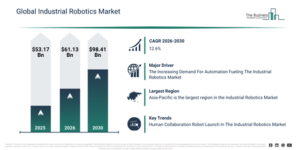
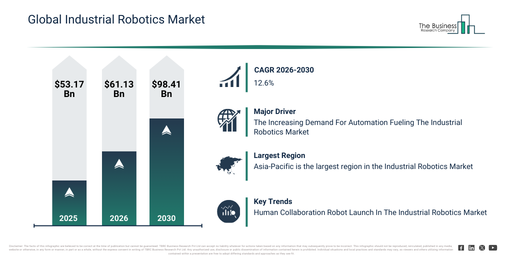
The industrial robotics market has experienced significant expansion in recent times. Valued at $53.17 billion in 2025, it is projected to rise to $61.13 billion by 2026, reflecting a compound annual growth rate (CAGR) of 15.0%. This historical growth is driven by factors such as growing labor shortages within the manufacturing sector, the broadening of automotive manufacturing lines, an increased emphasis on production uniformity, the uptake of robotic technologies for welding and assembly tasks, and enhancements in robot precision and load-bearing capabilities.
The industrial robotics market is projected to experience substantial expansion over the coming years. By 2030, its value is anticipated to reach $98.41 billion, reflecting a compound annual growth rate (CAGR) of 12.6%. This upward trajectory during the forecast period can be explained by several key factors, including rising investments in smart manufacturing robotics, a growing integration of AI-driven robot control systems, the broadening application of robotics in sectors beyond automotive, an increasing demand for adaptable and reconfigurable robots, and a heightened emphasis on human-robot collaboration. Among the notable developments shaping this period are the growing deployment of collaborative robots, the widespread adoption of flexible robotic automation cells, the expanding incorporation of vision-guided robotics, the increasing use of robots for material handling, and a stronger focus on achieving high precision in industrial robots.
Download A Free Sample Report For Comprehensive Market Insights:
https://www.thebusinessresearchcompany.com/sample.aspx?id=15393&type=smp
Industrial Robotics Market Opportunity Drivers: What Is Creating New Revenue Potential?
The rising need for automation in industrial settings is anticipated to accelerate the expansion of the industrial robotics market in the coming period. Industrial automation involves the application of control systems, robotic technology, sensors, and software to manage manufacturing processes with limited human involvement. This demand is being fueled by factors such as greater operational efficiency, workforce shortages, cost reduction efforts, and the push for digital transformation in production environments. The industrial robotics sector supports this development by offering precise, adaptable, and scalable automation solutions that boost manufacturing speed, enhance workplace safety, and maintain consistent output. For example, the International Federation of Robotics, a non-profit entity headquartered in Germany, reported in September 2025 that 542,000 industrial robots were deployed in 2024, bringing the worldwide operational fleet to 4.66 million units—a 9% rise compared to the previous year. Consequently, the growing appetite for industrial automation is propelling forward the industrial robotics market.
Industrial Robotics Market Segmentation And Category Breakdown
The industrial robotics market covered in this report is segmented –
1) By Type: Articulated Robots, Cartesian Coordinate Robots, Cylindrical-Coordinate Robots, Spherical Coordinate Robots, Selective Compliance Assembly Robot Arm (SCARA) Robots, Other Types
2) By Application: Welding And Soldering, Material Handling, Assembling And Disassembling, Dispensing, Processing, Other Applications
3) By End-User: Automotive, Electrical And Electronics, Metals And Machinery, Plastics, Rubbers, And Chemicals, Food And Beverages, Precision Engineering And Optics, Pharmaceuticals And Cosmetics, Other End Users
Subsegments:
1) By Articulated Robots: 6-Axis Robots, 7-Axis Robots, Heavy Duty Articulated Robots
2) By Cartesian Coordinate Robots: Linear Robots, Gantry Robots, Pick-and-Place Robots
3) By Cylindrical-Coordinate Robots: Radial Arm Robots, Polar Coordinate Robots
4) By Spherical Coordinate Robots: Polar Robots: Multi-axis Spherical Robots
5) By Selective Compliance Assembly Robot Arm (SCARA) Robots: 4-Axis SCARA Robots, High-speed SCARA Robots
6) By Other Types: Delta Robots, Collaborative Robots (Cobots), Parallel Robots (Platform Robots)
Industrial Robotics Market Innovation Trends Driving Future Development
Leading firms in the industrial robotics sector are intensively focusing on creating innovative solutions like collaborative robots designed for human interaction, aiming to boost workplace safety, adaptability, and efficiency. A collaborative robot represents a type of robotic system engineered to operate directly alongside human employees, facilitating secure interaction, flexible task distribution, and heightened automation within manufacturing and logistics environments. In May 2023, for example, FANUC America—a company based in the US specializing in industrial robotics and automation—unveiled new high-payload cobots within its CRX and CR series. These models extend collaborative robot capabilities to handle loads of up to 50 kg, specifically engineered for human-machine cooperation in demanding industrial tasks. This update was debuted at Automate 2023, where the company demonstrated the CRX-25 i A, supporting a 30 kg payload, and the CR-35 i B, capable of a 50 kg payload, featuring extended reach, user-friendly programming, and human-oriented interaction. By expanding payload capacity, incorporating intuitive drag-and-drop programming, and integrating advanced safety mechanisms, these robots can more seamlessly collaborate with human workers and take on more substantial tasks, thereby enhancing operational efficiency and flexibility.
Industrial Robotics Market Competitive Analysis Of Major Industry Participants
Major companies operating in the industrial robotics market are ABB Group, FANUC Corporation, YASKAWA Electric Corporation, KUKA AG, Kawasaki Heavy Industries Ltd., Mitsubishi Electric Corporation, Denso Corporation, Panasonic Corporation, Seiko Epson Corporation, Omron Corporation, Nachi-Fujikoshi Corporation, Comau SpA, Stäubli International AG, Shibaura Machine Co. Ltd., Daihen Corporation, Siasun Robot & Automation Co. Ltd., Estun Automation, HyundAI Robotics, Universal Robots A/S, Techman Robot Inc., Doosan Robotics, Yamaha Motor Co., Ltd.
Access The Complete Industrial Robotics Market Report:
https://www.thebusinessresearchcompany.com/report/industrial-robotics-global-market-report
Industrial Robotics Market Regional Analysis And Leading Geography
Asia-Pacific was the largest region in the industrial robotics market in 2025. Europe is expected to be the fastest-growing region in the forecast period. The regions covered in the industrial robotics market report are Asia-Pacific, South East Asia, Western Europe, Eastern Europe, North America, South America, Middle East, Africa.
Access a Customized Industrial Robotics Market Report for Deeper Competitive Insights
https://www.thebusinessresearchcompany.com/sample.aspx?id=15393&type=smp
Get in touch with us:
The Business Research Company: https://www.thebusinessresearchcompany.com/
Americas: +1 310-496-7795
Asia: +44 7882 955267 & +91 8897263534
Europe: +44 7882 955267
Email us at: marketing@tbrc.info
Follow us on:
LinkedIn: https://in.linkedin.com/company/the-business-research-company
YouTube: https://www.youtube.com/channel/UC24_fI0rV8cR5DxlCpgmyFQ
Global Market Model: https://www.thebusinessresearchcompany.com/global-market-model

Wasay has over a decade of experience in market research, data modelling, and analytics, with prior experience at GlobalData and Decision Tree Consulting Services. At The Business Research Company , he leads research operations across syndicated studies, customized consulting engagements, and the Global Market Model platform. His professional experience includes supporting organizations such as Boston Consulting Group, KPMG, and Ernst & Young. Wasay holds a degree in Electronics and Communications Engineering, postgraduate management qualifications from International Management Institute Belgium and Indian School of Business and Entrepreneurship, and completed the Integrated Program in Business Analytics from Indian Institute of Management Indore.