The Business Research Company’s 2026 market reports combine market attractiveness scoring, total addressable market sizing, company benchmarking matrices, interactive Excel dashboards, deeper supply chain intelligence, emerging startup tracking, and granular product-level insights to deliver research that is more actionable and strategically valuable.
Industry 4.0 Market Revenue Forecast: $238.89 Billion In 2026 Rising To $459.68 Billion In 2030
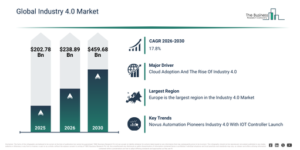
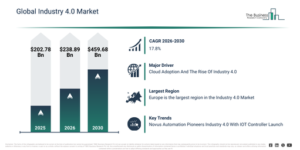
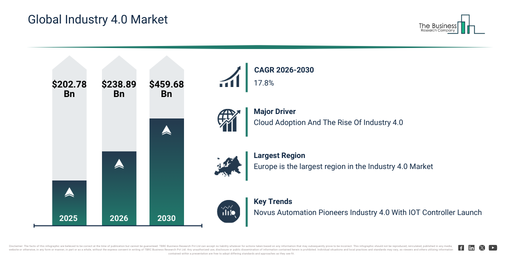
The industry 4.0 market size has experienced rapid growth in recent years. This market is projected to expand from $202.78 billion in 2025 to $238.89 billion in 2026, demonstrating a compound annual growth rate (CAGR) of 17.8%. Historically, this expansion can be linked to factors such as increased automation adoption in manufacturing, the imperative for productivity enhancements, continuous advancements in industrial robotics, a growing demand for quality optimization, and the proliferation of connected devices.
The Industry 4.0 market is projected to undergo significant expansion in the coming years. Its valuation is expected to reach $459.68 billion by 2030, growing at a compound annual growth rate (CAGR) of 17.8%. This anticipated growth during the forecast period stems from factors such as the broadening of smart manufacturing initiatives, the increased application of AI in production, the demand for real-time decision-making, the incorporation of digital twins, and the advancement of flexible manufacturing systems. Prominent trends throughout this period are expected to include the implementation of smart factories, the deployment of connected manufacturing systems, the rollout of predictive maintenance, the integration of digital twins, and the establishment of autonomous production processes.
Free Sample Report: Industry 4.0 Market Size, Trends And Forecast To 2030:
Industry 4.0 Market Growth Catalyst: What Is Creating New Demand?
The increasing integration of cloud technologies is projected to drive the expansion of the Industry 4.0 market in the future. Cloud adoption describes the methodical approach and plan businesses, organizations, and individuals employ to transition their computational resources, data, applications, and services from local infrastructures to cloud-hosted platforms. This adoption is a crucial facilitator for Industry 4.0, offering essential infrastructure and utilities that enable manufacturers to implement digital transformation, boost operational efficiency, and maintain competitiveness within a progressively interconnected and data-reliant industrial sector. An illustrative example comes from 2023, where the European Commission (EC), the executive body of the European Union (EU) based in Belgium, reported that node deployment grew significantly from 498 in 2022 to an estimated 1,836 in 2024. Consequently, the rising prevalence of cloud adoption is fueling the expansion of the Industry 4.0 market.
Industry 4.0 Market Segment Overview: Categories Covered In The 2026 Report
The industry 4.0 market covered in this report is segmented –
1) By Technology: Industrial Robots, Blockchain, Industrial Sensors, Industrial 3D Printing, Machine Vision, Human Machine Interface (HMI), Artificial Intelligence In Manufacturing, Digital Twin, Automatic Guided Vehicles (AGV), Machine Condition Monitoring
2) By Component: Solution, Services
3) By Enterprise Size: Small And Medium Enterprises, Large Enterprise
4) By End-User: Manufacturing, Automotive, Oil And Gas, Energy And Utilities, Electronics And Foundry, Food And Beverage, Aerospace And Defense, Other End-Users
Subsegments:
1) By Industrial Robots: Articulated Robots, Collaborative Robots (Cobots), SCARA Robots
2) By Blockchain: Supply Chain Management Solutions, Data Security Applications, Smart Contracts
3) By Industrial Sensors: Temperature Sensors, Pressure Sensors, Proximity Sensors
4) By Industrial 3D Printing: Additive Manufacturing Systems, Materials For 3D Printing, Software For Design And Simulation
5) By Machine Vision: Image Processing Systems, Quality Inspection Solutions, Identification And Tracking Systems
6) By Human Machine Interface (HMI): Touchscreen Panels, Software Interfaces, Remote Monitoring Tools
7) By Artificial Intelligence In Manufacturing: Predictive Maintenance Tools, Production Optimization Software, Quality Control Algorithms
8) By Digital Twin: Simulation Software, Monitoring And Analytics Platforms, Integration Solutions With IoT
9) By Automatic Guided Vehicles (AGV): Navigation Systems, Fleet Management Software, Charging And Maintenance Solutions
10) By Machine Condition Monitoring: Vibration Analysis Tools, Temperature Monitoring Systems, Acoustic Emission Monitoring Systems
How Are Leading Companies Shaping Industry 4.0 Market Trends?
Leading companies operating in the market are launching new products, such as IoT controllers, to enhance their market profitability. In Industry 4.0, an Internet of Things (IoT) controller refers to a device or system responsible for managing and coordinating connected devices, sensors, and machines within a smart industrial environment. For instance, in May 2023, NOVUS Automation, a Brazil-based manufacturer specializing in data solutions and process control, introduced the N20K48. The N20K48 controller features a robust core controller and expandable micromodules, catering to diverse industrial requirements. This N20K48 model improves Industry 4.0 integration with a Wi-Fi micromodule, enabling seamless communication and the incorporation of legacy devices. This innovation centralizes data on a single network, streamlining real-time monitoring and issue identification in production processes. Tailored specifically for industrial applications, the N20K48 reflects NOVUS Automation’s dedication to delivering advanced instruments for control, data acquisition, and SCADA systems.
Industry 4.0 Market Players: Key Companies Shaping Competition
Major companies operating in the industry 4.0 market are Siemens AG; General Electric Company; Intel Corporation; International Business Machines Corporation; Cisco Systems Inc.; Mitsubishi Electric Corporation; Honeywell International Inc.; ABB Ltd.; NVIDIA Corporation; Emerson Electric Co; Rockwell Automation Inc.; Omron Corporation; Bosch Rexroth AG; Fanuc Corporation; Dassault Systemes SE; Daifuku Co Ltd.; KUKA AG; Advantech Co Ltd.; PTC Inc.; Cognex Corporation; Stratasys Ltd.; 3D Systems Inc.; John Bean Technologies Corporation; Universal Robots A/S; Basler AG; Techman Robot Inc.; Addverb Technologies Limited; Algolux; AIBrain Inc.; Beckhoff Automation Pvt. Ltd.
Access Complete Industry 4.0 Market Data, Forecasts And Competitive Insights:
Industry 4.0 Market Regional Performance And Geographic Coverage
Europe was the largest region in the industry 4.0 market in 2025. Asia-Pacific is expected to be the fastest-growing region in the forecast period. The regions covered in the industry 4.0 market report are Asia-Pacific, South East Asia, Western Europe, Eastern Europe, North America, South America, Middle East, Africa.
Reach Out To Our Team:
The Business Research Company: https://www.thebusinessresearchcompany.com/
Americas: +1 310-496-7795
Asia: +44 7882 955267 & +91 8897263534
Europe: +44 7882 955267
Email us at: marketing@tbrc.info
Follow us on:
LinkedIn: https://in.linkedin.com/company/the-business-research-company
YouTube: https://www.youtube.com/channel/UC24_fI0rV8cR5DxlCpgmyFQ
Global Market Model: https://www.thebusinessresearchcompany.com/global-market-model

Wasay has over a decade of experience in market research, data modelling, and analytics, with prior experience at GlobalData and Decision Tree Consulting Services. At The Business Research Company , he leads research operations across syndicated studies, customized consulting engagements, and the Global Market Model platform. His professional experience includes supporting organizations such as Boston Consulting Group, KPMG, and Ernst & Young. Wasay holds a degree in Electronics and Communications Engineering, postgraduate management qualifications from International Management Institute Belgium and Indian School of Business and Entrepreneurship, and completed the Integrated Program in Business Analytics from Indian Institute of Management Indore.