Designed to make market research more actionable and strategically valuable, The Business Research Company’s 2026 market reports feature market attractiveness scoring, total addressable market sizing, company benchmarking matrices, interactive Excel dashboards, deeper supply chain intelligence, emerging startup tracking, and granular product-level insights.
Integrated Delivery Networks Market To Expand At A 10.3% CAGR: Size And Growth Projections Through 2030
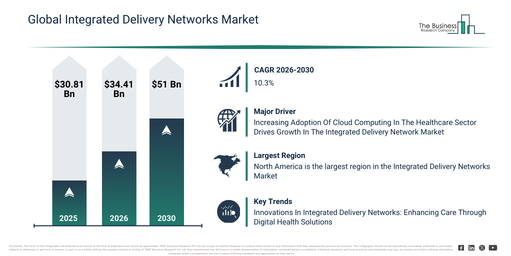
The integrated delivery networks market has experienced rapid expansion in recent years. This market is projected to grow from $30.81 billion in 2025 to $34.41 billion in 2026, achieving a compound annual growth rate (CAGR) of 11.7%. Historically, this growth can be attributed to the consolidation of healthcare provider networks, the expansion of hospital systems, rising healthcare cost pressures, an increased focus on coordinated patient care, and the adoption of electronic health records across providers.
The market for integrated delivery networks is projected to experience substantial expansion over the upcoming years. This market is anticipated to reach $51 billion by 2030, exhibiting a compound annual growth rate (CAGR) of 10.3%. This projected growth during the forecast period is driven by several factors, including heightened investments in digital health infrastructure, a rising demand for reimbursement models based on outcomes, the broader integration of remote and virtual care, a stronger focus on preventive healthcare services, and the expanded application of analytics in coordinating care. Key trends expected within this period encompass the increasing embrace of integrated care delivery models, a surge in data-driven population health management, the deeper integration of clinical and administrative systems, the broadening of value-based care frameworks, and improved coordination throughout the care continuum.
Get Your Free Integrated Delivery Networks Market Report Sample Today:
Which Factor Is Expected To Drive The Integrated Delivery Networks Market Over The Forecast Period?
The integrated delivery network market is projected to grow as a result of the increasing implementation of cloud computing within the healthcare sector. Cloud computing involves the provision of various computing services, including servers, data storage, databases, networking capabilities, and software, over the internet (referred to as ‘the cloud’). The rising adoption of cloud computing in healthcare is driven by the demand for economical data storage, remote access to patient information, enhanced data security, and improved collaboration among providers. This embrace of cloud technology helps integrate healthcare systems by facilitating data exchange, improving care coordination, boosting patient outcomes, and reducing operational costs through more efficient processes. For example, in November 2023, GHX, a US-based software-as-a-service company, indicated that nearly 70% of all US hospitals and health systems are expected to adopt cloud-based supply chain management by 2026. Around 45% have already transitioned to cloud technologies for this purpose, with many more anticipated to follow in the next two years. Therefore, the expanding use of cloud computing in the healthcare sector is a key driver for the growth of the integrated delivery network market.
Integrated Delivery Networks Market Segmentation Insights: How Is The Industry Categorized?
The integrated delivery networks market covered in this report is segmented –
1) By Type: Vertical Integration, Horizontal Integration
2) By Characteristics: Provider Alignment, Continuum Of Care, Clinical Integration, Regional Presence
3) By Application: Acute Care Hospitals, Primary Care, Long-Term Health, Specialty Clinics, Other Applications
Subsegments:
1) By Vertical Integration: Hospital-Based Vertical Integration, Physician Group Vertical Integration, Integrated Health Systems
2) By Horizontal Integration: Multi-Hospital Systems, Regional Healthcare Networks
Integrated Delivery Networks Market Trends Explained: What Is Changing And Why It Matters
Leading firms within the integrated delivery network market are concentrating on creating novel solutions, like real-world data (RWD) solutions, with the aim of improving patient care and health outcomes. Real-world data (RWD) solutions are defined as systems and tools designed to gather, consolidate, and examine information derived from routine healthcare encounters, including electronic health records (EHRs), claims and billing information, data produced by patients (for example, from wearable devices), and disease registries. As an illustration, during April 2024, OMNY Health, a biotechnology research enterprise based in the US, introduced a fresh collection of real-world data (RWD) solutions specifically designed for gastroenterology research, in collaboration with prominent community-based GI practices throughout the United States. This project incorporates data from over 5,000 GI providers, attending to more than 10 million patients, into OMNY’s expansive research network, which currently comprises around 380,000 providers and affects roughly 75 million patients. These solutions utilize de-identified electronic health records (EHRs) to provide valuable insights into patient demographics, treatment patterns, the severity of diseases, and the impact of social determinants on healthcare choices, with the ultimate goal of advancing research and bettering patient outcomes in gastroenterology.
Integrated Delivery Networks Market Competitor Landscape: Who Are The Major Companies?
Major companies operating in the integrated delivery networks market are CommonSpirit Health, Ascension Health, Trinity Health, Tenet Healthcare Corporation, Mass General Brigham Incorporated, Mayo Clinic Health System, Sutter Health, Bon Secours Mercy Health, Banner Health, Advocate Health, Northwell Health, Geisinger Health, NewYork-Presbyterian Hospital, Adventist Health, Cleveland Clinic, Intermountain Health, Kaiser Permanente, HCA Healthcare, Providence Health & Services, UPMC (University of Pittsburgh Medical Center), Johns Hopkins Health System
See The Full Integrated Delivery Networks Market Report For Complete Market Sizing And Trends:
Integrated Delivery Networks Market Regional Demand Analysis And Leading Geography
North America was the largest region in the integrated delivery networks market in 2025. Asia-Pacific is expected to be the fastest-growing region in the forecast period. The regions covered in the integrated delivery networks market report are Asia-Pacific, South East Asia, Western Europe, Eastern Europe, North America, South America, Middle East, Africa.
Reach Out To Our Team:
The Business Research Company: https://www.thebusinessresearchcompany.com/
Americas: +1 310-496-7795
Asia: +44 7882 955267 & +91 8897263534
Europe: +44 7882 955267
Email us at: marketing@tbrc.info
Follow us on:
LinkedIn: https://in.linkedin.com/company/the-business-research-company
YouTube: https://www.youtube.com/channel/UC24_fI0rV8cR5DxlCpgmyFQ
Global Market Model: https://www.thebusinessresearchcompany.com/global-market-model

Wasay has over a decade of experience in market research, data modelling, and analytics, with prior experience at GlobalData and Decision Tree Consulting Services. At The Business Research Company , he leads research operations across syndicated studies, customized consulting engagements, and the Global Market Model platform. His professional experience includes supporting organizations such as Boston Consulting Group, KPMG, and Ernst & Young. Wasay holds a degree in Electronics and Communications Engineering, postgraduate management qualifications from International Management Institute Belgium and Indian School of Business and Entrepreneurship, and completed the Integrated Program in Business Analytics from Indian Institute of Management Indore.