
Featuring market attractiveness scoring, total addressable market sizing, company benchmarking matrices, interactive Excel dashboards, deeper supply chain intelligence, emerging startup tracking, and granular product-level insights, The Business Research Company’s 2026 market reports are built to deliver research that is both more actionable and more strategically valuable.
Internet Of Things (IoT) Precision Agriculture Sensors Market CAGR Outlook And Future Development
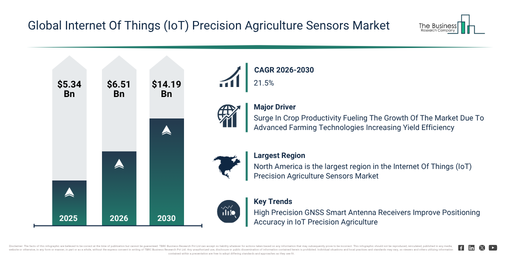
The market size for internet of things (IOT) precision agriculture sensors has witnessed exponential growth in recent years. This market is projected to expand from $5.34 billion in 2025 to $6.51 billion in 2026, demonstrating a compound annual growth rate (CAGR) of 21.9%. Historically, this expansion has been driven by factors such as the increasing embrace of precision farming methods, a greater need for enhanced crop productivity, heightened awareness regarding water conservation, the proliferation of smart farming projects, and governmental backing for digital agriculture.
The internet of things (IOT) precision agriculture sensors market size is projected to undergo significant expansion in the coming years, reaching $14.19 billion by 2030, demonstrating a compound annual growth rate (CAGR) of 21.5%. This projected growth is driven by several factors including the rising adoption of autonomous farming equipment, increased investments in connected agriculture infrastructure, a growing need for climate-resilient farming solutions, the expanded deployment of advanced agricultural analytics, and the increasing demand for efficient livestock monitoring. Prominent trends for this forecast period include the escalating adoption of multi-parameter agricultural sensors, the wider deployment of real-time farm monitoring systems, a heightened demand for remote crop and livestock monitoring, the broadening of sensor-based precision irrigation solutions, and the enhanced integration of predictive farm management platforms.
Get A Free Sample Report With In-Depth Market Insights:
Internet Of Things (IoT) Precision Agriculture Sensors Market Growth Factors Behind Sustained Expansion
The expansion of the Internet of Things (IoT) precision agriculture sensors market in the future is projected to be driven by enhanced crop productivity. Crop productivity is defined as the quantity of agricultural produce yielded per unit of land over a specified period. The increase in crop productivity is a result of the growing adoption of precision agriculture technologies, which optimize resource utilization, boost farming efficiency, and improve harvest yields. Internet of Things (IoT) precision agriculture sensors contribute to crop productivity by continuously monitoring soil moisture, nutrient levels, and weather conditions in real time, empowering farmers to make data-backed decisions that optimize irrigation, fertilization, and overall crop management for higher yields. For instance, in March 2026, according to the Australian Bureau of Statistics, an Australia-based government department, Australia’s 2024–25 winter broadacre crops amounted to 61.1 million tonnes with a value of $22.5 billion, including 34.8 million tonnes of wheat, which marked an increase of 6.8 million tonnes. Thus, the rising crop productivity is fueling the growth of the Internet of Things (IoT) precision agriculture sensors market.
Internet Of Things (IoT) Precision Agriculture Sensors Market Segment Analysis: What Are The Core Market Categories?
The internet of things (iot) precision agriculture sensors market covered in this report is segmented –
1) By Component: Hardware, Software, Services
2) By Farm Type: Large Farms, Mid Sized Farms, Small Farms
3) By Connectivity: Long Range Wide Area Network, Cellular, Satellite, Wireless Fidelity And Zigbee
4) By Application: Field Crop Monitoring, Irrigation Management, Greenhouse Automation, Livestock Management, Precision Spraying And Fertilization
5) By End Use: Individual Farmers, Agricultural Cooperatives, Research Institutions
Subsegments:
1) By Hardware: Soil Sensors, Weather Monitoring Stations, Crop Monitoring Sensors, Livestock Monitoring Devices, Irrigation Control Devices, Connectivity Modules
2) By Software: Farm Management Software, Device Management Platforms, Data Analytics Platforms, Predictive Analytics Platforms, Cloud Based Platforms
3) By Services: Installation And Integration Services, Deployment Services, Consulting Services, Training And Education Services, Maintenance And Support Services, Managed Services
Internet Of Things (IoT) Precision Agriculture Sensors Market Industry Trends Fueling Future Revenue Growth
Leading companies in the IoT precision agriculture sensors market are concentrating on developing sophisticated solutions, including dual-band GNSS smart antenna receivers, to enhance positioning accuracy, facilitate precise field operations, and boost the performance of connected agricultural equipment. A dual-band GNSS smart antenna receiver functions as an integrated positioning device that concurrently receives multiple satellite frequency bands to supply highly accurate real-time location data for precision farming applications. For example, in September 2024, Quectel Wireless Solutions, a China-based IoT solutions provider, introduced the QLM29H series GNSS smart antenna receiver. This solution incorporates a dual-band multi-constellation GNSS module with an integrated antenna, offering meter-level autonomous positioning and centimeter-level real-time kinematic (RTK) accuracy. Tailored for applications like precision agriculture and tractor steering systems, it streamlines system integration while simultaneously improving positioning reliability and operational efficiency in smart farming environments.
Internet Of Things (IoT) Precision Agriculture Sensors Market Top Companies Driving Competitive Growth
Major companies operating in the internet of things (iot) precision agriculture sensors market are Semtech Corporation, Phytech Ltd., Ag Leader Technology Inc., xFarm Technologies S.r.l., Semios Technologies Inc., METER Group Inc. USA, Davis Instruments Corporation, CropX Technologies Ltd., Libelium Comunicaciones Distribuidas S.L., Monnit Corporation, PsiBorg Technologies Private Limited, Arable Labs Inc., GroPoint Environmental Systems Ltd., Saturas Ltd., Pycno Ltd., Acclima Inc., AquaSpy Inc., Vegetronix Inc., Sol Chip Ltd., Cynomys S.A.S., Robert Bosch GmbH, Sentek Technologies, Trimble Inc.
View The Full Internet Of Things (IoT) Precision Agriculture Sensors Market Report:
Internet Of Things (IoT) Precision Agriculture Sensors Market Regional Analysis And Top Geography
North America was the largest region in the internet of things (IoT) precision agriculture sensors market in 2025. Asia-Pacific is expected to be the fastest-growing region in the forecast period. The regions covered in the internet of things (IoT) precision agriculture sensors market report are Asia-Pacific, South East Asia, Western Europe, Eastern Europe, North America, South America, Middle East, Africa.
Reach Out To Our Team:
The Business Research Company: https://www.thebusinessresearchcompany.com/
Americas: +1 310-496-7795
Asia: +44 7882 955267 & +91 8897263534
Europe: +44 7882 955267
Email us at: marketing@tbrc.info
Follow us on:
LinkedIn: https://in.linkedin.com/company/the-business-research-company
YouTube: https://www.youtube.com/channel/UC24_fI0rV8cR5DxlCpgmyFQ
Global Market Model: https://www.thebusinessresearchcompany.com/global-market-model

Wasay has over a decade of experience in market research, data modelling, and analytics, with prior experience at GlobalData and Decision Tree Consulting Services. At The Business Research Company , he leads research operations across syndicated studies, customized consulting engagements, and the Global Market Model platform. His professional experience includes supporting organizations such as Boston Consulting Group, KPMG, and Ernst & Young. Wasay holds a degree in Electronics and Communications Engineering, postgraduate management qualifications from International Management Institute Belgium and Indian School of Business and Entrepreneurship, and completed the Integrated Program in Business Analytics from Indian Institute of Management Indore.