Built to provide research that’s more actionable and strategically valuable, The Business Research Company’s 2026 market reports include market attractiveness analysis, total addressable market sizing, company benchmarking matrices, interactive Excel dashboards, broader supply chain intelligence, emerging startup tracking, and in-depth product insights.
Internet Of Things (IoT) Connectivity Policy Control Market Value Growth And Long-Term Outlook
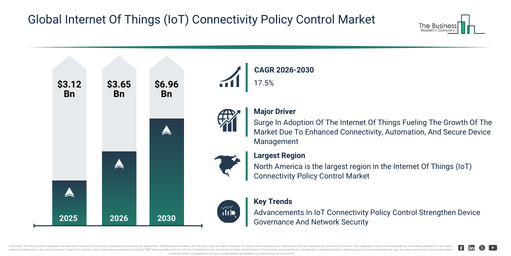
The internet of things (iot) connectivity policy control market has experienced significant expansion in recent years. It will grow from $3.12 billion in 2025 to $3.65 billion in 2026 at a compound annual growth rate (CAGR) of 17.3%. The historical growth can be attributed to several factors, including the increasing deployment of IoT devices, a rising need for secure network connectivity, the adoption of cloud and edge computing solutions, demand for centralized device management, and the proliferation of industrial IoT initiatives.
The internet of things (iot) connectivity policy control market is projected to experience swift expansion over the coming years. Its valuation is anticipated to reach $6.96 billion in 2030, exhibiting a compound annual growth rate (CAGR) of 17.5%. This projected growth during the forecast timeframe is attributable to factors such as the proliferation of smart city projects, an increase in industrial internet of things (iiot), greater telecom operator investments in iot networks, the uptake of ai-driven connectivity control, and a heightened need for integrated software-hardware iot solutions. Key trends identified for the forecast period encompass centralized iot policy enforcement, device authentication and security management, network usage monitoring and analytics, billing and subscription management, and connectivity optimization and resource allocation.
Get A Free Sample Report With In-Depth Market Insights:
Internet Of Things (IoT) Connectivity Policy Control Market Industry Drivers: What’s Behind The Revenue Growth?
The increasing data traffic is anticipated to fuel the expansion of the Internet of Things (IoT) connectivity policy control market moving forward. Data traffic refers to the volume of digital information transmitted across networks, including uploads, downloads, and streaming activities. The surge in data traffic is largely attributed to the widespread availability of connected devices and bandwidth-intensive applications, as millions of IoT devices, smartphones, and smart home systems constantly generate and exchange vast quantities of data across networks. This escalating volume of data traffic enhances the need for IoT connectivity policy control solutions, as these are crucial for managing network resources, guaranteeing quality of service, and maintaining efficient data flow within increasingly crowded networks. For instance, in June 2024, a report by Ericsson, a Sweden-based telecommunications company, revealed that mobile network data traffic experienced an approximate 6 percent quarter-on-quarter growth from the fourth quarter of 2023 to the first quarter of 2024. The total global mobile network data traffic for that month reached 145 exabytes (EB). Therefore, the rising data traffic is a primary driver for the growth of the Internet of Things (IoT) connectivity policy control market.
Internet Of Things (IoT) Connectivity Policy Control Market Segment Breakdown: Which Categories Lead On Revenue?
The internet of things (iot) connectivity policy control market covered in this report is segmented –
1) By Component: Software, Hardware, Services
2) By Connectivity Type: Cellular, Wi-Fi, Low-Power Wide-Area Network (LPWAN), Satellite
3) By Deployment Mode: On-Premises, Cloud
4) By Application: Smart Cities, Industrial Internet Of Things (IoT), Healthcare, Automotive, Energy And Utilities
5) By End-User: Enterprises, Telecom Operators, Government
Subsegments:
1) By Software: Policy Management Software, Connectivity Control Software, Network Access Control Software, Data Usage Monitoring Software
2) By Hardware: Network Gateways, Edge Computing Devices, Connectivity Routers, Security Appliances
3) By Services: Consulting Services, Implementation Services, Managed Services, Support And Maintenance Services
#Internet Of Things (IoT) Connectivity Policy Control Market Growth Trends: What’s Shaping The Future Outlook?
Major companies operating in the internet of things (IoT) connectivity policy control market are concentrating on developing sophisticated solutions, such as automated policy enforcement, to improve network management, bolster device compliance, and streamline the governance of connectivity across IoT ecosystems. Automated policy enforcement represents a technological feature that facilitates real-time monitoring and regulation of connected devices based on predefined criteria, which helps in prioritizing essential communications and mitigating security risks. For instance, in October 2025, SealSQ Corp, a Switzerland-based IoT security company, introduced Quantum Shield QS7001 at the QAI 2025 Conference in New York. This solution integrates advanced analytics and AI-driven policy management to offer seamless device connectivity oversight, guaranteeing secure onboarding, continuous surveillance, and automated compliance reporting across various IoT networks. These features enable organizations to optimize network efficiency, lessen operational risks, and bolster overall IoT security governance.
Internet Of Things (IoT) Connectivity Policy Control Market Top Companies Driving Competitive Growth
Major companies operating in the internet of things (iot) connectivity policy control market are American Telephone and Telegraph Incorporated, Huawei Technologies Company, Limited, Cisco Systems Incorporated, Oracle Corporation, Vodafone Group Public Limited Company, Hewlett Packard Enterprise Company, Telefonaktiebolaget LM Ericsson, Nokia Corporation, Zhongxing Telecommunication Equipment Corporation, Telenor Connexion Aktiebolag, Amdocs Limited, Mavenir Systems Incorporated, Semtech Corporation, Comarch Spólka Akcyjna, Telit Cinterion, KORE Wireless Group Incorporated, 1NCE Gesellschaft mit beschränkter Haftung, Aeris Communications Incorporated, Enea Aktiebolag, and Alepo Technologies Incorporated
View The Full Internet Of Things (IoT) Connectivity Policy Control Market Report:
Internet Of Things (IoT) Connectivity Policy Control Market Global Footprint: Which Region Leads The Market?
North America was the largest region in the internet of things (IoT) connectivity policy control in 2025. Asia-Pacific is expected to be the fastest-growing region in the forecast period. The regions covered in the internet of things (iot) connectivity policy control market report are Asia-Pacific, South East Asia, Western Europe, Eastern Europe, North America, South America, Middle East, Africa.
Reach Out To Our Team:
The Business Research Company: https://www.thebusinessresearchcompany.com/
Americas: +1 310-496-7795
Asia: +44 7882 955267 & +91 8897263534
Europe: +44 7882 955267
Email us at: marketing@tbrc.info
Follow us on:
LinkedIn: https://in.linkedin.com/company/the-business-research-company
YouTube: https://www.youtube.com/channel/UC24_fI0rV8cR5DxlCpgmyFQ
Global Market Model: https://www.thebusinessresearchcompany.com/global-market-model

Wasay has over a decade of experience in market research, data modelling, and analytics, with prior experience at GlobalData and Decision Tree Consulting Services. At The Business Research Company , he leads research operations across syndicated studies, customized consulting engagements, and the Global Market Model platform. His professional experience includes supporting organizations such as Boston Consulting Group, KPMG, and Ernst & Young. Wasay holds a degree in Electronics and Communications Engineering, postgraduate management qualifications from International Management Institute Belgium and Indian School of Business and Entrepreneurship, and completed the Integrated Program in Business Analytics from Indian Institute of Management Indore.