Backed by market attractiveness analysis, total addressable market sizing, company benchmarking matrices, interactive Excel dashboards, wider supply chain intelligence, emerging startup coverage, and detailed product-level insights, The Business Research Company’s 2026 market reports are designed to offer research that is more actionable and strategically valuable than ever.
Legacy Integration Market CAGR Outlook And Future Development
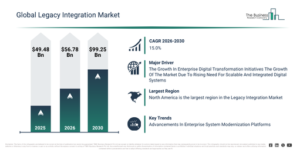
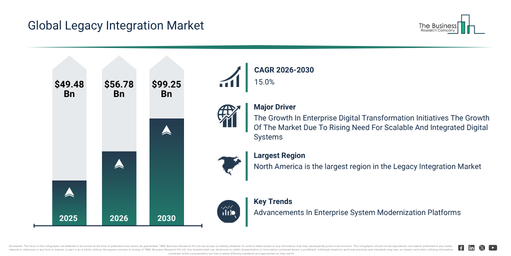
The legacy integration market’s size has expanded significantly in recent years. It is projected to increase from $49.48 billion in 2025 to $56.78 billion in 2026, at a compound annual growth rate (CAGR) of 14.7%. This historical expansion can be attributed to several factors, such as a substantial reliance on monolithic legacy systems, the necessity for business continuity within enterprises, the increasing adoption of enterprise resource planning, the emergence of data silos across departments, and a rise in enterprise digitization initiatives.
The legacy integration market is anticipated to experience substantial expansion over the upcoming years, projected to reach $99.25 billion by 2030, exhibiting a compound annual growth rate (CAGR) of 15.0%. This projected increase during the forecast period is fueled by several factors, including the acceleration of cloud migration strategies, a growing need for real-time data integration, the proliferation of hybrid IT environments, the rising adoption of API-driven architectures, and an increasing demand for cost-effective system modernization. Key developments expected within this period encompass the uptake of hybrid integration platforms as a service (iPaaS), API-led approaches to legacy modernization, the migration of legacy enterprise systems to the cloud, the decomposition of systems using microservices, and the modernization or replacement of enterprise service bus (ESB) technologies.
Get A Free Sample Report With In-Depth Market Insights:
Legacy Integration Market Growth Backed By Core Demand Fundamentals
The increasing adoption of enterprise digital transformation initiatives is projected to boost the legacy integration market. These initiatives involve organizations strategically implementing digital technologies to modernize operations, enhance efficiency, and elevate customer and employee experiences. The rise in these initiatives stems from a growing organizational demand to improve operational efficiency by streamlining workflows, automating processes, and enabling quicker, more precise decision-making via integrated digital systems. Legacy Integration supports these digital transformation efforts by enabling smooth connections between older systems and newer cloud-native applications. This allows organizations to modernize gradually without interrupting current operations, while also boosting agility, scalability, and data interoperability. An illustrative example shows that in October 2025, the Digital Government Authority, a Saudi Arabia-based government digital regulator, reported Saudi Arabian government agencies reached an average digital transformation score of 85.53%, up from 80.96% in 2022, indicating significant progress in digital service integration among 226 participating agencies. Consequently, the expansion of enterprise digital transformation initiatives is fueling the growth of the legacy integration market.
Legacy Integration Market Segment Performance And Emerging Opportunities
The legacy integration market covered in this report is segmented –
1) By Component: Software, Services, Hardware
2) By Deployment Mode: On Premise, Cloud
3) By Organization Size: Small And Medium Enterprises, Large Enterprises
4) By Application: Data Integration, Application Integration, Process Integration, Legacy System Migration, Application Programming Interface Management And Wrapping
5) By Vertical: Banking, Financial Services And Insurance, Healthcare And Life Sciences, Government And Public Sector, Manufacturing, Retail And E Commerce, Telecommunications, Energy And Utilities, Transportation And Logistics
Subsegments:
1) By Software: Middleware Platforms, Integration Platform As A Service (iPaaS), Application Programming Interface Integration Tools, Data Integration Tools, Application Integration Software, Cloud Integration Software, Enterprise Service Bus
2) By Services: Consulting Services, System Integration Services, Implementation Services, Support And Maintenance Services, Managed Services, Training And Education Services, Migration And Modernization Services
3) By Hardware: Servers And Mainframes, Networking Equipment, Storage Devices, Interface Adapters And Gateways, Data Center Infrastructure Components
Legacy Integration Market Growth Trends Reshaping The Competitive Landscape
Leading companies in the legacy integration market are concentrating on developing advanced platforms, such as modernization platforms, to enable seamless connections between existing legacy systems and modern cloud environments. This focus also aims to accelerate application transformation, minimize operational risks, and enhance scalability and agility. Modernization platforms are software solutions that empower organizations to update and transform their legacy systems into modern, cloud-ready applications by facilitating integration, automation, and a phased migration approach without disrupting current operations. For example, in March 2026, OpenLegacy Inc., a US-based software solutions company, introduced OpenLegacy Hub. This modernization platform, built on and integrated with Amazon Web Services (AWS), is designed to assist enterprises in progressively modernizing mainframe and legacy applications without experiencing downtime or business disruption. The platform allows organizations to expose legacy systems as APIs and microservices, ensuring smooth interoperability between mainframe environments and cloud-native applications. Additionally, it utilizes AI-driven automation to expedite code analysis and transformation, thereby reducing modernization time, cost, and the need for specialized mainframe skills.
Legacy Integration Market Leading Companies And Competitive Benchmarking
Major companies operating in the legacy integration market are Accenture plc; International Business Machines Corporation; Tata Consultancy Services Limited; Infosys Limited; Wipro Limited; Cognizant Technology Solutions Corporation; HCL Technologies Limited; Capgemini SE; Deloitte Consulting LLP; NTT DATA Corporation; Tech Mahindra Limited; DXC Technology Company; EPAM Systems Inc.; LTIMindtree Limited; CGI Inc.; Fujitsu Limited; Sopra Steria Group; Atos SE; Globant S.A.; Thoughtworks Holding Inc.
View The Full Legacy Integration Market Report:
Legacy Integration Market Largest Region By Revenue And Market Share
North America was the largest region in the legacy integration market in 2025. Asia-Pacific is expected to be the fastest-growing region in the forecast period. The regions covered in the legacy integration market report are Asia-Pacific, South East Asia, Western Europe, Eastern Europe, North America, South America, Middle East, Africa.
Reach Out To Our Team:
The Business Research Company: https://www.thebusinessresearchcompany.com/
Americas: +1 310-496-7795
Asia: +44 7882 955267 & +91 8897263534
Europe: +44 7882 955267
Email us at: marketing@tbrc.info
Follow us on:
LinkedIn: https://in.linkedin.com/company/the-business-research-company
YouTube: https://www.youtube.com/channel/UC24_fI0rV8cR5DxlCpgmyFQ
Global Market Model: https://www.thebusinessresearchcompany.com/global-market-model

Wasay has over a decade of experience in market research, data modelling, and analytics, with prior experience at GlobalData and Decision Tree Consulting Services. At The Business Research Company , he leads research operations across syndicated studies, customized consulting engagements, and the Global Market Model platform. His professional experience includes supporting organizations such as Boston Consulting Group, KPMG, and Ernst & Young. Wasay holds a degree in Electronics and Communications Engineering, postgraduate management qualifications from International Management Institute Belgium and Indian School of Business and Entrepreneurship, and completed the Integrated Program in Business Analytics from Indian Institute of Management Indore.