
Delivering more actionable and strategically valuable research, The Business Research Company’s 2026 market reports feature market attractiveness analysis, total addressable market evaluation, company benchmarking matrices, interactive Excel dashboards, expanded supply chain intelligence, emerging startup coverage, and detailed product insights.
Linux Software Market Value Analysis: What Growth Is Expected Over The Forecast Period?
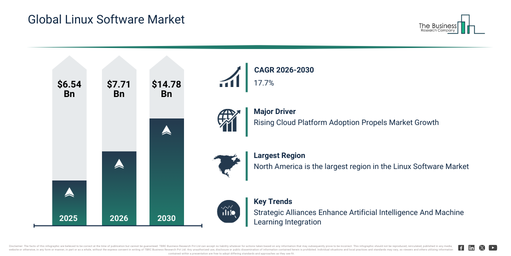
The linux software market has experienced rapid expansion in recent years. Projections indicate it will expand from $6.54 billion in 2025 to reach $7.71 billion in 2026, demonstrating a compound annual growth rate (CAGR) of 18.0%. Historically, this growth is linked to factors such as the rise of the open-source movement, an increase in linux-compatible hardware, a greater need for cost-effective software solutions, the early adoption of enterprise linux distributions, and the development of stronger developer communities.
The linux software market size is poised for substantial growth in the upcoming years. It is projected to expand to $14.78 billion by 2030, demonstrating a compound annual growth rate (CAGR) of 17.7%. This expansion during the forecast period is driven by the increasing presence of cloud computing, a growing requirement for robust cybersecurity and secure platforms, advancements in virtualization and container technologies, the integration of AI and machine learning onto Linux, and a rise in enterprise uptake of open-source software. Significant trends anticipated for this period involve open-source collaboration platforms, enhanced cross-platform compatibility, improvements in security and privacy, the development of cloud-native Linux applications, and the continued evolution of virtualization and containerization.
Download A Free Sample Report For Comprehensive Market Insights:
Linux Software Market Industry Drivers: What Is Driving Revenue Growth?
The growing integration of cloud platforms is anticipated to fuel the expansion of the linux software market in the future. Cloud platforms are defined as cloud computing environments providing instant access to resources for computing, storage, and applications via the internet. The rising popularity of cloud platforms stems from benefits like reduced costs, greater scalability, adaptability, stronger security, and better collaboration features. Due to its stability, scalability, and open-source characteristics, Linux software is extensively utilized within cloud platforms, facilitating effective management and deployment of cloud services and applications. For example, data from Flexera, a US-based computer software company, indicated in March 2024 that multi-cloud usage in 2023 experienced a modest increase, rising from 87% to 89%. Consequently, the expanding use of cloud platforms is a key driver for the linux software market.
Linux Software Market Segment Breakdown: Which Categories Generate The Most Revenue?
The linux software market covered in this report is segmented –
1) By Type: Web Browsers, Office Suites, Media Players, Graphics And Designs, Other Types
2) By Organization Size: Small and Medium-Sized Enterprises (SMEs), Large Enterprises
3) By Distribution: Standalone, Network, Cloud, Other Distributions
4) By Application: Household, Enterprise, Government, Other Applications
Subsegments:
1) By Web Browsers: Firefox, Chromium, Opera, Midori, Vivaldi
2) By Office Suites: LibreOffice, OpenOffice, WPS Office, OnlyOffice, Calligra Suite
3) By Media Players: VLC Media Player, MPV, Rhythmbox, Clementine, Audacious
4) By Graphics And Designs: GIMP, Inkscape, Blender, Krita, Darktable
5) By Other Types: Text Editors, File Managers, Virtualization Software, Development Tools, Security Tools
Linux Software Market Industry Trends Shaping Future Revenue Growth
Leading companies in the Linux software market are engaging in strategic partnerships to deliver vital automated machine learning and AI fairness technologies, aiming to bolster data processing and application efficiency. Strategic partnerships describe a method where organizations utilize each other’s capabilities and resources to achieve mutual advantages and success. For example, in September 2023, Fujitsu Ltd., a Japan-based information and communications technology company, collaborated with the Linux Foundation, a US-based non-profit organization. This alliance seeks to advance artificial intelligence (AI) democratization by providing global developers secure access to advanced technologies on open platforms. The collaboration intends to develop innovative applications and solutions for business and societal challenges, with Fujitsu’s automated machine learning and AI fairness technologies slated for release as open-source software.
Linux Software Market Key Players And Strategic Industry Positioning
Major companies operating in the linux software market are Amazon Inc., Alphabet Inc., Samsung Electronics Co Ltd, Microsoft Corporation, Meta Platforms Inc., Dell Technologies Inc, International Business Machines Corporation, Oracle Corporation, Fujitsu Ltd., SUSE S.A., Mozilla Foundation, Debian, Arch Linux, Linux Mint, LibreOffice, Shotcut, Elementary OS, Ubuntu, VideoLAN
Access The Complete Linux Software Market Report:
Linux Software Market Regional Distribution: Which Areas Drive Market Expansion?
North America was the largest region in the linux software market in 2025. The regions covered in the linux software market report are Asia-Pacific, South East Asia, Western Europe, Eastern Europe, North America, South America, Middle East, Africa.
Get in touch with us:
The Business Research Company: https://www.thebusinessresearchcompany.com/
Americas: +1 310-496-7795
Asia: +44 7882 955267 & +91 8897263534
Europe: +44 7882 955267
Email us at: marketing@tbrc.info
Follow us on:
LinkedIn: https://in.linkedin.com/company/the-business-research-company
YouTube: https://www.youtube.com/channel/UC24_fI0rV8cR5DxlCpgmyFQ
Global Market Model: https://www.thebusinessresearchcompany.com/global-market-model

Wasay has over a decade of experience in market research, data modelling, and analytics, with prior experience at GlobalData and Decision Tree Consulting Services. At The Business Research Company , he leads research operations across syndicated studies, customized consulting engagements, and the Global Market Model platform. His professional experience includes supporting organizations such as Boston Consulting Group, KPMG, and Ernst & Young. Wasay holds a degree in Electronics and Communications Engineering, postgraduate management qualifications from International Management Institute Belgium and Indian School of Business and Entrepreneurship, and completed the Integrated Program in Business Analytics from Indian Institute of Management Indore.