
Through market attractiveness analysis, total addressable market evaluation, company benchmarking matrices, interactive Excel dashboards, expanded supply chain intelligence, emerging startup coverage, and detailed product insights, The Business Research Company’s 2026 market reports provide more actionable and strategically valuable research.
Load Balancer As A Service Market Value Analysis: What Growth Is Expected Over The Forecast Period?
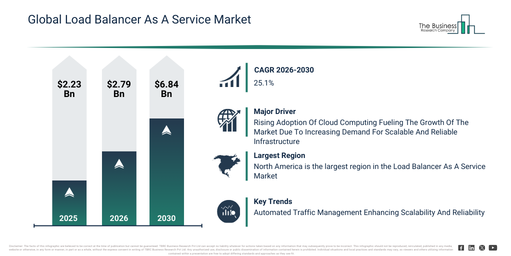
The load balancer as a service market has experienced significant expansion in recent years. Its valuation is predicted to climb from $2.23 billion in 2025 to $2.79 billion in 2026, demonstrating a compound annual growth rate (CAGR) of 25.4%. Historically, this growth can be linked to the proliferation of cloud-native applications, increasing web traffic and user experience expectations, the adoption of microservices and containers, a rise in DDoS attacks and security needs, and the expansion of multi-region deployments.
The load balancer as a service market is projected to experience substantial expansion in the coming years, reaching $6.84 billion by 2030, demonstrating a compound annual growth rate (CAGR) of 25.1%. This anticipated growth during the forecast period is driven by factors such as AI-assisted traffic routing optimization, enhanced integration with zero trust security, the increasing need for low-latency edge delivery, wider adoption of service mesh and ingress controllers, and a move towards consumption-based networking services. Key developments expected in this period encompass cloud-native application delivery controllers, global traffic management and anycast routing, integrated waf and ddos protection, api gateway and edge load balancing, and observability-driven traffic steering.
Download A Free Sample Report For Comprehensive Market Insights:
Load Balancer As A Service Market Opportunity Drivers: What Is Creating New Revenue Potential?
The expanding use of cloud computing is anticipated to fuel the expansion of the load balancer as a service market in the future. Cloud computing involves delivering computing assets like servers, storage, databases, networking, software, and analytics via the internet, facilitating quicker innovation, adaptable resources, and cost efficiencies through economies of scale. Businesses primarily embrace cloud computing due to its inherent scalability, enabling them to readily adjust computing resources according to demand while simultaneously lowering infrastructure expenses. Load balancer as a service significantly improves cloud computing environments by offering automated traffic distribution and scalability, making it perfectly suited for applications experiencing fluctuating workloads. This service further minimizes downtime and performance issues through effective management of network traffic, thereby boosting overall reliability and enhancing the user experience. As an illustration, data from Eurostat, a Luxembourg-based government organization, revealed that in December 2023, 45.2% of enterprises throughout the European Union acquired cloud computing services. This included adoption by 77.6% of large enterprises, 59% of medium-sized enterprises, and 41.7% of small businesses. Consequently, the growing uptake of cloud computing is undeniably propelling the expansion of the load balancer as a service market.
Load Balancer As A Service Market Segment Outlook: Which Categories Are Expanding The Fastest?
The load balancer as a service market covered in this report is segmented –
1) By Component: Software, Hardware, Services
2) By Deployment Mode: Public Cloud, Private Cloud, Hybrid Cloud
3) By Enterprise Size: Small And Medium Enterprises, Large Enterprises
4) By End-User: Banking, Financial Services, And Insurance (BFSI), Information Technology (IT) And Telecommunications, Healthcare, Retail, Government, Media And Entertainment, Other End-Users
Subsegments:
1) By Software: Virtual Load Balancers, Cloud-Native Or Load-Balancer-As-Software, Application Delivery Controller (ADC) Software, Open-Source Or Load Balancer Projects, API Gateway And Edge-Proxy Software, SSL Or TLS Offload And Crypto Acceleration Modules, DNS-Based Load Balancing Software.
2) By Hardware: Dedicated Hardware Load Balancer Appliances (ADC Appliances), SSL Or TLS Hardware Off loaders, Application Acceleration Appliances, DDoS Mitigation Appliances, High-Throughput Ethernet Or ASIC-Accelerated Load Balancers, Edge Or Edge-Gateway Hardware Devices.
3) By Services: Managed LBaaS (Fully Managed Load Balancer Operations), Professional Services, Integration And Implementation Services, Support And Maintenance Services (SLA, Patching), Monitoring And Performance Tuning Services, Migration And Deployment Services, Security Services
Load Balancer As A Service Market Industry Trends: What Changes Are Reshaping Demand?
Leading companies in the load balancer as a service market are concentrating on developing advanced cloud-native solutions, including automated traffic management systems, to enhance application performance, strengthen security, and reduce manual configuration and operational costs. Automated traffic management systems are defined as intelligent platforms that dynamically distribute incoming network traffic across numerous servers, thereby ensuring optimal resource utilization and preventing any single server from becoming a point of failure. For example, in February 2025, Alkira Inc., a US-based software company, launched the Load Balancer-as-a-Service (LBaaS) to simplify and modernize traffic management in both cloud and on-premises environments. This solution is a fully integrated, cloud-native offering that provides centralized management and precise control of load balancing across multi-cloud and hybrid settings. It incorporates automated health checks and real-time traffic distribution, facilitating seamless application scalability and high availability without requiring operator intervention.
Load Balancer As A Service Market Key Companies And Competitive Benchmarking
Major companies operating in the load balancer as a service market are Amazon.com Inc., Google LLC, Microsoft Corporation, Alibaba Cloud Computing Ltd., Huawei Technologies Co. Ltd., Tencent Cloud Computing (Beijing) Co. Ltd., International Business Machines Corporation (IBM), Oracle Corporation, Fortinet Inc., AkamAI Technologies Inc., Citrix Systems Inc., F5 Inc., Cloudflare Inc., DigitalOcean Holdings Inc., OVH Groupe SA, Radware Ltd., A10 Networks Inc., Array Networks Inc., Progress Software Corporation, HAProxy Technologies LLC, Loadbalancer.org Ltd.
Access The Complete Load Balancer As A Service Market Report:
Load Balancer As A Service Market Largest Region By Revenue And Market Share
North America was the largest region in the load balancer as a service market in 2025. Asia-Pacific is expected to be the fastest-growing region in the forecast period. The regions covered in the load balancer as a service market report are Asia-Pacific, South East Asia, Western Europe, Eastern Europe, North America, South America, Middle East, Africa.
Get in touch with us:
The Business Research Company: https://www.thebusinessresearchcompany.com/
Americas: +1 310-496-7795
Asia: +44 7882 955267 & +91 8897263534
Europe: +44 7882 955267
Email us at: marketing@tbrc.info
Follow us on:
LinkedIn: https://in.linkedin.com/company/the-business-research-company
YouTube: https://www.youtube.com/channel/UC24_fI0rV8cR5DxlCpgmyFQ
Global Market Model: https://www.thebusinessresearchcompany.com/global-market-model

Wasay has over a decade of experience in market research, data modelling, and analytics, with prior experience at GlobalData and Decision Tree Consulting Services. At The Business Research Company , he leads research operations across syndicated studies, customized consulting engagements, and the Global Market Model platform. His professional experience includes supporting organizations such as Boston Consulting Group, KPMG, and Ernst & Young. Wasay holds a degree in Electronics and Communications Engineering, postgraduate management qualifications from International Management Institute Belgium and Indian School of Business and Entrepreneurship, and completed the Integrated Program in Business Analytics from Indian Institute of Management Indore.